Plot Explained Spoilers guaranteed!
Plot Explained

Browse by genre

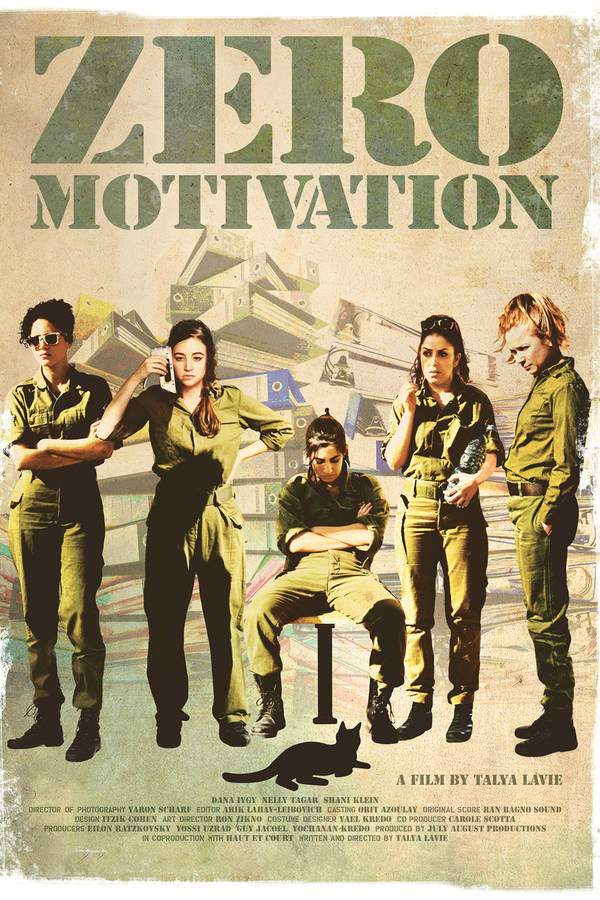
Zero Motivation (2014) movie poster

Plot Summary

Zero Motivation (2014) Plot Summary Explained

Release, runtime and language
2014 · 97 min · Hebrew
JustWatch #33,104 2
Directed by
Talya Lavie
Starring
Meytal Gal, Dana Ivgy, Heli Twito, Neli Tagar, Shani Klein, Tamara Klingon

Set in a remote Israeli military base, the film follows Zohar and Daffi, two HR clerks who prefer video games and dreams of Tel Aviv to their mundane jobs. Their supervisor, Rama, desperately tries to inspire her team of female soldiers, who are equally disengaged. Through absurd situations and sharp satire, the movie explores youthful apathy and the frustrations of navigating a rigid bureaucratic system.

On this page (6)
  1. 1 Where to watch
  2. 2 What happens: full plot
  3. 3 Plot questions answered
  4. 4 Movie threads
  5. 5 Movies like Zero Motivation
  6. 6 Every angle

Where to watch

Where to Watch Zero Motivation (2014)

Where can you watch Zero Motivation? Stream, rent or buy it in the US, including on Chai Flicks, Kanopy and Amazon Video: current JustWatch availability with up-to-date prices.

Streaming availability powered by JustWatch

Full plot summary · contains spoilers

What Happens in Zero Motivation: Full Plot Summary

The whole story of Zero Motivation (2014) explained, from the opening scene to the final frame: every key event, every twist and what it all adds up to. Read it as a quick recap before the sequel, to check a scene you missed, or to finally understand what really happened.

Zohar (Dana Ivgy) and Daffi (Neli Tagar) are making their way back to Shizafón, the isolated IDF base where they serve in Personnel. Their unit is filled with a mix of incompetents, including Irena (Tamara Klingon), and two overly enthusiastic ditzes, Livnat (Heli Twito) and Liat (Meytal Gal), who relentlessly fill the air with their off-key duets. At the helm is the stern and domineering Rama (Shani Klein), reminiscent of Nurse Ratched, completely invested in her version of military discipline.

Daffi finds herself in a position she despises as the Chief Paper Shredder and has repeatedly crafted pleas to transfer to the more vibrant Kiryáh in Tel Aviv, dreaming of glamourous lunches at Azrieli Towers. However, unbeknownst to Daffi, Zohar has stashed those appeals away, fearing the loneliness that Daffi's departure would bring her. Just as Daffi's frustrations reach a boiling point, a new recruit, Tehila (Yonit Tobi), appears, prompting Daffi to believe her transfer wishes have been granted. Without hesitation, she begins to train Tehila, thinking of her as the perfect replacement.

That evening, a dramatic scene unfolds as Eitan ([Moshe Ashkenazi]) and his girlfriend, Anat ([Dana Meinrath]), are interrupted by Tehila, who, against the rules, has donned a borrowed uniform to see Eitan. Tehila, still infatuated with him, reveals her feelings passionately, but her hopes are shattered when Anat emerges from hiding, leading to Tehila fleeing in despair. In a tragic turn, the following morning, the girls awaken to a blood-soaked scene, discovering Tehila's lifeless body, which quickly draws the ire of Rama toward the Personnel team.

As the story progresses, Zohar's bed collapses, making her reluctant to occupy the empty bed that once belonged to Tehila. Irena decides to take that spot, but soon finds herself haunted by Tehila's ghost, resulting in her becoming catatonic. Struggling with the consequences, Daffi resolves to attain her transfer through officer training, but instead of her much-desired position at the Kiryáh, she is informed that she will replace Rama at Shizafón, leading to a cascade of tears.

Meanwhile, mockery ensues as the other girls taunt Zohar about her virginity, compelling her to take action. She seduces a reservist, planning to meet him at night. However, the encounter takes a dark turn as Zohar faces an attempted assault. In a shocking twist, Irena intervenes, threatening Zohar's assailant with his own weapon. This confrontation sends shockwaves through the base as Zohar and Irena find themselves at the mercy of Rama's strict orders.

In the climactic final act, Daffi steps into the role of commander, but her authority is under constant ridicule from the very soldiers she now leads. In retaliation, Zohar publicly displays Daffi's unfiled transfer requests, turning them into fodder for laughs. This escalating prank leads to chaos as Daffi inadvertently deletes crucial files while trying to unearth Zohar's games. Ultimately, the two reconcile in detention, bonding over shared experiences and ridiculous antics, with Zohar enjoying a budding romance with the IT guy. The tale concludes with Zohar leaving the base for Tel Aviv, a new chapter in her life set against the backdrop of the iconic Azrieli Towers on the horizon.
Last updated: November 04, 2024 at 00:30

Was this helpful?

Plot questions answered

Zero Motivation Plot Explained: Your Questions Answered

The questions people ask most about Zero Motivation (2014): what happens in the confusing scenes, why the characters do what they do, the twists, hidden details and what the ending means. Each answer contains spoilers.

Q1

Why did Zohar hide Daffi's transfer requests?

Zohar secretly discarded Daffi's transfer appeals because she feared being left alone at the isolated base. Despite their constant bickering, Zohar valued Daffi's companionship more than her own happiness, choosing to prioritize their friendship over Daffi's dreams of Tel Aviv.

Foreshadowing: Earlier scenes show the two friends playing video games together and complaining about their jobs, hinting at their codependent relationship.

  • zohar
  • daffi
  • transfer
  • shizafón
  • friendship
Q2

What happened to the new recruit Tehila?

Tehila was found dead in her room, discovered by the other soldiers in a blood-soaked scene. After being rejected by Eitan when his girlfriend Anat revealed herself, Tehila fled in despair and subsequently took her own life.

Foreshadowing: Tehila's reckless act of wearing a borrowed uniform to see Eitan against rules hinted at her emotional instability and desperate state of mind.

  • tehila
  • death
  • suicide
  • eitan
  • anat
Q3

Why did Irena become catatonic after taking Tehila's bed?

Irena took over Tehila's empty bed after her death and began experiencing supernatural encounters with Tehila's ghost. The psychological trauma of sharing a room with the dead soldier's lingering presence overwhelmed her, leaving her in a catatonic state.

Foreshadowing: The film establishes early on that Irena is more sensitive and superstitious than the other soldiers.

  • irena
  • tehila
  • ghost
  • bed
  • catatonic
Q4

What happened during Zohar's encounter with the reservist?

Zohar seduced a reservist soldier planning to meet him privately, but the encounter turned violent when he attempted to assault her. Irena unexpectedly intervened, threatening the attacker with his own weapon and saving Zohar from harm.

Foreshadowing: The constant mocking about Zohar's virginity created the pressure that drove her to seek this risky encounter.

  • zohar
  • reservist
  • assault
  • irena
  • attack
Q5

Why did Daffi end up replacing Rama as commander?

Daffi enrolled in officer training hoping to earn her transfer to Kiryáh in Tel Aviv, but instead was assigned to replace Rama at Shizafón. This bittersweet outcome trapped her at the very base she desperately wanted to escape, though it gave her the authority she sought.

Foreshadowing: Daffi's repeated failed attempts to transfer and her ambitious personality set up her eventual promotion.

  • daffi
  • rama
  • commander
  • officer training
  • shizafón
Q6

Why did Zohar leave for Tel Aviv at the end?

Zohar finally left the Shizafón base for Tel Aviv, representing her personal escape from military life and isolation. The film ends with her looking toward the Azrieli Towers, symbolizing hope and a fresh start away from the traumatic events that unfolded at the base.

Foreshadowing: Throughout the film, Zohar and Daffi both dreamed of Tel Aviv as their escape from the mundane military routine.

  • zohar
  • tel aviv
  • azrieli towers
  • leaving
  • escape
Q7

How did Zohar and Daffi reconcile after their conflict?

After Zohar publicly humiliated Daffi by displaying her unfiled transfer requests, leading to chaos and deleted files, both ended up in detention together. In this low point, they bonded over their shared suffering and ridiculous circumstances, reconciling their friendship.

Foreshadowing: Their friendship had been tested before, but the detention forced them to face reality together.

  • zohar
  • daffi
  • reconciliation
  • detention
  • prank
Q8

Why was Rama so strict with the soldiers?

Rama ruled the Personnel unit with an iron fist, modeled after Nurse Ratched, enforcing military discipline at all times. Her strictness stemmed from a genuine belief in military order, though her methods alienated the disengaged soldiers she commanded.

Foreshadowing: Rama's character is introduced immediately as the domineering supervisor obsessed with discipline.

  • rama
  • discipline
  • commander
  • strict
  • military
Q9

Why did the other soldiers mock Zohar about her virginity?

The soldiers teased Zohar relentlessly about being a virgin, creating social pressure that eventually drove her to seduce the reservist. This mockery represented the petty, caustic social dynamics among the bored soldiers at the isolated base.

Foreshadowing: The mocking scenes appear early and escalate, building toward Zohar's fateful decision.

  • zohar
  • virginity
  • mockery
  • teasing
  • soldiers
Q10

What was the significance of Daffi's Azrieli Towers dreams?

Daffi fantasized about glamorous lunches at the Azrieli Towers in Tel Aviv as the ultimate symbol of escape from military mundanity. This landmark represented everything she wanted: civilian life, glamour, and freedom from the boring Personnel job at Shizafón.

Foreshadowing: Daffi's desire for transfer to Kiryáh in Tel Aviv is established in the opening scenes.

  • daffi
  • azrieli towers
  • tel aviv
  • dreams
  • transfer

Movie threads

More Movies Like Zero Motivation, by Mood & Story

Curated lists built around what makes Zero Motivation tick: the same mood, the same kind of story or the same emotional payoff. Each list explains why these movies belong together.

Absurdist Bureaucratic Satire like Zero Motivation

Darkly comedic stories exposing the hilarious and frustrating nature of institutional systems. If you enjoyed the darkly funny critique of military bureaucracy in Zero Motivation, you'll appreciate these films. This section features movies like Zero Motivation that use satire and absurdity to explore the frustrations of institutional life, from dead-end office jobs to rigid government systems.

  • satirical
  • absurd
  • darkly funny
  • frustrated
  • apathetic
  • institutional
  • Tone: darkly funny, satirical, bittersweet
  • Pacing: steady, incident-driven
Why these movies?

The story pattern: These narratives often unfold within a closed, rule-bound system, following characters who are trapped by their roles. The plot is driven by a series of absurd incidents and administrative hurdles that escalate, revealing the inherent ridiculousness and occasional cruelty of the institution. Character journeys typically involve a struggle between conformity and rebellion, often ending in a compromise that is as funny as it is tragic.

Why they belong together: Movies are grouped here for their shared tone of dark, satirical comedy focused on the banal evils of bureaucracy. They share a specific mix of apathetic humor and genuine frustration, creating a unique vibe where laughter is tinged with recognition of systemic absurdity.

Coming-of-Age in Constraining Worlds like Zero Motivation

Stories of young adults navigating self-discovery within rigid, isolating systems. For viewers who liked the theme of youthful alienation within the Israeli army in Zero Motivation. Discover more movies like Zero Motivation about young people finding their way in restrictive settings, where the journey to adulthood is complicated by the rules and boredom of their environment.

  • youthful alienation
  • melancholic
  • bittersweet
  • frustrated
  • coming of age
  • apathetic
  • Tone: bittersweet, melancholic, apathetic
  • Pacing: steady, character-driven
Why these movies?

The story pattern: The narrative follows a young protagonist or ensemble as they grapple with their identity and future while being shaped by a confining system. The plot is character-driven, focusing on personal rebellions, small victories, and the painful compromises of growing up. Endings are often bittersweet, balancing a character's escape or personal growth with the realization that some constraints are inescapable.

Why they belong together: This thread connects films through their shared focus on the 'constrained coming-of-age' narrative pattern. The similarity lies in the specific emotional mix of youthful hope, apathy, and frustration, all set against a backdrop that actively suppresses individual expression.

If you liked this

Movies Like Zero Motivation

Similar movies to Zero Motivation: the same genre, themes or kind of story. Each one comes with its own plot summary, timeline and ending explained.

Browse all movie summaries

Every angle

Zero Motivation (2014) Explained: Plot, Timeline & Characters

Everything about Zero Motivation in one place: what happens in the plot summary, the timeline in chronological order, the characters and meaning and a spoiler-free summary. What's After the Movie adds the cast, box office and post-credit scenes.

Coming soon on iOS and Android

The Plot Explained Movie Summary App

Plot summaries, endings explained and timelines on your phone. Catch up on any movie in minutes, save your favorites and never miss a twist again.

Be the first to know when we launch. Your email stays private, always.

Learn more about the app