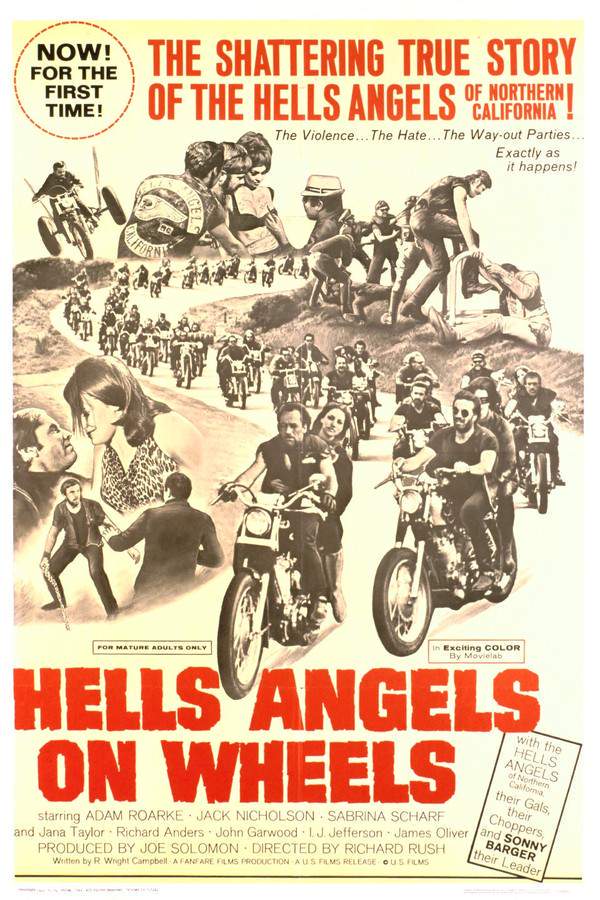
Heavenly Blues is a gritty portrayal of motorcycle gang life set in San Pedro, California, focusing on the leader of the Angels gang, Bruce Dern, known as Heavenly Blues. The story revolves around his close friend, Loser, or "the Loser," played by an unnamed actor, who faces a series of tumultuous events after his motorcycle is stolen.
The narrative begins with Loser and his gang, indulging in a reckless lifestyle filled with sex, drugs, rock and roll, loud Harley chopper engines, bongos, and frequent fights. When Loser’s motorcycle goes missing, the Angels set off on a journey to the desert town of Mecca, California, to find it. Their search leads them to a garage occupied by a Mexican gang where a fragment of Loser’s motorcycle—a brake pedal—is discovered. A violent confrontation ensues, resulting in a brawl the Angels seem to win, but chaos quickly spills over when the police arrive. During their escape, Loser gets separated from the group and, in a daring move, steals a police motorcycle. Unfortunately, this reckless act results in him being shot in the back by an officer, landing him in the hospital.
The gang’s leader, Heavenly Blues, orchestrates a daring escape to retrieve Loser from the hospital, leading a small group of Angels. Their efforts to free Loser are thwarted when a nurse overhears their plan, and one of the gang members (an Angel) assaults her in the process. Seeing Blues, the nurse identifies him to the police, making further escape impossible.
Despite the risks, the Angels take Loser to a biker bar and a safe house run by Momma, a friend of the gang. However, without proper medical care, Loser succumbs to his wounds and dies. His friends then forge a death certificate and arrange a symbolic funeral in Sequoia Grove, Loser’s rural hometown. The funeral is marked by visual chaos, with the gang carrying Loser's coffin—draped with a Nazi flag—into a church where a preacher delivers a clichéd funeral sermon, which angers Blues. In defiance, they turn the church into a party zone, with alcohol, dancing, and destruction.
During this rowdy celebration, they further disrespect Loser by removing his coffin and sitting him upright as a guest of honor, placing a joint in his mouth, and tying up and beating the preacher, ultimately placing him inside the coffin. The gang’s brutality extends to Gaysh, Loser’s girlfriend, who is drugged and raped by several gang members; Blues’s relationship with Momma is also intimate, with Blues having sex with her. Tensions escalate when Blues discovers Mike, his girlfriend, being kissed by another gang member, prompting him to slap her in a heated moment.
The gang then moves in a funeral procession towards Sequoia Grove Cemetery, where hostility from the townspeople leads to a violent brawl. As police sirens approach, everyone scatters—Blues instructs Mike to leave with another gang member’s motorcycle. Left alone in the cemetery, Blues begins to shovel dirt into Loser’s grave, the act signifying his grief and the loss of a friend who embodied the rebellious spirit of their gang.
Throughout the film, the raw depiction of brotherhood, rebellion, and the tragic consequences of a life on the edge is emphasized with intense scenes of chaos and defiance, making Heavenly Blues a stark, visceral exploration of motorcycle gang culture and its brutal realities.