Plot Explained Spoilers guaranteed!
Plot Explained

Browse by genre

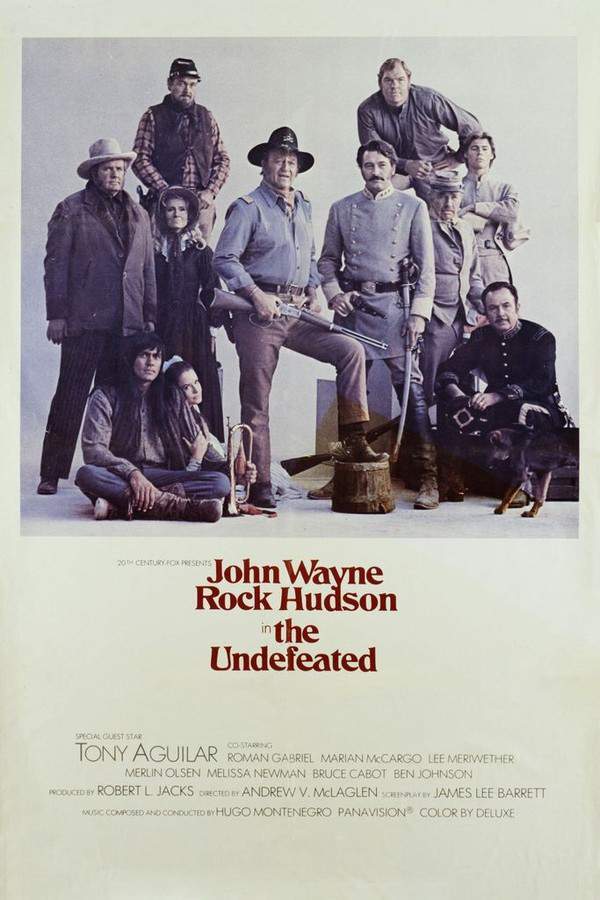
The Undefeated (1969) movie poster

Timeline

The Undefeated (1969) Timeline Explained – Every Event in Order

Release, runtime and language
1969 · 119 min · English
Loading streaming availability…
Directed by
Andrew V. McLaglen
Starring
John Wayne, Bruce Cabot, Rock Hudson, Lee Meriwether, Jan-Michael Vincent, Antonio Aguilar

Amidst the turmoil of post-Civil War Mexico, John Henry Thomas and James Langdon, once adversaries, find themselves united by circumstance. They lead small bands of settlers seeking refuge from outlaws and rebel factions in the harsh and unforgiving land. To ensure the survival of their people and reach the promise of a new frontier, these former enemies must overcome their past and work together, facing danger and hardship at every turn.

On this page (6)
  1. 1 Where to watch
  2. 2 Events in order (15)
  3. 3 Timeline questions answered
  4. 4 Movie threads
  5. 5 Movies like The Undefeated
  6. 6 Every angle
Loading streaming availability…

15 events in order · contains spoilers

The Undefeated Timeline: Events in Chronological Order

Every key event of The Undefeated (1969) in order, scene by scene, with when and where it takes place. Use it to untangle flashbacks, time jumps and parallel storylines, to refresh your memory before the sequel or to find the exact scene you are thinking of.

  1. Final Union assault near Natchez

    Near Natchez, Mississippi, Union Colonel John Henry Thomas and his company launch one final assault on a small Confederate unit. The engagement is brutal and decisive, leaving the Confederate force defeated. After the battle, they learn that the war ended three days earlier at Appomattox Courthouse.

    When
    April 1865
    Where
    Near Natchez, Mississippi
  2. News of Appomattox reaches the field

    Saddened and weary, Thomas is shaken by the report that General Lee surrendered at Appomattox, effectively ending the war. The men confront the futility of more fighting and begin to reassess their futures. The revelation sets a new goal: to secure a livelihood and a sense of purpose in the postwar West.

    When
    April 1865
    Where
    Natchez vicinity
  3. Thomas leads his men west to sell horses

    Deciding to put their loyalty to good use, Thomas leads his company west toward the Arizona and New Mexico Territories to round up and auction 3 wild horses. They leave behind the comforts of home as they press into the frontier. Their journey bonds the veterans further as they travel together.

    When
    Post-war 1865
    Where
    Starting from Natchez, Mississippi toward the Southwest
  4. Langdon torches plantation and plans to emigrate

    Colonel James Langdon, fearing loss of home to Northern carpetbaggers, burns his plantation rather than let it fall into enemies. He joins a contingent of Confederates pursuing a new life in Mexico, hoping to align with Emperor Maximilian. The moment marks a violent end to his old life and a tentative beginning of a new exile.

    When
    Spring 1865
    Where
    Langdon's plantation
  5. Thomas reunites with Blue Boy and tribal allies

    Along the way, Thomas is joined by his adopted Cherokee son, Blue Boy, and other tribal members from the Oklahoma and Indian Territories. The diverse group signals a fragile but hopeful collaboration across former lines. They prepare to ride with the herd on an uneasy shared mission.

    When
    Mid-1865
    Where
    Oklahoma/Indian Territories
  6. The herd is assembled: 3,000 horses

    They gather an immense herd of roughly 3,000 horses, pooling the veterans' resources and the tribe's help. The animals are intended for sale to Maximilian's envoys in Durango, though some doubts linger about the risks of crossing hostile lands. The operation tests the expedition's discipline, trust, and perseverance.

    When
    Mid-1865
    Where
    Frontier, Oklahoma/Arizona region
  7. Moving south across the Rio Grande toward Durango

    The caravan drives the horses south across the Rio Grande toward Durango, Mexico, leaving the U.S. border behind. They refuse a lower offer from corrupt U.S. Army buyers, insisting on fair terms. The journey becomes a trek of endurance and stubborn resolve.

    When
    Mid-1865
    Where
    Rio Grande border region toward Durango
  8. Blue Boy spots ambush plans; warning given

    Blue Boy detects tracks indicating Mexican Comanchero bandits plan an ambush on the caravan. He and Thomas race to warn the emigrants, delaying the attack and giving them a chance to prepare. The sense of imminent danger keeps everyone alert as they press on.

    When
    Mid-1865
    Where
    Trail toward Durango
  9. Bandit raid is repelled; a fragile alliance holds

    When the ambush erupts, the Americans—Northerners, Southerners, and Cherokee—fight side by side with unexpected unity. The defenders, aided by Langdon’s men, repel the bandits and safeguard the caravan. The victory cements a fragile camaraderie amid lingering war memories.

    When
    Mid-1865
    Where
    On the trail near Durango
  10. Fourth of July celebration and brawl

    Langdon invites the refugees to a Fourth of July celebration in a makeshift camp, a 'Southern style' festival to honor shared survival. Old hostilities flare, and a fight erupts that fractures the uneasy alliance. The men decide to part ways, each group pursuing different futures.

    When
    July 4, 1865
    Where
    Langdon's camp
  11. Charlotte and Blue Boy fall in love

    During the fragile lull after the melee, Langdon's daughter Charlotte and Blue Boy fall in love, a powerful symbol of reconciliation. Their romance bridges the war's lingering divides and adds a personal stake to the group's journey. It also hints at a quieter future that may be possible beyond conflict.

    When
    Mid-1865
    Where
    Langdon's camp
  12. Durango arrival; discovery of Juárez control

    Langdon's company reaches Durango only to find Emperor Maximilian's regime collapsed, replaced by Juárez's Republican forces under General Rojas. They are imprisoned as outsiders and potential threats in a reshaped political order. The men must negotiate their fate with a new government.

    When
    Late 1865
    Where
    Durango, Mexico
  13. Ransom negotiations and release

    Rojas demands the men’s horses as ransom in exchange for release. Thomas negotiates and agrees to pay the price to free his fellow Confederates, choosing loyalty to comrades over pride. The ransom binds the two sides in a precarious, uneasy peace.

    When
    Late 1865
    Where
    Durango
  14. French cavalry clash; victory and payment

    On the way back to town, French cavalry confront the group, leading to a sharp battle in which the Americans emerge victorious. They escort the horses into Durango and complete the ransom payment to free their comrades. The action confirms their resolve and their willingness to fight together when needed.

    When
    Late 1865
    Where
    Durango vicinity
  15. Return to the United States and final decisions

    With the horses secured and the Confederate fugitives freed, the united band rides north toward home. They debate what song to play while riding, initially considering Dixie and Battle Hymn of the Republic before settling on Yankee Doodle. The film closes with Charlotte and Blue Boy as a couple, sharing a moment of humor about Blue Boy's haircut.

    When
    Late 1865
    Where
    On the trail back to the USA

Last updated: November 22, 2025 at 15:58

Was this helpful?

Timeline questions answered

The Undefeated Timeline Explained: Your Questions Answered

When does it happen, and why in that order? The questions people ask about the chronology of The Undefeated (1969): time jumps, flashbacks, cause and effect between scenes and the correct order of events, each answered with spoilers.

Q1

Why did Colonel Thomas launch an attack after the Civil War had already ended?

Thomas and his Union troops attacked a Confederate unit near Natchez without knowing the war had ended three days earlier at Appomattox Courthouse. The news had not reached them in time, so they fought what turned out to be a pointless battle. This realization deeply affected Thomas and his men, leading them to seek a new purpose by heading west to sell horses.

  • colonel thomas
  • appomattox
  • civil war ended
  • attack after surrender
Q2

Why did Colonel Langdon burn his own plantation?

Langdon destroyed his plantation rather than let it fall into Northern carpetbaggers' hands after the Confederacy's defeat. He saw this as a preferable alternative to watching Union supporters take over his home and land. This act marks his decisive break with the old life and his willingness to start over in Mexico.

Foreshadowing: The burning plantation establishes Langdon's pride and refusal to accept defeat or Northern occupation.

  • langdon plantation
  • carpetbaggers
  • burned
  • confederate defeat
Q3

Why did Thomas turn down the U.S. Army's offer for his horses?

Thomas refused a lower bid from corrupt U.S. Army purchasing agents who were trying to cheat the veterans. Instead, he chose to risk the dangerous journey to Durango, Mexico, to sell the horses directly to Emperor Maximilian's representatives for a fair price. This decision reflected the men's insistence on being treated with dignity after their service.

  • horses
  • u.s. army
  • corrupt buyers
  • maximilian
  • durango
Q4

Why did Blue Boy warn the Confederate travelers about the bandit ambush?

Blue Boy discovered Comanchero bandit tracks indicating an ambush was planned against the Confederate group traveling nearby. Because he was allied with Thomas's men and had joined their expedition, he rode with Thomas to warn the Confederates, demonstrating loyalty to the new alliance despite past enmities between North and South.

  • blue boy
  • comanchero bandits
  • ambush warning
  • tracks
Q5

What caused the fight to break out during the Fourth of July celebration?

Despite the temporary unity after defeating the bandits, old resentments from the Civil War resurfaced during the celebration. The mixing of former Union soldiers, Confederates, and Cherokee in close quarters reignited tensions, leading to a brawl that fractured their fragile alliance and caused them to split apart.

Foreshadowing: The celebration was meant to bury hatchets, but the deep-rooted animosity between Northern and Southern soldiers proves difficult to overcome.

  • fourth of july
  • celebration
  • brawl
  • confederates
  • union soldiers
Q6

Why were Langdon's men imprisoned upon arriving in Durango?

When Langdon's Confederate company reached Durango, they discovered Emperor Maximilian's French-backed forces had been chased out days earlier by Mexican Republican forces under President Juárez. General Rojas viewed the Confederates as foreign threats and imprisoned them as potential enemies in the newly reestablished republican territory.

  • durango
  • maximilian
  • juárez
  • general rojas
  • imprisoned
  • confederates
Q7

Why did Thomas agree to pay the ransom with his horses to free Langdon's men?

Thomas negotiated with General Rojas and agreed to give up his horses as ransom to free the Confederates he had fought alongside against the bandits. Despite their past enmity and recent separation, Thomas valued the comradeship they had formed and chose loyalty to his fellow soldiers over keeping his valuable cargo.

  • ransom
  • horses
  • thomas
  • langdon
  • freed
  • durango
Q8

Why did Thomas's men battle French cavalry near Durango?

On their way back to town after the ransom agreement, Thomas and his men were confronted by French cavalry loyal to the displaced Emperor Maximilian. A battle ensued, and the Americans successfully defeated the French forces before completing their delivery of horses to pay for the Confederates' release.

  • french cavalry
  • battle
  • maximilian
  • americans
  • durango
Q9

What is the significance of the ending song choice between Dixie and Yankee Doodle?

As the united group rides back to the United States, they debate what song to listen to, first considering Dixie (a Southern anthem) and the Battle Hymn of the Republic (a Northern one), before settling on Yankee Doodle. This progression symbolizes their reconciliation and newfound unity, leaving old divisions behind as they return home together.

  • yankee doodle
  • dixie
  • battle hymn
  • song
  • reconciliation
  • ending
Q10

How did Charlotte and Blue Boy develop a relationship despite their backgrounds?

During the journey and the tense aftermath of the bandit attack and Fourth of July celebration, Charlotte and Blue Boy grew close and fell in love. Their romance transcended the racial and cultural divides of the era, Blue Boy being Cherokee and Charlotte the daughter of a Confederate colonel, and represented a hopeful symbol of reconciliation.

Foreshadowing: Their connection begins to form during the fragile peace after repelling the bandits, growing stronger as they face hardships together.

  • charlotte
  • blue boy
  • love
  • romance
  • cherokee
  • langdon
Q11

Why did General Rojas consider the Confederate exiles a threat?

General Rojas saw the Confederate soldiers as potential enemies because they had come to Mexico specifically to serve Emperor Maximilian, who was fighting against President Juárez's republican government. With Maximilian's forces recently defeated, Rojas treated the newcomers as foreign insurgents rather than innocent refugees.

  • general rojas
  • juárez
  • maximilian
  • confederates
  • enemies
  • threat

Movie threads

More Movies Like The Undefeated, by Mood & Story

Curated lists built around what makes The Undefeated tick: the same mood, the same kind of story or the same emotional payoff. Each list explains why these movies belong together.

Movies about post-war alliances like The Undefeated

Former enemies forge uneasy alliances for survival in a broken world. If you liked the theme of former Civil War soldiers cooperating in The Undefeated, you'll enjoy these movies about pragmatic alliances forged in the aftermath of war. These stories feature characters setting aside past conflicts to face common threats, focusing on survival and rebuilding in a fractured world.

  • post-war
  • cooperative
  • resilient
  • pragmatic
  • uneasy truce
  • redemptive
  • Tone: neutral, resilient
  • Pacing: steady, journey-focused
Why these movies?

The story pattern: In these narratives, the central conflict shifts from a historical, large-scale war to the immediate, personal struggle for survival. Characters with a shared, adversarial past are forced into a partnership of convenience. The plot unfolds as they navigate external dangers while internally grappling with distrust, gradually building a functional, and sometimes even familial, bond through shared hardship.

Why they belong together: Movies are grouped here for their shared focus on the theme of reconciliation through necessity. They share a specific setting (the aftermath of war), a central character dynamic (former foes turned allies), and a tone that balances action with the pragmatic, character-driven work of building trust.

Frontier journey movies with found family like The Undefeated

Diverse groups bond into a new family while facing the hardships of a frontier. Fans of The Undefeated will appreciate these movies about groups forming a found family on a perilous frontier journey. These films feature a steady-paced adventure where a band of settlers or travelers face external dangers and, in the process, become a tight-knit, cooperative community.

  • found family
  • journey
  • resilient
  • cooperative
  • adventurous
  • determined
  • Tone: hopeful, determined
  • Pacing: steady, episodic
Why these movies?

The story pattern: The narrative follows a linear journey, often a migration or escape across a harsh landscape. The group, initially defined by their differences, faces a series of challenges that test their resolve. Success depends on their ability to cooperate and protect one another, leading to the gradual formation of a new, chosen family with a shared purpose and a hopeful future.

Why they belong together: These movies share a specific blend of genre (often Western or adventure), a central 'found family' arc, and a consistent mood of determined resilience. The pacing is steady, focusing on the progression of the journey and the evolution of group dynamics, culminating in a sense of earned unity.

If you liked this

Movies Like The Undefeated

Similar movies to The Undefeated: the same genre, themes or kind of story. Each one comes with its own plot summary, timeline and ending explained.

Browse all movie summaries

Every angle

The Undefeated (1969) Explained: Plot, Timeline & Characters

Everything about The Undefeated in one place: what happens in the plot summary, the timeline in chronological order, the characters and meaning and a spoiler-free summary. What's After the Movie adds the cast, box office and post-credit scenes.

Coming soon on iOS and Android

The Plot Explained Movie Summary App

Plot summaries, endings explained and timelines on your phone. Catch up on any movie in minutes, save your favorites and never miss a twist again.

Be the first to know when we launch. Your email stays private, always.

Learn more about the app