





Plot Explained Spoilers guaranteed!
Plot Explained

Browse by genre

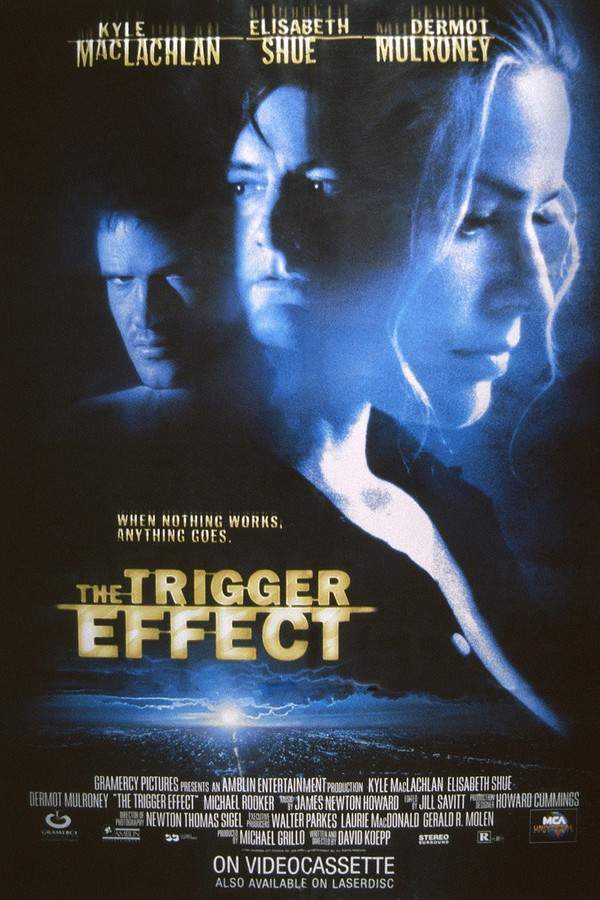
The Trigger Effect (1996) movie poster

Plot Summary

The Trigger Effect (1996) Plot Summary Explained

Release, runtime and language
1996 · 94 min · English
Directed by
David Koepp
Starring
Michael Rooker, Elisabeth Shue, Dermot Mulroney, Kyle MacLachlan, Bill Smitrovich, Edhem Barker

When a sudden blackout throws the nation into turmoil, Matthew and Annie struggle to protect their sick child. Driven to desperate measures, they turn to theft, initiating a perilous journey that challenges their values. As they travel to Annie's parents, seeking safety and assistance, they confront increasingly difficult choices and witness the fragility of societal order and the depths of human behavior under extreme pressure.

On this page (6)
  1. 1 Where to watch
  2. 2 What happens: full plot
  3. 3 Plot questions answered
  4. 4 Movie threads
  5. 5 Movies like The Trigger Effect
  6. 6 Every angle

Where to watch

Where to Watch The Trigger Effect (1996)

Where can you watch The Trigger Effect? Stream, rent or buy it in the US, including on Amazon Video, Apple TV Store and Fandango At Home: current JustWatch availability with up-to-date prices.

Streaming availability powered by JustWatch

Full plot summary · contains spoilers

What Happens in The Trigger Effect: Full Plot Summary

The whole story of The Trigger Effect (1996) explained, from the opening scene to the final frame: every key event, every twist and what it all adds up to. Read it as a quick recap before the sequel, to check a scene you missed, or to finally understand what really happened.

Annie and Matthew, a young married couple, are thrown into a nightmare when they discover their infant daughter suffering from a high fever and an earache. In a desperate attempt to get help, Matthew contacts the doctor, who assures him that a prescription will be called into the pharmacist the next day. However, during the night, a massive power outage sweeps through the neighborhood, leaving everyone in disarray.

The following day, when Matthew attempts to procure the much-needed medicine, the pharmacist informs him that due to the blackout, the medicine is unavailable. In a moment of panic and frustration, Matthew resorts to stealing the medicine while the pharmacist is distracted. As the blackout drags on, social unrest begins to unfold, prompting Matthew and their close friend Joe to purchase a shotgun and temporarily stay together during this chaotic time.

Things take a turn for the worse when an intruder breaks into their home one night. Matthew, alongside Joe, chases the intruder outside, only for a neighbor to step in and fatally shoot him. In a sinister twist, the neighbors decide to conceal the fact that the intruder was unarmed. As the days pass with the blackout still in effect, chaos ensues more broadly, leading the group to the difficult decision to flee to Annie's parents' house, located a daunting 530 miles away.

Faced with limited fuel for the long journey, they pull over near an abandoned vehicle hoping to siphon some gas. To their shock, they find a man named Gary slumped in the backseat, armed with a handgun. In a tense standoff, as Joe goes back to fetch his own shotgun for a scare tactic, tragedy strikes when Gary shoots Joe and makes off with their vehicle.

In a bid for help for his family, Matthew walks an hour to a nearby farmhouse. Initially met with hostility, the occupant, Raymond, refuses assistance due to a lack of trust. After retrieving the shotgun and preparing to confront Raymond, Matthew's resolve softens when Raymond's young daughter unexpectedly enters the room, prompting him to lower his weapon. This change of heart allows for a fragile alliance, and Raymond decides to lend Matthew a helping hand. Just in time, paramedics arrive to take Joe away in an ambulance.

As power is gradually restored and society begins to normalize, Annie, Matthew, and their neighbors are left forever changed by their harrowing ordeal. Their experiences have transformed them, leaving an indelible mark that will alter their perceptions of safety and community in the wake of adversity.

Last updated: November 16, 2024 at 11:35

Was this helpful?

Plot questions answered

The Trigger Effect Plot Explained: Your Questions Answered

The questions people ask most about The Trigger Effect (1996): what happens in the confusing scenes, why the characters do what they do, the twists, hidden details and what the ending means. Each answer contains spoilers.

Q1

Why does Matthew steal medicine from the pharmacy?

Matthew steals the medicine because his infant daughter has a high fever and earache, and the blackout has made the pharmacy's computer systems inoperable, the pharmacist cannot access the prescription. With his daughter's condition worsening and no other options available, Matthew acts out of desperate parental instinct. This moment marks the first significant moral compromise he makes under pressure, setting the tone for his gradual descent into lawlessness throughout the film.

Foreshadowing: Earlier, the doctor had promised the prescription would be ready the next day, creating false hope that quickly evaporates when the blackout strikes.

  • matthew steals medicine
  • pharmacy theft
  • desperate parent
  • blackout
Q2

Why does the neighbor shoot and kill the intruder who was unarmed?

During the home invasion, Matthew and Joe chase the intruder outside into the darkness. A neighbor intervenes and fatally shoots the intruder, later revealed to have been unarmed. The neighbor's action appears to stem from fear and adrenaline, mistaking the situation in the dark, he assumes the intruder poses an immediate lethal threat. This triggers the conspiracy among neighbors to conceal the truth, as they realize their killing was unjustified and could have legal consequences.

Foreshadowing: Earlier scenes establish growing paranoia among the neighbors as the blackout continues, with everyone viewing each other as potential threats.

  • neighbor kills intruder
  • home invasion
  • shooting
  • unarmed intruder
Q3

Why do the neighbors hide the fact that the intruder was unarmed?

The neighbors conspire to hide the truth because they realize the shooting was unjustified, the intruder was unarmed and arguably fleeing rather than attacking. By concealing this information, they protect themselves from potential legal repercussions and moral accountability. This moment illustrates how the breakdown of normal social order leads characters to protect each other through deception rather than face consequences, reflecting the erosion of civic responsibility under stress.

Foreshadowing: The decision to hide the truth foreshadows further moral compromises the group will make as conditions deteriorate.

  • conspiracy
  • cover-up
  • neighbors
  • truth
  • intruder
Q4

Why do Matthew and Annie decide to flee 530 miles to Annie's parents' house?

The group decides to flee because the escalating chaos and continued blackout make their neighborhood increasingly dangerous. After the home invasion and the neighbor's killing, they fear more violence and realize staying put offers no safety or resources. Annie's parents' house represents the only reliable refuge they know, a place with resources, safety, and family support. The 530-mile journey reflects their desperation; they believe the risks of traveling outweigh the risks of staying in a lawless environment.

Foreshadowing: Social unrest and the home invasion establish that their neighborhood has become untenable, pushing them toward extreme measures.

  • flee
  • journey
  • annie's parents
  • 530 miles
  • escape
Q5

What happens to Joe after Gary shoots him?

Joe is shot by Gary during the confrontation at the abandoned vehicle. After Gary steals their vehicle and leaves them stranded, Matthew walks to a nearby farmhouse for help. Raymond agrees to assist, and paramedics eventually arrive to take Joe away in an ambulance. While the film does not specify his ultimate fate, the fact that he receives medical attention suggests he survives the initial shooting, though the traumatic experience leaves lasting effects.

Foreshadowing: Joe's decision to retrieve his shotgun for intimidation purposes escalates the standoff, directly leading to his shooting.

  • joe shot
  • ambulance
  • paramedcs
  • gary shooting
Q6

Why does Matthew lower his weapon at the farmhouse?

Matthew lowers his weapon when Raymond's young daughter unexpectedly enters the room during their standoff. This moment triggers Matthew's recognition of what he is about to become, a man pointing a gun at another parent in front of his child. The innocent presence of the child breaks through Matthew's desperation and paranoia, reminding him of his own daughter and causing him to reconsider his violent course. This pivotal moment leads Raymond to trust him and agree to help.

Foreshadowing: Matthew's actions throughout the film have been driven by protecting his own family, making his connection to another parent's child a powerful catalyst for change.

  • matthew lowers weapon
  • raymond daughter
  • farmhouse
  • trust
Q7

Why does Gary shoot Joe at the abandoned vehicle?

Gary, found slumped in the backseat of the abandoned vehicle with a handgun, shoots Joe when Joe attempts to retrieve his own shotgun. Joe's movement toward the shotgun is perceived by Gary as a threatening gesture, triggering his defensive response. Gary is clearly terrified and on edge, possibly desperate himself from the blackout situation, which leads him to view Joe's action as an imminent threat rather than an attempt at intimidation. The shooting is a tragic consequence of two frightened people misreading each other's intentions.

Foreshadowing: Gary's initial discovery already establishes him as armed and desperate, setting up the volatile confrontation.

  • gary shoots joe
  • abandoned vehicle
  • shooting
  • confrontation
Q8

How does the power outage lead to societal breakdown?

The blackout serves as the catalyst that unravels social order by cutting off essential services: pharmacies cannot operate, communication fails, and resources become inaccessible. As the outage continues, fear and paranoia replace trust in institutions. Characters who never would have considered theft or violence begin making moral compromises when survival instincts override social norms. The film demonstrates how quickly civilized behavior dissolves when the infrastructure supporting it disappears, revealing the fragility underlying societal order.

Foreshadowing: Early scenes show minor inconveniences escalating into resource fights and mutual suspicion among neighbors.

  • power outage
  • societal breakdown
  • chaos
  • blackout
  • civilization
Q9

Does the baby survive and recover from the illness?

The film never explicitly confirms the baby's survival or recovery. After Matthew steals the medicine, there's no further mention of the infant's condition. The focus shifts to the family's survival and the escalating external threats. This omission by the filmmakers keeps the stakes ambiguous, the viewer is left to hope the medicine helped, but the narrative deliberately avoids closure on this point, maintaining tension around whether the original crisis was ever truly resolved.

Foreshadowing: The initial health crisis establishes the desperate circumstances that drive all subsequent decisions, but resolution of this primal threat is left unresolved.

  • baby survival
  • infant health
  • medicine
  • daughter fever
Q10

What does the ending imply about the characters being 'forever changed'?

The ending suggests that while power is restored and society returns to normalcy on the surface, the characters' psychological state has been permanently altered. They've witnessed and participated in events that shattered their previous worldview, their moral compromises, the violence they've seen, and the survival decisions they've made cannot be undone. The film implies that returning to their прежняя жизнь (former lives) is impossible; they've gained a darker understanding of human nature and their own capacity for wrongdoing under pressure, leaving them with lasting trauma and a changed perspective on safety and community.

Foreshadowing: Throughout the journey, each character makes increasingly difficult moral choices that cumulatively transform them.

  • ending
  • forever changed
  • psychological
  • trauma
  • power restored

Movie threads

More Movies Like The Trigger Effect, by Mood & Story

Curated lists built around what makes The Trigger Effect tick: the same mood, the same kind of story or the same emotional payoff. Each list explains why these movies belong together.

Movies about societal collapse in a neighborhood like The Trigger Effect

Stories where the familiar world crumbles right outside your front door. If you liked The Trigger Effect's tense portrayal of a neighborhood descending into chaos, you'll find similar stories here. These movies focus on the personal, claustrophobic experience of societal collapse, where the threat isn't a distant army but the people next door. They explore themes of trust, survival, and moral decay in a suddenly lawless local world.

  • paranoid
  • claustrophobic
  • suspenseful
  • fearful
  • desperate
  • unsettling
  • Tone: tense, bleak, unsettling
  • Pacing: variable, building from slow dread to frantic action
Why these movies?

The story pattern: Narratives in this thread typically begin with an ordinary community disrupted by a sudden event. The story follows a small group, often a family, as they witness the rapid disintegration of social order. The conflict is intimate and immediate, pitting former friends and neighbors against each other in a desperate struggle for safety and resources, forcing characters to confront their own capacity for violence and moral compromise.

Why they belong together: Movies are grouped here because they share a specific focus on the micro-level of societal collapse. They create a powerful sense of claustrophobia and paranoia by limiting the scope to a neighborhood or small town, making the threat feel personal and inescapable. The shared experience is one of watching the world you know fall apart from within.

Movies about moral ambiguity and desperate choices like The Trigger Effect

Character-driven stories where good people are pushed to commit unthinkable acts. Fans of The Trigger Effect's exploration of a family's moral collapse will appreciate these films. They feature characters who make increasingly desperate and ethically questionable decisions when faced with life-or-death situations. These stories are heavy dramas or thrillers that ask difficult questions about how far one would go to survive.

  • desperate
  • unsettling
  • suspenseful
  • anxious
  • grim
  • thought-provoking
  • Tone: tense, heavy, morally complex
  • Pacing: steady, character-driven progression
Why these movies?

The story pattern: The narrative pattern follows a linear progression of escalating pressure on the protagonist. Starting from a position of normalcy, a crisis forces a small moral compromise, which then snowballs into more significant transgressions. The story is a character study of this descent, examining the psychological toll and the point of no return, often culminating in an ambiguous ending where the characters' humanity is deeply scarred.

Why they belong together: These movies are connected by their intense focus on the theme of moral ambiguity. They are united by a heavy emotional weight and a straightforward narrative that efficiently charts a character's fall from grace. The viewer's experience is one of tense, uncomfortable identification with protagonists making impossible choices.

If you liked this

Movies Like The Trigger Effect

Similar movies to The Trigger Effect: the same genre, themes or kind of story. Each one comes with its own plot summary, timeline and ending explained.

Browse all movie summaries

Every angle

The Trigger Effect (1996) Explained: Plot, Timeline & Characters

Everything about The Trigger Effect in one place: what happens in the plot summary, the timeline in chronological order, the characters and meaning and a spoiler-free summary. What's After the Movie adds the cast, box office and post-credit scenes.

Coming soon on iOS and Android

The Plot Explained Movie Summary App

Plot summaries, endings explained and timelines on your phone. Catch up on any movie in minutes, save your favorites and never miss a twist again.

Be the first to know when we launch. Your email stays private, always.

Learn more about the app