Year: 1989
Runtime: 124 mins
Language: English
Director: Peter Greenaway
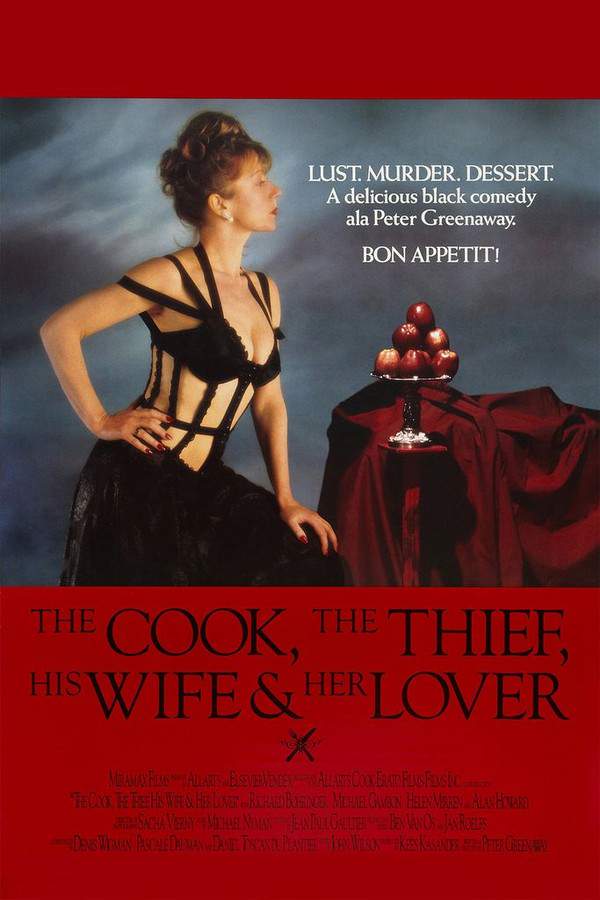
Lust…Murder…Dessert. Bon Appetit! The wife of an abusive criminal finds solace in the arms of a kind regular guest in her husband’s restaurant.
Warning: spoilers below!
Haven’t seen The Cook, the Thief, His Wife & Her Lover yet? This summary contains major spoilers. Bookmark the page, watch the movie, and come back for the full breakdown. If you're ready, scroll on and relive the story!
Trace every key event in The Cook, the Thief, His Wife & Her Lover (1989) with our detailed, chronological timeline. Perfect for unpacking nonlinear stories, spotting hidden connections, and understanding how each scene builds toward the film’s climax. Whether you're revisiting or decoding for the first time, this timeline gives you the full picture.
Last updated: January 28, 2026 at 12:46
Find frequently asked questions about the The Cook, the Thief, His Wife & Her Lover (1989) timeline, including chronological order, nonlinear jumps, cause-and-effect links, and scene sequence clarifications. This timeline FAQ helps explain when key events happen, how moments connect, and why the story unfolds in that specific order.
Georgina begins the affair because she is trapped in an abusive relationship with Albert Spica. While she maintains an outward appearance of elegance, she is emotionally imprisoned and desperate for genuine human connection. Michael, a quiet bookshop owner, represents everything her husband is not, kind, gentle, and intellectual. The affair becomes her only escape from the psychological imprisonment she endures alongside Spica.
Earlier scenes show Georgina watching the chaos around her with quiet resignation, hinting at her growing desperation.
Spica's method of killing Michael is deliberately symbolic. By force-feeding him pages from his own books, Spica is destroying Michael with the very thing that defines him, his intellectual life and love of literature. It also reflects Spica's contempt for art and civilization, as he overruns the book depository (a space of culture) with brutality. The act is both a personal act of revenge and a statement about power over intellectualism.
Spica's general contempt for the restaurant's refined setting and his intimidation of staff foreshadow his willingness to desecrate spaces of culture.
Boarst reluctantly agrees to cook Michael's body primarily because Georgina, devastated and vengeful, pleads with him. While the exact motivation is layered, part coercion, part Boarst's own complicated relationship with Spica, it serves the film's thematic structure. As the master of the kitchen, Boarst becomes an instrument of Georgina's extreme revenge, transforming the restaurant (Spica's domain) into the site of his own destruction. His compliance ties directly to the film's exploration of the chef's role in serving even the most grotesque demands.
Boarst's earlier practice of cruelty in the kitchen, shown through his harsh treatment of staff, hints at his capacity to participate in something macabre.
Georgina's extreme act is a calculated reclamation of power after being dehumanized by Spica. By forcing him to consume the flesh of the man she loved, she turns his own predatory nature against him, she reduces him to the cannibal he truly is. The public spectacle in the restaurant (his domain) maximizes his humiliation. It's a brutal form of poetic justice that mirrors the film's dark theme: in a world of barbarism, she meets barbarism with barbarism.
Georgina's quiet observation of Spica's cruelty throughout the film builds toward her transformation from victim to orchestrator of this horrific revenge.
Spica locates the book depository by torturing Pup, the young boy soprano who works in the kitchen. Boarst had been sending food to Georgina through Pup, and the boy unknowingly carried a book containing the depository's address. When Spica learns from the boy that Georgina has been receiving deliveries from somewhere, he brutalizes Pup until he reveals the location. The innocent boy becomes an unwilling conduit to the lovers' hideout.
The scene where Boarst arranges food deliveries through Pup plants the seed for this later discovery.
Georgina kills Spica with a gunshot to the head immediately after he consumes the cooked flesh because she has achieved her goal of humiliating him and proving him to be a cannibal. The act of eating human flesh is what she weaponizes to label him a monster, exactly what he has been all along. The shooting is the final step in her transformation from victim to avenger, bringing definitive closure to his reign of terror. The phrase she uses, labeling him a cannibal, is her final condemnation.
Georgina's gathering of everyone Spica has wronged indicates she plans a public, decisive reckoning.
The restaurant Le Hollandais serves as a crucial contrast between civilization and barbarism. Despite its refined atmosphere of haute cuisine and elegance, it becomes a stage for Spica's violence and intimidation. This dissonance, the refinement of the setting versus the brutality occurring within it, amplifies the film's thematic message about the thin veneer of civilization. The restaurant is Spica's kingdom, making it the perfect stage for both his tyranny and his ultimate downfall.
The opening scenes establish the tension between the restaurant's elegance and Spica's boorish disruption of it.
Pup, the young kitchen helper who sings while he works, becomes an innocent victim in Spica's quest for revenge. He unknowingly carries a book with the book depository's address when Boarst sends food to Georgina. When Spica discovers this connection, he tortures Pup to extract the location. Pup ends up in the hospital, where Georgina visits him. His suffering represents the collateral damage of Spica's tyranny, even those uninvolved in the affair become targets of his violence.
Pup's role as a messenger between the restaurant and the bookshop sets up his tragic involvement.
Spica tortures Pup because he needs to find where Georgina is hiding with Michael. Pup is the weak link, Boarst had been sending food to Georgina through the boy, and Spica realizes the boy must know where the deliveries are going. Pup is vulnerable and easily intimidated, making him a target. The torture reveals Spica's willingness to harm an innocent child to get what he wants, further establishing his capacity for cruelty.
The delivery arrangement between Boarst and Georgina provides the logical connection Spica exploits.
Georgina initially stays with Spica because she is trapped, both financially and psychologically. She is his wife, and Spica's control extends beyond the restaurant to every aspect of her life. Her 'elegant' appearance is maintained at his insistence; she is essentially a possession. She has no independent means of escape until she meets Michael, and even then, her initial position is one of quiet endurance rather than active rebellion. Her staying reflects the reality of abusive relationships where leaving is not simple.
Early scenes show Georgina maintaining poise while enduring Spica's behavior, indicating her constrained situation.
The film presents a stark examination of power dynamics and cyclical abuse. Spica's tyrannical control over the restaurant and his wife represents systematic abuse, while Georgina's extreme revenge demonstrates how victims can become perpetrators when given no alternative. The film does not romanticize her actions, her revenge is horrifying. Rather, it suggests that environments of brutality produce brutal responses. The bleak ending offers no redemption, only a continuation of violence in a different form.
The consistent depiction of Spica's escalating cruelty throughout builds the film's commentary on abuse.
Discover curated groups of movies connected by mood, themes, and story style. Browse collections built around emotion, atmosphere, and narrative focus to easily find films that match what you feel like watching right now.
Lavish settings contrast with brutal power struggles and poetic, savage justice.Explore movies like The Cook, the Thief, His Wife & Her Lover that feature stories of revenge set against opulent, corrupt backdrops. If you liked the clash of high aesthetics and brutal violence, these films offer similar intense experiences.
The journey typically follows a victim of profound abuse or oppression within a closed, powerful system. As the protagonist endures humiliation, they forge an alliance leading to a meticulously planned, often allegorical, revenge that turns the oppressor's world against them in a shocking finale.
These films are grouped by their shared atmosphere of oppressive glamour and their central theme of brutal, symbolic retribution. They combine a steady, deliberate pacing with high emotional intensity and a dark tone, creating a coherent experience of stylized vengeance.

Allegorical stories depicting the brutal dynamics of control, abuse, and desperate resistance.Find movies similar to The Cook, the Thief, His Wife & Her Lover that serve as bleak allegories about power dynamics. If you appreciated the film's intense symbolism and graphic critique of tyranny, these recommendations share that thematic weight.
The plot operates on two levels: a literal story of conflict and a deeper allegorical meaning. Characters often represent broader concepts (like tyranny, intellect, or rebellion). The story builds steadily towards a climax that is both a narrative resolution and a stark, unsettling philosophical statement.
This thread groups films that prioritize heavy thematic allegory, exploring dark subjects like domestic tyranny or societal control through intense, graphic storytelling. They share a bleak tone, steady pacing, and a conclusion that offers a horrifying yet poetic form of justice.
Don't stop at just watching - explore The Cook, the Thief, His Wife & Her Lover in full detail. From the complete plot summary and scene-by-scene timeline to character breakdowns, thematic analysis, and a deep dive into the ending - every page helps you truly understand what The Cook, the Thief, His Wife & Her Lover is all about. Plus, discover what's next after the movie.
Read a complete plot summary of The Cook, the Thief, His Wife & Her Lover, including all key story points, character arcs, and turning points. This in-depth recap is ideal for understanding the narrative structure or reviewing what happened in the movie.
Discover the characters, locations, and core themes that shape The Cook, the Thief, His Wife & Her Lover. Get insights into symbolic elements, setting significance, and deeper narrative meaning - ideal for thematic analysis and movie breakdowns.
Get a quick, spoiler-free overview of The Cook, the Thief, His Wife & Her Lover that covers the main plot points and key details without revealing any major twists or spoilers. Perfect for those who want to know what to expect before diving in.
Discover movies like The Cook, the Thief, His Wife & Her Lover that share similar genres, themes, and storytelling elements. Whether you’re drawn to the atmosphere, character arcs, or plot structure, these curated recommendations will help you explore more films you’ll love.
The Cook, the Thief, His Wife & Her Lover (1989) Plot Summary & Movie Recap
The Cook, the Thief, His Wife & Her Lover (1989) Scene-by-Scene Movie Timeline
The Cook, the Thief, His Wife & Her Lover (1989) Spoiler-Free Summary & Key Flow
Movies Like The Cook, the Thief, His Wife & Her Lover – Similar Titles You’ll Enjoy
The Cook, the Thief, His Wife & Her Lover (1990) Full Summary & Key Details
Eating Raoul (1982) Full Summary & Key Details
Aamis (2019) Story Summary & Characters
Cook F**k Kill (2019) Story Summary & Characters
A Crime (2006) Detailed Story Recap
Carnal Crimes (1991) Complete Plot Breakdown
Vicious and Nude (1980) Complete Plot Breakdown
Killer Soup (1000) Full Movie Breakdown
Thief of Hearts (1984) Detailed Story Recap
So Sweet… So Perverse (1969) Ending Explained & Film Insights
Love to Kill (1993) Full Summary & Key Details
Introspectum Motel (2021) Full Movie Breakdown
A Taste for Women (1964) Ending Explained & Film Insights
Loving Adults (2022) Complete Plot Breakdown
Deadly Delicious (2008) Detailed Story Recap