




Plot Explained Spoilers guaranteed!
Plot Explained

Browse by genre

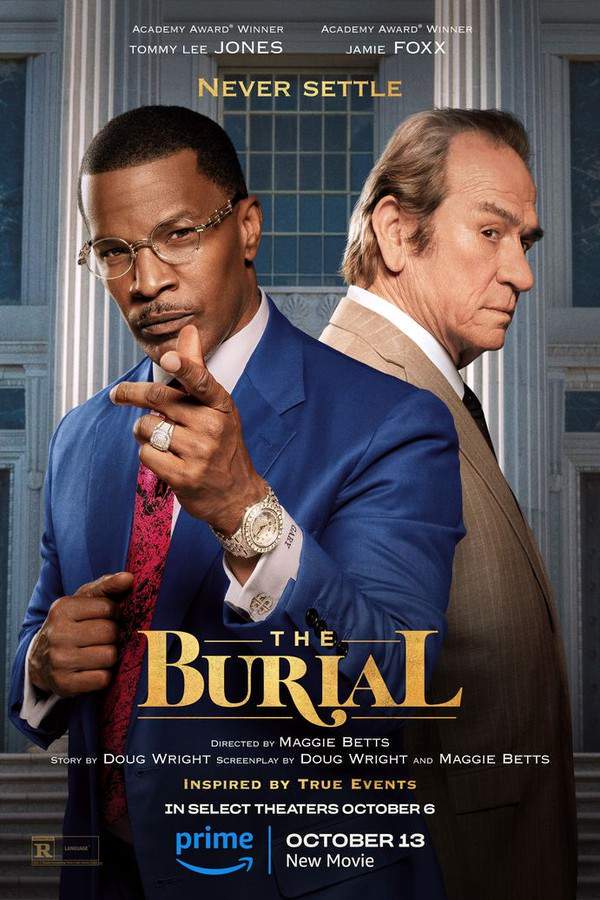
The Burial (2023) movie poster

Timeline

The Burial (2023) Timeline Explained – Every Event in Order

Release, runtime and language
2023 · 2 h 6 m · English
Echo score 76
JustWatch #13,710 5
Directed by
Maggie Betts
Starring
Jamie Foxx, Mamoudou Athie, Tommy Lee Jones, Bill Camp, Jurnee Smollett, Dorian Missick
Budget
$32.5M

When a respected funeral home owner faces a lawsuit threatening his livelihood, he finds an unlikely ally in a skilled lawyer. Together, they confront corporate greed and racial injustice in a David versus Goliath legal battle. As they delve deeper into the case, they forge an unexpected bond while exposing a troubling web of corruption and fighting for justice and a chance at redemption.

On this page (6)
  1. 1 Where to watch
  2. 2 Events in order (11)
  3. 3 Timeline questions answered
  4. 4 Movie threads
  5. 5 Movies like The Burial
  6. 6 Every angle

Where to watch

Where to Watch The Burial (2023)

Where can you watch The Burial? Stream, rent or buy it in the US, including on Amazon Prime Video, Amazon MX Player and Amazon Prime Video Free: current JustWatch availability with up-to-date prices.

Streaming availability powered by JustWatch

11 events in order · contains spoilers

The Burial Timeline: Events in Chronological Order

Every key event of The Burial (2023) in order, scene by scene, with when and where it takes place. Use it to untangle flashbacks, time jumps and parallel storylines, to refresh your memory before the sequel or to find the exact scene you are thinking of.

  1. O'Keefe's financial crisis and the sale agreement

    In 1995, funeral home owner Jeremiah O'Keefe faces severe financial pressure after losses from a Ponzi scheme and demands from the Mississippi State Insurance Commission. He enters a contract with the Loewen Group to sell three funeral homes, insisting that Loewen not sell funeral insurance as part of the deal. The move aims to stave off bankruptcy and preserve his business.

    When
    1995
    Where
    Mississippi
  2. Loewen delays payment and ignores the oral agreement

    Four months after signing, the Loewen Group delays payment for the purchase and does not honor the oral agreement not to sell funeral insurance. O'Keefe's hope to secure his business begins to fade as the deal's terms crumble and financial strain mounts.

    When
    Four months after signing (1995–1996)
    Where
    Mississippi
  3. O'Keefe hires Willie E. Gary and funds the defense

    An enraged O'Keefe hires Willie E. Gary, a flamboyant Florida personal injury lawyer, after Dockins suggests a different approach to win over a presumably black jury. To pay for Gary's services, O'Keefe remortgages his home. The switch signals a new, high-stakes legal battle ahead.

    When
    Late 1990s (after four months from contract)
    Where
    Mississippi
  4. Loewen counters with a black-led defense team

    Loewen counters with a black-led legal team fronted by Mame Downes, aiming to blunt the jury's sentiment and secure a win. The strategy leverages diversity on the defense side to challenge O'Keefe's case.

    When
    Mid-1990s
    Where
    Mississippi
  5. Courtroom strategy shifts as Gary is replaced

    During the trial, Downes questions O'Keefe's character and ties his finances to a convicted felon, challenging Gary's strategy. In response, O'Keefe replaces Gary with his white contract lawyer Mike Allred as lead attorney to try a different approach.

    When
    During trial (late 1990s)
    Where
    Mississippi
  6. Dockins exposes tactics; Allred's past questioned

    Dockins produces a witness insinuating Loewen overcharges minority communities. Downes cross-examines Allred and reveals that his grandfather was a Ku Klux Klan member, complicating the defense's credibility.

    When
    During trial
    Where
    Mississippi
  7. Black legal team walks out; Allred withdraws

    Gary defends Allred, triggering the black legal team to walk out of the courtroom. With the team gone, Allred withdraws from the case to give the remaining lawyers a better chance at winning the verdict.

    When
    During trial
    Where
    Mississippi
  8. Evidence of exploiting a church emerges

    Dockins uncovers evidence that Loewen exploited the National Baptist Church by selling overpriced packages to its members. The revelation reframes the case and strengthens O'Keefe's position.

    When
    During trial
    Where
    Mississippi
  9. Verdict in favor of O'Keefe

    Facing the evidence and Loewen's lack of remorse, the jury awards O'Keefe $500 million in damages—$100 million in compensatory damages and $400 million in punitive damages. The verdict marks a significant victory against the corporation.

    When
    During trial (verdict delivered)
    Where
    Mississippi
  10. Loewen Group's downfall

    Two years after the verdict, Ray Loewen is fired from his position and the Loewen Group heads toward bankruptcy. The company struggles under the weight of the civil judgment and ongoing financial pressures.

    When
    Two years after verdict
    Where
    USA (corporate) / Loewen Group
  11. Cameo by Willie E. Gary

    After the closing credits, Willie E. Gary makes a cameo appearance in person, underscoring his role and lasting impact on the case. The film closes with this final nod to the lawyer who led the high-stakes litigation.

    When
    End of film
    Where
    Film credits

Last updated: October 09, 2025 at 16:13

Was this helpful?

Timeline questions answered

The Burial Timeline Explained: Your Questions Answered

When does it happen, and why in that order? The questions people ask about the chronology of The Burial (2023): time jumps, flashbacks, cause and effect between scenes and the correct order of events, each answered with spoilers.

Q1

Why did Jeremiah O'Keefe need to sell his funeral homes?

Jeremiah O'Keefe faced severe financial pressure after losing money in a Ponzi scheme run by a business associate. The Mississippi State Insurance Commission demanded he meet certain financial requirements, forcing him to sell parts of his funeral business to avoid bankruptcy. He entered a deal with the Loewen Group to sell three funeral homes, hoping to keep his remaining business afloat.

  • Jeremiah O'Keefe
  • funeral home
  • financial crisis
  • Ponzi scheme
  • bankruptcy
Q2

Why did O'Keefe hire Willie Gary to represent him?

O'Keefe hired flashy Florida personal injury lawyer Willie E. Gary because his lawyer Hal Dockins suggested that a white contract lawyer would struggle to win over a black jury in Mississippi. Gary was known for his bold courtroom presence and high settlements, so O'Keefe believed hiring a prominent Black lawyer would resonate better with the jury and improve his chances of winning the case.

  • Willie Gary
  • jury selection
  • courtroom strategy
  • Mississippi
Q3

Why was the funeral insurance agreement significant in the case?

When O'Keefe sold three funeral homes to the Loewen Group, he insisted on a strict condition: Loewen would not sell funeral insurance as part of the deal. Four months later, Loewen ignored this oral agreement and began selling funeral insurance anyway. This broken promise became a key point in O'Keefe's lawsuit, as it showed Loewen acted in bad faith and deliberately tried to push O'Keefe into bankruptcy to seize his entire business at a discount.

  • funeral insurance
  • oral agreement
  • Loewen Group
  • contract breach
Q4

Why did O'Keefe replace Willie Gary with Mike Allred?

During the trial, attorney Mame Downes questioned O'Keefe's character and tied his financial troubles to dealings with a convicted felon. Feeling pressure from this aggressive cross-examination, O'Keefe replaced Gary with his white contract lawyer Mike Allred as lead attorney, hoping a different approach might salvage the case.

  • Mike Allred
  • courtroom strategy
  • attorney change
  • trial
Q6

What was the National Baptist Church connection in the case?

Hal Dockins uncovered evidence that the Loewen Group had exploited members of the National Baptist Church by selling them overpriced funeral packages. This revelation reframed the case as more than a business dispute, it showed Loewen was systematically targeting vulnerable minority communities. The jury viewed this exploitation as morally indefensible, strengthening O'Keefe's position.

  • National Baptist Church
  • exploitation
  • minority communities
  • funeral packages
Q7

How did the jury arrive at the $500 million verdict?

The jury awarded O'Keefe $500 million in total, $100 million in compensatory damages to cover his financial losses and $400 million in punitive damages meant to punish Loewen for their egregious conduct. The punitive amount was so high because the jury saw Loewen's exploitation of church members and lack of remorse as particularly egregious, warranting severe punishment.

  • $500 million verdict
  • compensatory damages
  • punitive damages
  • jury decision
Q8

What happened to Ray Loewen and the Loewen Group after the trial?

Two years after the verdict, Ray Loewen was fired from his position as head of the company, and the Loewen Group filed for bankruptcy. The massive $500 million judgment created insurmountable financial pressure on the corporation, leading to its collapse.

  • Ray Loewen
  • Loewen Group
  • bankruptcy
  • corporate downfall
Q9

Why did the Loewen Group delay paying O'Keefe?

Hal Dockins suspected Loewen deliberately delayed payment to push O'Keefe into bankruptcy, allowing Loewen to seize his entire funeral business at a significantly discounted price. This strategy of attrition was designed to force O'Keefe out of business rather than honor the original purchase agreement.

  • payment delay
  • bankruptcy strategy
  • Loewen Group business tactics
Q10

Why did Mame Downes focus on O'Keefe's character during the trial?

Mame Downes, leading Loewen's black legal team, aggressively questioned O'Keefe's character to undermine his credibility with the jury. By connecting his financial troubles to dealings with a convicted felon, she aimed to paint O'Keefe as unreliable or equally guilty of financial misconduct, weakening his moral standing in the case.

  • Mame Downes
  • cross-examination
  • character assassination
  • credibility

Movie threads

More Movies Like The Burial, by Mood & Story

Curated lists built around what makes The Burial tick: the same mood, the same kind of story or the same emotional payoff. Each list explains why these movies belong together.

Cathartic David vs. Goliath Legal Dramas like The Burial

Where skilled lawyers face impossible odds against corporate giants in tense but steady battles. If you loved the tense, steady-paced courtroom strategy and ultimate catharsis of The Burial, you'll enjoy these movies. This thread gathers legal dramas where an underdog team methodically builds a case against a powerful corporation, culminating in a hopeful and emotionally rewarding victory that feels just.

  • tense
  • determined
  • cathartic
  • underdog
  • courtroom
  • strategic
  • Tone: tense, determined, hopeful
  • Pacing: steady, methodical
Why these movies?

The story pattern: The narrative follows a classic underdog structure, beginning with a seemingly insurmountable challenge. A skilled but underestimated legal team methodically investigates and builds their case, often exposing deep corruption. The central conflict is a tense courtroom battle where strategy and evidence triumph over brute financial force, ending in a decisive, happy victory.

Why they belong together: These movies are grouped together because they share a specific blend of tense, strategic legal proceedings, a steady pacing that builds anticipation, and a powerful emotional payoff. They focus on themes of justice, fighting systemic greed, and the triumph of determination, creating a consistently cathartic viewing experience.

Movies about Fighting Corporate Injustice like The Burial

Stories that methodically unravel webs of corporate corruption and fight for redemption. For viewers who appreciated The Burial's focus on confronting corporate greed and racial injustice, this thread collects movies with a similar determined mood. These films follow protagonists uncovering corruption and fighting systemic exploitation, offering a mix of tense drama and hopeful, redemptive conclusions.

  • urgent
  • determined
  • corporate
  • exposé
  • redemption
  • hopeful
  • Tone: urgent, determined, cathartic
  • Pacing: steady, investigative
Why these movies?

The story pattern: The narrative pattern involves a protagonist whose livelihood or principles are threatened by a faceless, exploitative system. They form an unlikely alliance to investigate and expose the corruption, often facing significant personal and professional risk. The journey is one of determined resilience, leading to a public reckoning that provides both personal redemption and a sense of broader justice.

Why they belong together: These films are connected by their central theme of challenging powerful, corrupt systems. They share a mood of urgent determination and a steady pacing that allows for a thorough exploration of the issue. The emotional core is a blend of righteous anger and hopeful resolve, culminating in a cathartic sense of victory.

If you liked this

Movies Like The Burial

Similar movies to The Burial: the same genre, themes or kind of story. Each one comes with its own plot summary, timeline and ending explained.

Browse all movie summaries

Every angle

The Burial (2023) Explained: Plot, Ending, Timeline & Characters

Everything about The Burial in one place: what happens in the plot summary, the timeline in chronological order, the characters and meaning, the ending explained and a spoiler-free summary. What's After the Movie adds the cast, box office and post-credit scenes.

Coming soon on iOS and Android

The Plot Explained Movie Summary App

Plot summaries, endings explained and timelines on your phone. Catch up on any movie in minutes, save your favorites and never miss a twist again.

Be the first to know when we launch. Your email stays private, always.

Learn more about the app