Plot Explained Spoilers guaranteed!
Plot Explained

Browse by genre

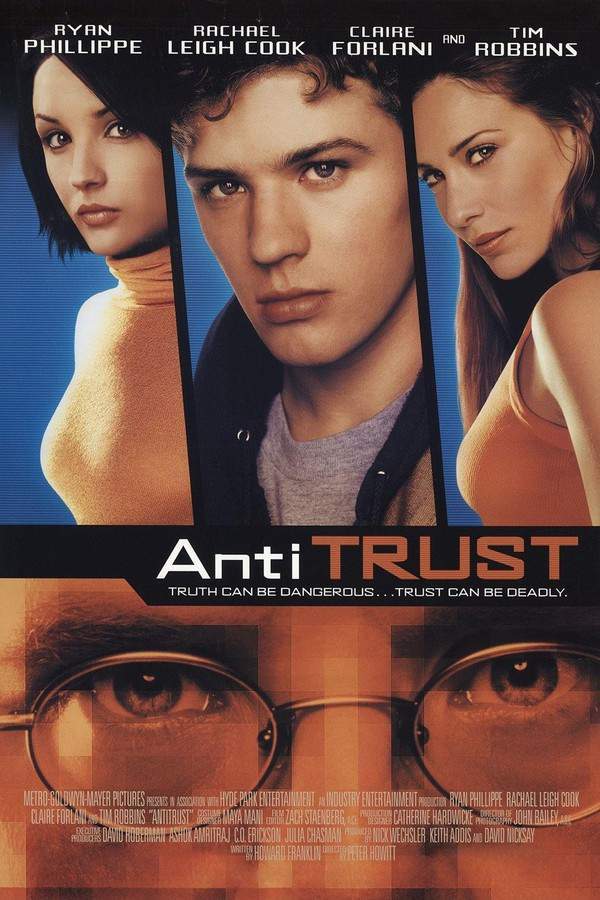
Antitrust (2001) movie poster

Plot Summary

Antitrust (2001) Plot Summary Explained

Release, runtime and language
2001 · 109 min · English
Loading streaming availability…
Directed by
Peter Howitt
Starring
Tim Robbins, Ryan Phillippe

A young, ambitious programmer, Milo Hoffman, is thrilled to be recruited by a leading technology company. Initially drawn to the charismatic founder he admires, Milo soon realizes that the seemingly utopian environment harbors a darker side. He finds himself embroiled in a complex web of corporate intrigue and legal battles, uncovering a ruthless competition for dominance in the software industry. Milo must decide where his loyalties lie as he confronts the ethical compromises inherent in the pursuit of power and innovation.

On this page (5)
  1. 1 Where to watch
  2. 2 What happens: full plot
  3. 3 Plot questions answered
  4. 4 Movie threads
  5. 5 Every angle
Loading streaming availability…

Full plot summary · contains spoilers

What Happens in Antitrust: Full Plot Summary

The whole story of Antitrust (2001) explained, from the opening scene to the final frame: every key event, every twist and what it all adds up to. Read it as a quick recap before the sequel, to check a scene you missed, or to finally understand what really happened.

Milo Hoffman, a Stanford graduate, works with his three friends at their new software development company, Skullbocks. He is recruited by Gary Winston, the ambitious CEO of the software giant NURV, who offers him a generous salary, near-total creative control, and a permissive working environment. After accepting, Milo and his girlfriend, Alice Poulson, move to NURV's headquarters in Portland, Oregon.

At the heart of NURV's ambitions is Synapse, a worldwide media distribution network that appears to be on track. Yet Milo grows uneasy about the pristine source code that Winston personally provides whenever the company needs it, and Winston refuses to reveal where it comes from.

Tragedy strikes when Milo's best friend and fellow programmer, Teddy Chin, is murdered. He discovers a chilling pattern: NURV is stealing code from programmers around the world—and killing those who stand in their way. The company relies on an expansive surveillance system to monitor and lift ideas, has infiltrated the Justice Department, and even exercises influence over mainstream media. To complicate matters, Milo's girlfriend is revealed to be a plant, an ex-con hired by NURV to spy on him.

Hidden within a secret NURV database are sensitive dossiers on a friendly coworker, Lisa Calighan. Confronting her about the data, Milo learns she is willing to help expose NURV. He teams with his old start-up friend, Brian Bissel, to hijack Synapse via a local public-access television station and broadcast their charges to the world. But Calighan turns out to be Winston's accomplice and foils the plan.

As the failed operation unfolds and Winston moves to kill Milo, a backup plan goes into motion. Off-screen, Milo had already persuaded Poulson to turn against NURV; she joins the others—the fourth Skullbocks member—and, with NURV's incorruptible security contractors, they seize one of the company's own centers—Building 21—and transmit incriminating evidence using the Synapse code. The plan leads to the arrest of Calighan, Winston, and his entourage by the FBI. In the aftermath, Milo parts ways amicably with the redeemed Poulson and rejoins Skullbocks.

Last updated: November 22, 2025 at 15:58

Was this helpful?

Plot questions answered

Antitrust Plot Explained: Your Questions Answered

The questions people ask most about Antitrust (2001): what happens in the confusing scenes, why the characters do what they do, the twists, hidden details and what the ending means. Each answer contains spoilers.

Q1

Why does Gary Winston recruit Milo Hoffman?

Gary Winston recruits Milo because he needs a talented programmer he can control. While Winston presents himself as offering creative freedom, his real motive is to bring Milo into NURV where he can be monitored and ultimately used. Winston's refusal to explain where the pristine Synapse code originates reveals he's acquiring stolen work, and bringing in a skilled programmer like Milo helps maintain the illusion that NURV's technology is legitimately developed.

Foreshadowing: Winston's initial charm and too-good-to-be-true offer hint at a hidden agenda from the very beginning.

  • gary winston
  • milo hoffman
  • recruitment
  • nurv
  • motivation
Q2

Why is Milo suspicious of the Synapse source code?

Milo grows suspicious because Winston provides perfect, pristine code whenever NURV needs it, but refuses to reveal where it comes from. This secrecy strikes Milo as unnatural for a company that claims to foster innovation. His suspicion is validated when he discovers NURV has been systematically stealing code from programmers worldwide, using surveillance to lift ideas and killing those who resist.

Foreshadowing: Early in his tenure, Milo notices the code appears too perfect and questions why Winston keeps its source hidden.

  • synapse
  • source code
  • nurv
  • surveillance
  • stolen code
Q3

Why is Teddy Chin murdered?

Teddy Chin is murdered because he is one of the programmers whose code NURV has been stealing. When Teddy refuses to cooperate or stay silent about his work being taken, NURV eliminates him as part of their pattern of killing programmers who become obstacles. His murder sends a clear message to anyone who might resist NURV's code theft operation.

Foreshadowing: Teddy's murder is the result of NURV's established pattern of eliminating programmers who won't participate in their code theft scheme.

  • teddy chin
  • murder
  • nurv
  • code theft
  • programmer
Q4

Is Alice Poulson really a NURV plant?

Yes, Alice Poulson is revealed to be an ex-con hired by NURV to spy on Milo and manipulate him from within. She was planted specifically to monitor Milo's activities and ensure he remains compliant with NURV's agenda. However, Milo eventually persuades her to turn against NURV, and she ultimately helps expose the company's crimes.

Foreshadowing: Alice's initial relationship with Milo was engineered by NURV as a way to keep tabs on their new recruit.

  • alice poulson
  • spy
  • plant
  • nurv
  • betrayal
Q5

What is Lisa Calighan's true role at NURV?

Lisa Calighan appears to be a sympathetic coworker willing to help Milo expose NURV's crimes, but she is actually Gary Winston's accomplice. She gains Milo's trust by offering to help, then sabotages the plan to hijack Synapse when the operation begins. Her betrayal nearly destroys Milo and Brian's exposure attempt.

Foreshadowing: Lisa's access to sensitive NURV databases and her willingness to help should raise questions about why someone in her position would risk everything.

  • lisa calighan
  • betrayal
  • winston
  • nurv
  • accomplice
Q6

How does Milo convince Alice Poulson to turn against NURV?

Milo persuades Alice Poulson to defect off-screen, before the final confrontation. While the exact conversation isn't shown, Milo's ability to win her over suggests he exposed the truth about NURV's crimes and convinced her that her own position was precarious. Her defection proves crucial, as she joins the fourth Skullbocks member and helps seize Building 21.

Foreshadowing: Milo's earlier suspicions about Alice's loyalty become irrelevant once he successfully turns her against her former employers.

  • alice poulson
  • defection
  • persuasion
  • skullbocks
  • building 21
Q7

Why is Building 21 important in the finale?

Building 21 is one of NURV's own centers that the group seizes for their backup operation. It serves as the strategic location from which they transmit the incriminating evidence using Synapse's code. By using NURV's own infrastructure against them, the group can broadcast to the global network and ensure the evidence reaches the world.

Foreshadowing: Building 21 represents NURV's own technology being turned into the tool of their destruction.

  • building 21
  • nurv
  • evidence
  • transmission
  • seizure
Q8

Why does the plan to hijack Synapse fail?

The plan fails because Lisa Calighan is Winston's accomplice. She sabotage the technical execution of the hijack attempt, preventing the broadcast from happening. This betrayal forces Milo and Brian to pivot to their backup plan, which relies on seizing Building 21 instead of the public-access station.

Foreshadowing: Calighan's involvement in planning the operation gave her the opportunity to identify and exploit its vulnerabilities.

  • synapse hijack
  • plan failure
  • lisa calighan
  • sabotage
  • public access tv
Q9

How does NURV steal code from programmers?

NURV uses an extensive surveillance system to monitor programmers around the world, lifting ideas and code from their work. When programmers refuse to cooperate or threaten to expose the theft, NURV eliminates them, as evidenced by Teddy Chin's murder. This system allows Winston to provide pristine code without genuine internal development.

Foreshadowing: The surveillance network is so comprehensive that NURV can identify and target any programmer whose work they wish to appropriate.

  • surveillance
  • code theft
  • monitoring
  • programmers
  • nurv system
Q10

How does NURV influence the Justice Department and media?

NURV has infiltrated both the Justice Department and mainstream media, allowing the company to control information and protect itself from legal consequences. This institutional infiltration means NURV can suppress investigations and shape public narrative about the company. The depth of this infiltration is part of what makes exposing NURV so difficult.

Foreshadowing: Winston's power extends far beyond the technology industry, reaching into the very institutions meant to regulate and oversee corporate conduct.

  • justice department
  • media infiltration
  • nurv
  • corruption
  • influence
Q11

Why is Synapse so important to NURV's plans?

Synapse is a worldwide media distribution network that represents NURV's attempt to control global information flow. Once operational, it would give NURV unprecedented power over media distribution. This is why Milo and his allies specifically target Synapse for their exposure, both to steal its code for their broadcast and to demonstrate its potential for manipulation.

Foreshadowing: The massive resources Winston invests in Synapse indicate it's meant to be NURV's ultimate tool for controlling information.

  • synapse
  • media distribution
  • network
  • global
  • control
Q12

What happens to Gary Winston at the end?

Gary Winston, Lisa Calighan, and their entire entourage are arrested by the FBI at the end of the film. The evidence transmitted through Synapse from Building 21 exposes their crimes, leading to criminal charges. Winston's elaborate scheme to control technology and information collapses entirely.

Foreshadowing: The same surveillance and control systems Winston used to maintain power become the evidence of his crimes.

  • gary winston
  • arrest
  • fbi
  • consequences
  • ending
Q13

Does Milo rejoin Skullbocks at the end?

Yes, Milo Hoffman leaves NURV and rejoins Skullbocks after the fallout. He parts ways amicably with the redeemed Alice Poulson, who continues working with Skullbocks. The film ends with Milo recommitting to his original mission of building technology independently, away from corporate control.

Foreshadowing: Milo's recruitment by Winston was always a detour from his original vision, and his return to Skullbocks represents a return to his principles.

  • milo hoffman
  • skullbocks
  • reunion
  • ending
  • resolution

Movie threads

More Movies Like Antitrust, by Mood & Story

Curated lists built around what makes Antitrust tick: the same mood, the same kind of story or the same emotional payoff. Each list explains why these movies belong together.

Corporate Whistleblower Thrillers like Antitrust

When an idealist uncovers deadly corruption within a powerful organization. If you enjoyed the tense corporate espionage and moral dilemmas in Antitrust, you'll find similar stories here. These movies feature protagonists uncovering corruption within powerful organizations, blending fast-paced thrills with ethical conflicts. Explore more films about whistleblowers and tech conspiracies.

  • tense
  • suspenseful
  • paranoid
  • anxious
  • thrilling
  • high-stakes
  • Tone: tense, paranoid
  • Pacing: fast, relentless
Why these movies?

The story pattern: Stories in this thread typically follow a linear path: recruitment into an alluring organization, the gradual discovery of its unethical practices, a rising sense of paranoia and danger, and a final confrontation where the protagonist must use their insider knowledge to dismantle the system from within.

Why they belong together: These films are grouped together because they share a core narrative of idealism clashing with corporate greed, creating a specific blend of intellectual puzzle-solving and life-or-death suspense. The mood is consistently tense and paranoid, driven by a fast pace and high stakes.
Techno-Paranoia and Moral Compromise like in Antitrust

Stories exploring the dark side of innovation and the price of power. Fans of Antitrust who enjoyed its themes of technological ethics and corporate surveillance will appreciate this selection. These films explore the tension between innovation and morality, often set in high-tech worlds filled with paranoia. Discover more movies about the dark side of the tech industry.

  • paranoid
  • claustrophobic
  • disillusioned
  • anxious
  • suspenseful
  • ethically complex
  • Tone: tense, disillusioned
  • Pacing: fast to steady, building dread
Why these movies?

The story pattern: The narrative pattern involves a character becoming deeply immersed in a technologically advanced world, initially seduced by its potential. As they advance, they encounter the system's inherent ethical flaws—surveillance, manipulation, or ruthless competition—forcing a crisis of conscience and a struggle against an omnipresent, systemic threat.

Why they belong together: These movies are united by their focus on the psychological and ethical impact of technology. They share a tense, claustrophobic mood generated by themes of surveillance and betrayal, and a pacing that steadily builds unease as the protagonist's disillusionment grows.

Every angle

Antitrust (2001) Explained: Plot, Timeline & Characters

Everything about Antitrust in one place: what happens in the plot summary, the timeline in chronological order, the characters and meaning and a spoiler-free summary. What's After the Movie adds the cast, box office and post-credit scenes.

Coming soon on iOS and Android

The Plot Explained Movie Summary App

Plot summaries, endings explained and timelines on your phone. Catch up on any movie in minutes, save your favorites and never miss a twist again.

Be the first to know when we launch. Your email stays private, always.

Learn more about the app