Plot Explained Spoilers guaranteed!
Plot Explained

Browse by genre

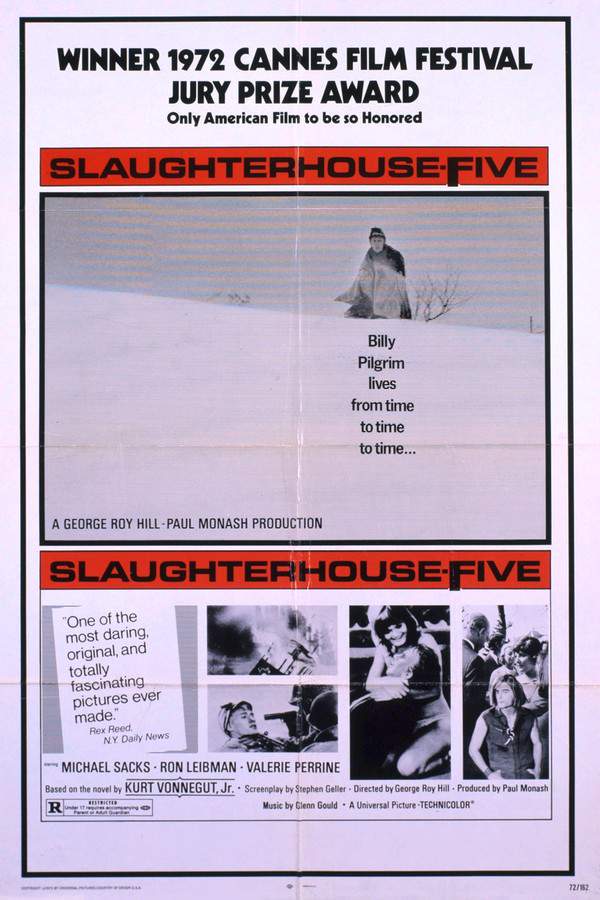
Slaughterhouse-Five (1972) movie poster

Plot Summary

Slaughterhouse-Five (1972) Plot Summary Explained

Release, runtime and language
1972 · 104 min · English
Loading streaming availability…
Directed by
George Roy Hill
Starring
Kevin Conway, Ron Leibman, Valerie Perrine, Ekkehardt Belle, Eugene Roche, Friedrich von Ledebur

Billy Pilgrim, an optometrist from upstate New York, finds himself unstuck in time, experiencing moments from his life out of order. His story includes a harrowing World War II captivity as a prisoner of war, a seemingly ordinary existence back home, and a bizarre abduction by aliens from the planet Tralfamadore. While with the Tralfamadorians, he becomes an attraction in an intergalactic zoo, grappling with their perspective on time and free will.

On this page (8)
  1. 1 Where to watch
  2. 2 What happens: full plot
  3. 3 Plot questions answered
  4. 4 The book behind the movie
  5. 5 Movie threads
  6. 6 Movies like Slaughterhouse-Five
  7. 7 Categories
  8. 8 Every angle
Loading streaming availability…

Full plot summary · contains spoilers

What Happens in Slaughterhouse-Five: Full Plot Summary

The whole story of Slaughterhouse-Five (1972) explained, from the opening scene to the final frame: every key event, every twist and what it all adds up to. Read it as a quick recap before the sequel, to check a scene you missed, or to finally understand what really happened.

In the serene town of Ilium, New York, Billy Pilgrim (Michael Sacks) begins to articulate his reflections in a letter to the editor. Unbeknownst to him, this moment of contemplation will catapult him back into the tumultuous events of World War II. As he finds himself on the front lines in Belgium, Billy faces the grim realities of warfare alongside his fellow American soldiers, who soon fall into the hands of the German army. Suspense looms heavily over him, particularly due to the vengeful intentions of Paul Lazzaro (Ron Leibman), a former comrade in captivity who harbors a deep grudge against him. Within the confines of their POW camp, Billy forms a profound connection with the wise and experienced Edgar Derby (Kevin Conway), who stands up for him during crucial moments.

As the conflict intensifies, Billy becomes part of a harrowing journey to Dresden, Germany, where their group must choose a leader. To everyone’s shock, he advocates for Edgar Derby over Lazzaro, who has put his own name forth. The others rally around Derby, and he is selected as their commander. However, this fleeting victory is shattered as they are sent to Slaughterhouse-Five, a facility that will soon witness devastating atrocities.

The deafening wail of sirens announces the beginning of the Allied forces' relentless firebombing of Dresden. Billy watches in horror as the city disintegrates into chaos, resulting in the loss of approximately 100,000 lives. As the ashes settle, the POWs search through the wreckage for survivors, where Billy's enduring friendship with Derby faces its ultimate test, leading to a heartbreaking conclusion as Derby meets his end at the hands of Nazi soldiers.

In the wake of such horror, Billy seeks healing in the embrace of love, marrying Valencia (Valerie Perrine), whose father runs an optometry school. Their marriage brings forth two children, Robert and Barbara. However, as Robert matures, his inner turmoil leads him to reckless actions, including vandalism that jeopardizes his future. Billy is able to intervene and secure his son's release from law enforcement.

Their family embarks on a flight to an optometry convention, but Billy is soon struck by a vision — an ominous premonition that foretells the crash of their aircraft. Tragically, his forewarning comes true; the plane spirals down, claiming the life of Valencia's father, Lionel Merble. Although Billy survives, he finds himself recuperating in a hospital bed, grappling with the immense weight of loss.

As fate continues to unfold, Valencia sets out to see him but encounters a series of unfortunate events that lead to her tragic death from carbon monoxide poisoning in her car. Determined to move forward, Billy leaves the hospital alone, despite the protests of Barbara. Meanwhile, Robert has transformed, enlisting to fight in Vietnam. Billy's quest for solace takes a surreal turn when he is suddenly transported to the alien world of Tralfamadore, where he meets the dazzling Montana Wildhack (Holly Near). The inhabitants of Tralfamadore reveal to him a philosophy of time that transcends earthly confines; they explain that life is a series of disconnected moments, and upon death, an individual can revisit significant experiences while forsaking the painful ones.

The Tralfamadorians express a desire for Billy and Montana to bond, hoping to continue their kind. As the two find love within this extraterrestrial realm, they welcome a child named Billy Jr. Back on Earth, Billy finds himself in a contentious conversation with Barbara, debating the reality of Tralfamadore. Possessing the extraordinary gift to navigate through past and future timelines, Billy reveals a chilling vision of his impending death, where an elderly Lazzaro takes aim at him during a speech about Tralfamadore, sealing his fate in an inescapable cycle of destiny.

Last updated: November 22, 2024 at 16:18

Was this helpful?

Plot questions answered

Slaughterhouse-Five Plot Explained: Your Questions Answered

The questions people ask most about Slaughterhouse-Five (1972): what happens in the confusing scenes, why the characters do what they do, the twists, hidden details and what the ending means. Each answer contains spoilers.

Q1

Why does Billy Pilgrim become unstuck in time?

The novel and film never explicitly explain why Billy becomes unstuck in time. This condition simply happens to him - he begins experiencing moments from his life out of chronological order, jumping between his childhood, WWII experiences, postwar life, and time on Tralfamadore. The Tralfamadorians, when he meets them, reveal they perceive time all at once, suggesting that Billy may have somehow gained access to this non-linear perception of existence.

Foreshadowing: Early in the film, Billy writes a letter to the editor and suddenly finds himself back at the front lines in Belgium - his first unplanned time jump.

  • unstuck in time
  • time travel
  • Billy Pilgrim
  • Tralfamadore
  • nonlinear
Q2

Why does Paul Lazzaro want revenge on Billy Pilgrim?

Paul Lazzaro develops a deep grudge against Billy during their time as prisoners of war. The specific cause stems from when the POWs needed to choose a leader for their group being transported to Dresden. Lazzaro puts himself forward, but Billy surprises everyone by nominating Edgar Derby instead. The others vote for Derby, humiliating Lazzaro. This incident, combined with tensions during captivity, leads Lazzaro to vow revenge, which he eventually acts upon years later when he kills Billy at a public event.

Foreshadowing: While in the POW camp, Lazzaro explicitly threatens Billy, stating he will someday get revenge for this humiliation.

  • Paul Lazzaro
  • revenge
  • Billy Pilgrim
  • grudge
  • Dresden
Q3

What happens to Edgar Derby in the movie?

Edgar Derby, the older soldier who becomes Billy's mentor and friend during captivity, meets a tragic end in Dresden. After the firebombing of the city, the POWs search through the wreckage for survivors. Derby is captured and executed by Nazi soldiers. His death is particularly poignant because he was chosen as the group's leader partly due to Billy's nomination, and Billy feels responsible for putting him in that position.

Foreshadowing: Billy nominates Derby over Lazzaro for leadership, leading to tension and setting up the tragic consequences that follow.

  • Edgar Derby
  • death
  • Dresden
  • Nazi
  • execution
  • POW
Q4

What is the Tralfamadorian philosophy about time?

The Tralfamadorians explain that all moments in time exist simultaneously - past, present, and future are all happening at once. They describe human life as a series of disconnected moments that cannot be changed. When someone dies, they continue to exist in all the moments they experienced during life, but they can choose to focus only on the pleasant ones. This philosophy leads Billy to accept his fate and the deaths of those he loved, since nothing can be altered.

Foreshadowing: The Tralfamadorians reveal they can see all of time at once, which explains Billy's ability to experience his past and future.

  • Tralfamadore
  • time
  • philosophy
  • fatalism
  • aliens
Q5

How does Valencia die in Slaughterhouse-Five?

Valencia dies from carbon monoxide poisoning in her car. After Billy survives the plane crash that killed his father-in-law Lionel Merble, Valencia tries to visit him at the hospital. While driving to see Billy, she stops the car in a snowstorm to help dig out another stuck vehicle. She then returns to her car, where she falls asleep with the engine running. The exhaust pipe becomes clogged with snow, causing carbon monoxide to fill the car and kill her.

Foreshadowing: Billy has a premonition of the plane crash before it happens, suggesting his ability to see future events.

  • Valencia
  • death
  • carbon monoxide
  • plane crash
  • hospital
Q6

Why does Billy's son Robert enlist in Vietnam?

Robert Pilgrim, Billy's son, becomes troubled as he grows older. He engages in rebellious behavior including vandalism that threatens his future. Despite Billy's attempts to intervene and secure his release from law enforcement, Robert's internal turmoil leads him to enlist in the Vietnam War. This decision creates a strained relationship with Billy, who is already struggling with the deaths of his wife and father-in-law, and reflects the generational impact of war on families.

Foreshadowing: Robert's behavioral problems and anger issues are established early, showing his trajectory toward reckless decisions.

  • Robert
  • Vietnam
  • enlistment
  • war
  • son
  • Billy
Q7

How does Billy Pilgrim die in the end?

Billy is killed by Paul Lazzaro at a public speaking event. Billy has a vision of this moment earlier - he sees an elderly Lazzaro taking aim at him during a speech about Tralfamadore. This prophesied death comes true when Lazzaro, now an old man, shoots Billy during his presentation. The death is presented as inevitable, fitting the Tralfamadorian philosophy that all moments in time already exist and cannot be changed.

Foreshadowing: Billy reveals to his daughter Barbara that he has seen his own death, foreshadowing the final confrontation with Lazzaro.

  • death
  • Lazzaro
  • shooting
  • prophecy
  • fate
Q8

Why does Billy choose Edgar Derby over Paul Lazzaro as leader?

When the POWs must choose a leader during their transport to Dresden, Billy surprises everyone by nominating Edgar Derby instead of Paul Lazzaro, who had put himself forward. Billy's choice is unexpected because Derby is older and less aggressive than Lazzaro. The group votes for Derby, leading to Lazzaro's lasting resentment. Billy's decision may stem from his intuition about Derby's wisdom and integrity, or simply his instinctive distrust of Lazzaro's aggressive nature.

Foreshadowing: During captivity, Derby stands up for Billy against threats, proving his character and earning Billy's loyalty.

  • Edgar Derby
  • leader
  • POW
  • nomination
  • Lazzaro
Q9

Is the Tralfamadore part real or Billy's imagination?

The film presents Tralfamadore as a genuine experience rather than imagination. Billy is actually transported to the alien planet and encounters the Tralfamadorians, who show him their unique perception of time. He meets Montana Wildhack, they have a child together (Billy Jr.), and he returns to Earth multiple times. While his daughter Barbara questions whether it was real, the Tralfamadorians' ability to show Billy events throughout all of time and his physical changes suggest it is an actual experience.

Foreshadowing: The Tralfamadorians demonstrate knowledge of Billy's entire life timeline, including future events he hasn't experienced yet.

  • Tralfamadore
  • reality
  • imagination
  • Montana Wildhack
  • aliens
Q10

Why does Billy have premonitions of future events?

Billy's premonitions are a result of being unstuck in time - he experiences moments from his life non-chronologically. This means he can see into both his past and future. The Tralfamadorians explain that all moments exist simultaneously, so Billy's ability to see his future death is simply part of his condition. His premonition of the plane crash is one example of this ability, though he cannot change these events due to the Tralfamadorian philosophy that time cannot be altered.

Foreshadowing: Billy's first vision comes when he writes a letter in Ilium and suddenly finds himself back at the war front.

  • premonition
  • future
  • vision
  • time
  • prophecy
Q11

What is the significance of the title Slaughterhouse-Five?

Slaughterhouse-Five refers to the actual building in Dresden, Germany, where Billy and other POWs are held during World War II. The name becomes infamous because it is the site of immense tragedy - the firebombing of Dresden kills approximately 100,000 people. The title contrasts the mundane name of the building with the horrific massacre that occurs there, embodying the novel's theme of finding meaning in traumatic historical events.

Foreshadowing: The POWs are taken to Slaughterhouse-Five knowing it will witness devastating events.

  • Slaughterhouse-Five
  • Dresden
  • title
  • bombing
  • WWII
Q12

Why does Billy accept his fate instead of trying to avoid death?

Billy accepts his death because of the Tralfamadorian philosophy he learns on their planet. The aliens teach him that all moments in time exist simultaneously and cannot be changed. Since his death already exists in the timeline, trying to avoid it would be futile. This knowledge gives Billy a strange peace about his impending death at Lazzaro's hands - he understands it as an inevitable moment in his life that was always going to happen.

Foreshadowing: The Tralfamadorians show Billy his death during his time with them, explaining that all moments are equally real.

  • fate
  • acceptance
  • death
  • Tralfamadorian
  • philosophy

Movie threads

More Movies Like Slaughterhouse-Five, by Mood & Story

Curated lists built around what makes Slaughterhouse-Five tick: the same mood, the same kind of story or the same emotional payoff. Each list explains why these movies belong together.

Movies with disjointed timelines like Slaughterhouse-Five

Stories where fractured time mirrors the shattered psychology of trauma. If you liked the way Slaughterhouse-Five uses a fractured timeline to explore trauma, you'll find similar narrative structures here. These movies, spanning drama, sci-fi, and psychological thrillers, use non-linear storytelling to immerse you in a character's disoriented and haunted perspective.

  • disorienting
  • fragmented
  • philosophical
  • traumatic
  • dreamlike
  • somber
  • Tone: melancholic, philosophical, somber
  • Pacing: variable, contemplative
Why these movies?

The story pattern: Narratives in this thread deliberately break from chronological order, jumping between past, present, and sometimes imagined futures. This structure mimics the way memory and PTSD can surface, creating a puzzle-box experience where the viewer pieces together the emotional truth alongside the protagonist.

Why they belong together: Movies are grouped here based on their shared use of complex, non-linear structure as a primary vehicle for exploring themes of trauma, memory, and existential dread, creating a uniquely disorienting and intellectually engaging viewing experience.

Movies about cosmic fatalism like Slaughterhouse-Five

Where vast, indifferent cosmic forces frame the small tragedies of human life. For viewers who appreciated the Tralfamadorian perspective in Slaughterhouse-Five, this collection features similar films blending sci-fi or fantasy with heavy human drama. These stories explore themes of fate, existential philosophy, and the search for meaning in a seemingly predetermined or indifferent universe.

  • fatalistic
  • existential
  • somber
  • philosophical
  • tragic
  • cosmic
  • Tone: bleak, melancholic, philosophical
  • Pacing: variable, slow
Why these movies?

The story pattern: Stories often follow a protagonist confronted with a larger cosmic truth or power that renders their personal struggles insignificant or preordained. The central conflict is internal—a philosophical grappling with destiny, the nature of time, and the meaning of action in a universe that may not allow for true choice.

Why they belong together: These films are connected by their profound exploration of existential themes through a sci-fi or metaphysical lens, creating a specific mood of melancholic acceptance and philosophical weight regarding the human condition.

If you liked this

Movies Like Slaughterhouse-Five

Similar movies to Slaughterhouse-Five: the same genre, themes or kind of story. Each one comes with its own plot summary, timeline and ending explained.

Browse all movie summaries

Categories

Movie Lists Featuring Slaughterhouse-Five

Slaughterhouse-Five appears in these hand-built movie categories. Each one groups movies by a specific mood, theme or story type, with their plot summaries and endings explained.

View all movie categories

Every angle

Slaughterhouse-Five (1972) Explained: Plot, Timeline & Characters

Everything about Slaughterhouse-Five in one place: what happens in the plot summary, the timeline in chronological order, the characters and meaning and a spoiler-free summary. What's After the Movie adds the cast, box office and post-credit scenes.

Coming soon on iOS and Android

The Plot Explained Movie Summary App

Plot summaries, endings explained and timelines on your phone. Catch up on any movie in minutes, save your favorites and never miss a twist again.

Be the first to know when we launch. Your email stays private, always.

Learn more about the app