Plot Explained Spoilers guaranteed!
Plot Explained

Browse by genre

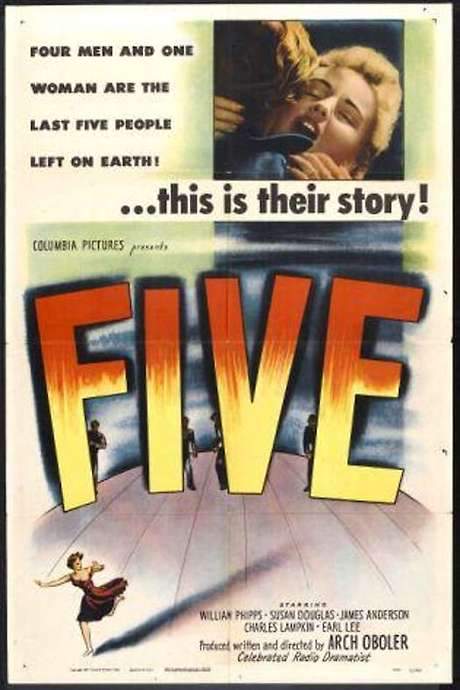
Five (1951) movie poster

Plot Summary

Five (1951) Plot Summary Explained

Release, runtime and language
1951 · 93 mins · English
JustWatch #14,576 14
Directed by
Arch Oboler
Starring
James Anderson, William Phipps, Charles Lampkin, Susan Douglas, Earl Lee

Four men and a woman are the last survivors after an atomic bomb wipes out humanity. They gather in an isolated hillside house, trying to understand the disaster and figure out how to stay alive together amid scarcity and the psychological strain of being the only people left.

On this page (6)
  1. 1 Where to watch
  2. 2 What happens: full plot
  3. 3 Plot questions answered
  4. 4 Movie threads
  5. 5 Movies like Five
  6. 6 Every angle

Where to watch

Where to Watch Five (1951)

Where can you watch Five? Stream, rent or buy it in the US, including on Artiflix, Eternal Family and Plex: current JustWatch availability with up-to-date prices.

Streaming availability powered by JustWatch

Full plot summary · contains spoilers

What Happens in Five: Full Plot Summary

The whole story of Five (1951) explained, from the opening scene to the final frame: every key event, every twist and what it all adds up to. Read it as a quick recap before the sequel, to check a scene you missed, or to finally understand what really happened.

Roseanne Rogers, Susan Douglas, trudges from place to place, searching for another living human being as a stark headline from a nearby newspaper warns that detonating a new kind of atomic bomb could push humanity toward extinction. Her journey leads her to her aunt’s isolated hillside house, where she faints upon discovering Michael, William Phipps, already living there. Initially, she is too numb to speak and slow to recover, but she gathers the courage to resist an attempted sexual assault and, in a quiet moment of honesty, reveals that she is married and pregnant.

Two more survivors arrive in a car, drawn by the smoke curling from the house’s chimney. Oliver P. Barnstaple, Earl Lee, an elderly bank clerk who clings to denial, acts as if he’s simply on vacation, while Charles, a thoughtful and affable African American man, Charles Lampkin, explains their survival: they were locked inside a bank vault when the catastrophe struck, or sheltered in a lead-lined X-ray room. Roseanne had been in a hospital’s lead-lined X-ray room, and Michael had been trapped in an elevator in New York’s Empire State Building.

Barnstaple grows sick, and Michael suspects radiation poisoning, though Barnstaple eventually seems to recover and longs to see the sea. The group soon drags a man named Eric, James Anderson, out of the ocean. A mountain climber, he recounts how a blizzard trapped him on Mount Everest and how he crawled down to base camp only to find everyone dead, then wandered across Asia and Europe to the sea, where more bodies lay. He eventually reached Hawaii by ship, finding only more corpses, and a plane ride home ends in fuel exhaustion near the United States. In the end, Barnstaple dies peacefully on the beach.

The next day, Charles helps Michael with a construction project, and Michael watches Roseanne bring food to the injured Eric. Michael suspects that Eric is exaggerating his condition and questions whether Roseanne should be running about for him. Eric’s presence quickly becomes divisive; he sows discord and theorizes that they are somehow immune to radiation, pushing the group to search for other survivors. Michael remains skeptical and warns that radiation will be most concentrated in the cities Eric wants to scour.

Eric also reveals a racist streak and clashes with Charles, who objects to his views. A confrontation erupts, and it stops only when Roseanne goes into labor; she delivers a boy with Michael acting as midwife. Afterward, while the others labor to build a new life, Eric retreats to his own space. He then vandalizes the group’s cultivated field by driving a jeep through it, destroying part of their crops. Michael orders him to leave, but Eric pulls a pistol and declares he will depart only on his own terms.

One night, Eric confides that he plans to head to the city, Oak Ridge. Hoping to learn what happened to her husband, Roseanne agrees to accompany him, though he insists she not tell Michael. After stealing supplies, Eric is challenged by Charles; a struggle ends with Charles being stabbed in the back and dying.

When they reach the city, Eric begins looting, while Roseanne seeks out her husband’s office and then his hospital waiting room. There she discovers his remains and longs to return to Michael, but Eric refuses to let her go. A struggle exposes Eric’s advanced radiation poisoning, and he runs away in despair.

Roseanne starts the long walk back to the hillside house, only to lose her baby along the way. Michael, who has been searching, eventually finds her. They bury their son and return to the house, where Michael quietly resumes tending the soil and Roseanne joins him, steady and resolute in the quiet life they cling to together.
Last updated: October 09, 2025 at 10:45

Was this helpful?

Plot questions answered

Five Plot Explained: Your Questions Answered

The questions people ask most about Five (1951): what happens in the confusing scenes, why the characters do what they do, the twists, hidden details and what the ending means. Each answer contains spoilers.

Q1

Why does Michael try to assault Roseanne when she arrives?

When Roseanne arrives at the house, Michael attempts to sexually assault her. This reflects the psychological deterioration and desperation that has set in after the apocalypse. Having been alone in the house since the disaster, Michael has succumbed to the psychological strain and isolation. Roseanne resists and reveals she is married and pregnant, which seems to snap him back to reality. This moment establishes the tension and moral complexity of the survivors' situation.

  • michael
  • roseanne
  • assault
  • psychological strain
  • survivors
Q2

How did each survivor escape the atomic bomb?

Each survivor escaped the bomb by being inside lead-lined shelters: Roseanne was in a hospital's lead-lined X-ray room, Michael was trapped in an elevator in New York's Empire State Building, and Charles was locked inside a bank vault. Eric, the mountain climber, was on Mount Everest when the disaster struck and survived because of his remote location. Barnstaple was also in a bank vault with Charles. The lead lining provided protection from the radiation.

  • atomic bomb
  • radiation
  • survivors
  • lead-lined
  • shelter
Q3

Why does Eric believe the survivors might be immune to radiation?

Eric suggests that they might be immune to radiation because they have all survived this long without showing severe symptoms. He uses this theory to justify his desire to search other cities for more survivors, particularly urging the group to go to urban areas. However, Michael warns that radiation would be most concentrated in cities. Eric's theory proves false when he himself shows advanced radiation poisoning symptoms later, demonstrating the danger of his reckless optimism.

  • eric
  • radiation
  • immunity
  • cities
  • survival
Q4

Why does Eric kill Charles?

Eric kills Charles during a struggle when they are traveling toward Oak Ridge. After stealing supplies, Charles confronts Eric, and the confrontation escalates into physical violence. Eric stabs Charles in the back, killing him. This murder is motivated by Eric's desire to continue his looting unchecked and his racist hostility toward Charles, combined with the desperate, lawless atmosphere of the post-apocalyptic world where social constraints have broken down.

Foreshadowing: Eric's racist attitudes and confrontations with Charles have been building throughout the story, foreshadowing this violent outcome.

  • eric
  • charles
  • murder
  • stabbing
  • oak ridge
Q5

Why does Roseanne agree to go to Oak Ridge with Eric?

Roseanne agrees to accompany Eric to Oak Ridge because she hopes to learn what happened to her husband, who lived in that city. Eric reveals he plans to go there, and Roseanne sees this as an opportunity to find closure. She keeps the plan secret from Michael because Eric insists she not tell him. Despite knowing Eric is dangerous and divisive, her desperation to discover her husband's fate outweighs her caution.

  • roseanne
  • eric
  • oak ridge
  • husband
  • search
Q6

What does Roseanne find in Oak Ridge?

In Oak Ridge, Roseanne searches her husband's office and then a hospital waiting room, where she discovers his remains. This confirms that her husband did not survive the disaster and perished in the city. The discovery brings her closure but also deepens her grief, as she now knows the fate of her family.

  • oak ridge
  • husband
  • remains
  • roseanne
  • death
Q7

How does Roseanne's baby die?

After Roseanne gives birth to a baby boy with Michael assisting, she and Eric travel to Oak Ridge. During the long walk back to the hillside house after Eric abandons her, Roseanne loses the baby. The exact circumstances of the baby's death are not detailed in the summary, but it occurs during her difficult solo journey back to Michael, adding another devastating loss to her character arc.

  • baby
  • roseanne
  • death
  • birth
  • loss
Q8

Why does Eric's racism cause conflict with Charles?

Eric's explicit racist attitudes create direct conflict with Charles, who is the only African American survivor. Eric's racism surfaces during confrontations, triggering heated arguments. This tension escalates throughout the story, particularly after Roseanne goes into labor during one of their confrontations. Eric's racial hostility ultimately contributes to his decision to murder Charles, representing the movie's exploration of how human cruelty persists even after civilization's collapse.

Foreshadowing: Eric's racist comments and confrontations with Charles build progressively, culminating in violence.

  • eric
  • charles
  • racism
  • conflict
  • confrontation
Q9

What causes Barnstaple's death?

Barnstaple becomes sick shortly after arriving at the house, and Michael suspects radiation poisoning. Although Barnstaple appears to recover initially and expresses a desire to see the sea, he eventually dies peacefully on the beach. His death represents the slow, invisible toll of radiation exposure that doesn't immediately manifest but eventually claims those who were even partially exposed.

  • barnstaple
  • radiation
  • death
  • beach
  • illness
Q10

Why does Eric destroy the group's crops with the jeep?

After Roseanne gives birth, Eric drives the group's jeep through their cultivated field, destroying part of their crops. This act of vandalism is motivated by his jealousy and resentment toward the others, particularly after they welcomed the newborn while he remains an outsider. Eric's destructive behavior demonstrates his growing alienation and hostility toward the community, further dividing the group.

  • eric
  • jeep
  • crops
  • destruction
  • sabotage
Q11

What does the ending mean for Michael and Roseanne?

After burying their dead child, Michael and Roseanne return to the hillside house together. Michael resumes tending the soil while Roseanne joins him, and they find solace in each other's company. The ending is bittersweet, they have survived and found a resolute partnership, but this hope is tempered by immense tragedy. Their quiet labor represents human resilience and the possibility of rebuilding, even after catastrophic loss.

  • ending
  • michael
  • roseanne
  • survival
  • hope
  • rebuild

Movie threads

More Movies Like Five, by Mood & Story

Curated lists built around what makes Five tick: the same mood, the same kind of story or the same emotional payoff. Each list explains why these movies belong together.

Post-apocalyptic character studies like Five

Stories where the end of the world becomes a backdrop for intense human drama. Discover movies like Five that prioritize human drama over action in a post-apocalyptic setting. If you liked the focus on psychological strain and interpersonal conflict among the last survivors, these similar slow-burn stories explore grief, morality, and the fragile bonds formed after the end.

  • post-apocalyptic
  • contemplative
  • somber
  • grief
  • isolated
  • tense
  • Tone: melancholic, somber, contemplative
  • Pacing: slow, deliberate
Why these movies?

The story pattern: Narratives in this thread typically follow a small group of survivors grappling with the immediate aftermath of a global catastrophe. The central conflict is often internal and interpersonal, driven by scarcity, trauma, and the challenge of forging new rules for living. The plot serves the character development.

Why they belong together: Movies are grouped here for their shared focus on the human element within a ruined world. They prioritize emotional weight, moral dilemmas, and the slow, arduous process of survival over fast-paced action or monster threats, creating a contemplative and somber experience.

Bittersweet survival stories like Five

Journeys where survival is achieved, but at a profound and lasting cost. Find films with endings similar to Five, where survival comes with a deep sense of loss. These movies like Five feature heavy emotional journeys where characters endure immense tragedy, and their continued existence is a fragile hope tempered by grief and sacrifice.

  • bittersweet
  • somber
  • grief
  • resigned
  • hopeful but sad
  • heavy
  • Tone: bittersweet, melancholic, resigned
  • Pacing: slow to steady
Why these movies?

The story pattern: The narrative arc involves characters overcoming extreme adversity, but the resolution is not purely triumphant. Survival is paired with irrevocable loss—of companions, innocence, or a past way of life. The ending acknowledges the strength to continue while honoring the pain of what was left behind.

Why they belong together: This thread groups movies based on their emotionally complex conclusions. They share a specific narrative and tonal pattern where the climax delivers on the survival goal but leaves the characters and audience with a lingering, poignant sadness, creating a deeply resonant and realistic feeling.

If you liked this

Movies Like Five

Similar movies to Five: the same genre, themes or kind of story. Each one comes with its own plot summary, timeline and ending explained.

Browse all movie summaries

Every angle

Five (1951) Explained: Plot, Timeline & Characters

Everything about Five in one place: what happens in the plot summary, the timeline in chronological order, the characters and meaning and a spoiler-free summary. What's After the Movie adds the cast, box office and post-credit scenes.

Coming soon on iOS and Android

The Plot Explained Movie Summary App

Plot summaries, endings explained and timelines on your phone. Catch up on any movie in minutes, save your favorites and never miss a twist again.

Be the first to know when we launch. Your email stays private, always.

Learn more about the app