Year: 2004
Runtime: 90 min
Language: English
Director: Wallace Wolodarsky
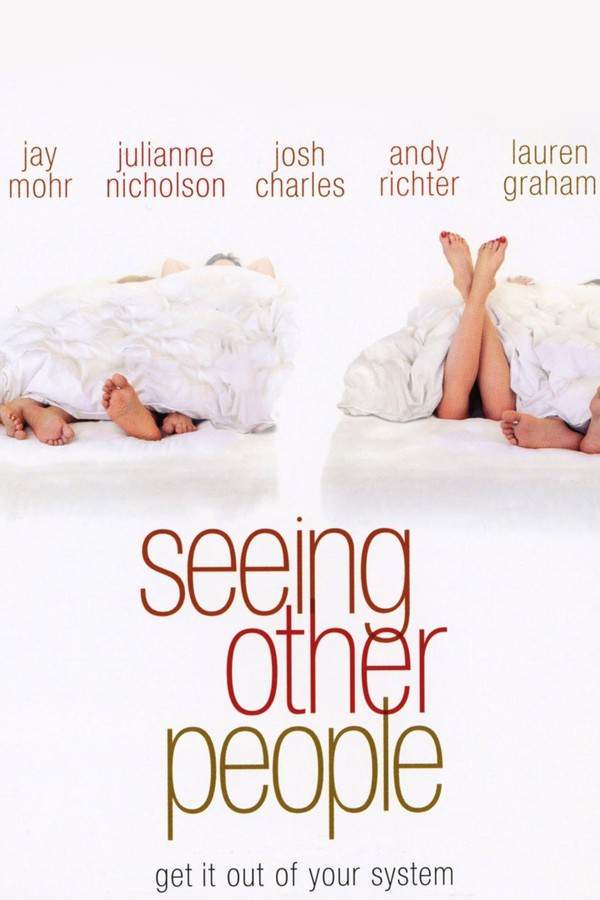
As a couple prepares for marriage, they decide to test their relationship with a prenuptial agreement that allows for open relationships. Ed and Alice explore other connections, hoping to spice up their impending nuptials. However, the initial excitement fades, and their experiment exposes vulnerabilities and unexpected consequences. They find themselves grappling with the challenges of temptation and the enduring pull of commitment, ultimately questioning the foundation of their relationship.
Warning: spoilers below!
Haven’t seen Seeing Other People yet? This summary contains major spoilers. Bookmark the page, watch the movie, and come back for the full breakdown. If you're ready, scroll on and relive the story!
Read the complete plot breakdown of Seeing Other People (2004), including all key story events, major twists, and the ending explained in detail. Discover what really happened—and what it all means.
As Ed and Alice navigate the complexities of their relationship, the passion that once united them has gradually diminished, replaced by a routine of simple joys, such as Saturday laundry and tender exchanges of affection. This shift becomes evident during their engagement party, where a fleeting interaction between Alice and a server ignites an awakening within her: a desire to explore her sexuality before fully committing to Ed.
At first, Ed is uncertain about the idea of expanding their boundaries, but he soon becomes open to adventure. Alice takes the initiative, engaging in a secret affair with Donald, a contractor who works with her friend. When Alice shares her escapade with Ed, his initial shock quickly transforms into excitement, and their intimate life is revitalized as they delve into new experiences together.
However, Ed’s attempts to reciprocate by pursuing an actress at work fall short, leading to feelings of inadequacy and frustration. Meanwhile, Alice embraces her attraction to Donald, who is clearly enamored with her. After their encounter, Alice confesses to Ed, who feels betrayed and hurt, prompting him to leave abruptly. Seeking comfort, he attends a house party thrown by his friend Carl but faces rejection in his attempts at casual encounters.
Back home, Ed finds Alice contemplating whether to abandon their arrangement. He reassures her that questioning their decisions is valid but insists they should continue exploring until both are completely satisfied. The next day, Ed finally succeeds in connecting with an actress, anticipating that Alice would react with jealousy. To his surprise, she is thrilled at the idea of further exploration together.
As their journey continues, Ed and Alice not only discover new desires but also notice a positive impact on their relationship. Simultaneously, Carl becomes interested in Penelope, a woman coping with a recent divorce. He offers his help in installing a new stereo for her and her son Jake, all while weaving through the complexities of his own romantic entanglements.
An unexpected reunion occurs when Ed finds himself dining alongside Alice and Donald at a restaurant, tension palpable in the air. Their conversation later reveals deeper issues; Ed is troubled by Alice’s bond with Donald, while she is frustrated by Ed’s numerous conquests that seem to stem from a fear of emotional attachment. Her argument strikes a chord with Ed, leading him to reconsider the path of his reckless lifestyle.
As Alice grows weary of Donald’s clinginess, Ed seeks a more meaningful connection with Sandy, who represents stability. However, just as feelings blossom, she exposes a darker inclination, suggesting they experiment with crack cocaine, a jarring revelation that casts their relationship in a disconcerting light.
In a twist of fate, Alice’s attempts to reconnect with Ed falter when she learns of his feelings for Sandy. In a moment of desperation to reclaim the past, Alice turns to her sister’s husband, Peter. This impulsive choice backfires dramatically when her sister appears, revealing her own betrayal with Ed’s friend Lou.
As chaos surrounds them, Ed finds himself abandoned after Sandy leaves with his car and a stash of crack, forcing him to wander the night in search of solace. This journey ultimately leads him back to Alice, where they sit together, facing the uncertainty of their relationship. In a touching moment, Ed reveals a book of stamps he had bought weeks before—a symbol of his affection for Alice and a reminder that despite the turmoil, there is always a glimmer of hope for renewal and redemption.
Last Updated: November 17, 2024 at 20:14
Discover curated groups of movies connected by mood, themes, and story style. Browse collections built around emotion, atmosphere, and narrative focus to easily find films that match what you feel like watching right now.
Couples who test their bonds through risky agreements, facing chaotic emotional consequences.If you liked Seeing Other People, explore more movies about couples testing their commitment. These films explore the emotional chaos of open relationships and prenuptial pacts, blending comedy with the bittersweet fallout of exploring temptation and love.
This thread follows a predictable arc: a stable or committed couple decides to challenge their relationship's boundaries, leading to a period of exciting but destabilizing exploration. The core conflict arises from the gap between expectation and reality, as jealousy and emotional distance create a crisis that forces the characters to confront what they truly want, often leading to an ambiguous resolution about their future.
Movies are grouped here for their shared focus on the deliberate destabilization of a romantic partnership. They share a medium emotional weight, a bittersweet tone balancing humor and pain, and a steady pacing that allows the emotional consequences of the 'experiment' to unfold realistically.
Romantic stories where love is laced with anxiety and the endings are realistically uncertain.Find movies similar to Seeing Other People that capture an anxious, bittersweet mood within a romantic comedy-drama framework. These stories explore love with a realistic edge, focusing on emotional fallout and uncertain futures rather than perfect fairy-tale endings.
The narrative pattern involves a central romantic relationship facing internal, rather than external, threats. The drama stems from the characters' own insecurities, miscommunications, or attempts to redefine their partnership. The journey is introspective, moving between tender connection and chaotic disconnection, and often concludes on a note of hopeful ambiguity, reflecting the ongoing work required in real relationships.
This grouping is defined by a specific emotional mix: the relatable anxiety of navigating love, balanced by a bittersweet tone that avoids pure cynicism or saccharine sentimentality. The pacing is steady, allowing for character depth, and the emotional weight is substantial enough to feel meaningful without being overwhelming.
Don't stop at just watching — explore Seeing Other People in full detail. From the complete plot summary and scene-by-scene timeline to character breakdowns, thematic analysis, and a deep dive into the ending — every page helps you truly understand what Seeing Other People is all about. Plus, discover what's next after the movie.
Track the full timeline of Seeing Other People with every major event arranged chronologically. Perfect for decoding non-linear storytelling, flashbacks, or parallel narratives with a clear scene-by-scene breakdown.
Discover the characters, locations, and core themes that shape Seeing Other People. Get insights into symbolic elements, setting significance, and deeper narrative meaning — ideal for thematic analysis and movie breakdowns.
Get a quick, spoiler-free overview of Seeing Other People that covers the main plot points and key details without revealing any major twists or spoilers. Perfect for those who want to know what to expect before diving in.
Visit What's After the Movie to explore more about Seeing Other People: box office results, cast and crew info, production details, post-credit scenes, and external links — all in one place for movie fans and researchers.
Discover movies like Seeing Other People that share similar genres, themes, and storytelling elements. Whether you’re drawn to the atmosphere, character arcs, or plot structure, these curated recommendations will help you explore more films you’ll love.
Seeing Other People (2004) Scene-by-Scene Movie Timeline
Seeing Other People (2004) Movie Characters, Themes & Settings
Seeing Other People (2004) Spoiler-Free Summary & Key Flow
Movies Like Seeing Other People – Similar Titles You’ll Enjoy
The Other Side of the Bed (2003) Movie Recap & Themes
Made for Each Other (2009) Detailed Story Recap
Sleeping with Other People (2015) Story Summary & Characters
10 Rules for Sleeping Around (2014) Ending Explained & Film Insights
30 Nights (2018) Spoiler-Packed Plot Recap
Wedding Swingers (2018) Spoiler-Packed Plot Recap
Just Sex and Nothing Else (2005) Full Summary & Key Details
Sex, Love, and Other Perversions (2006) Complete Plot Breakdown
Sex and the Other Man (1995) Full Movie Breakdown
The Other Man (1994) Full Movie Breakdown
Married People, Single Sex (1994) Plot Summary & Ending Explained
Group Marriage (1973) Detailed Story Recap
Why Not! (1977) Movie Recap & Themes
The Marriage of a Young Stockbroker (1971) Complete Plot Breakdown
Splitsville (2025) Full Summary & Key Details