Year: 2014
Runtime: 319 min
Language: English
Director: Matthew Barney
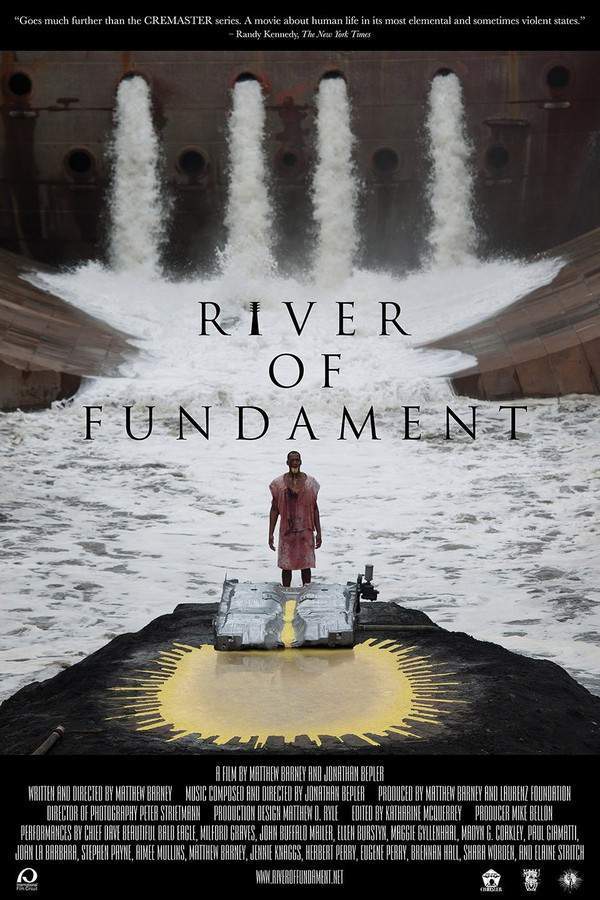
This avant-garde film follows two souls on a transformative journey across America. Loosely inspired by Norman Mailer's novel Ancient Evenings, the story intertwines the experiences of a man representing Mailer himself and a mysterious automobile. The narrative blends documentary footage, live performances, and cinematic storytelling to explore themes of rebirth and cultural change, set against the backdrop of urban decay and evolving landscapes.
Warning: spoilers below!
Haven’t seen River of Fundament yet? This summary contains major spoilers. Bookmark the page, watch the movie, and come back for the full breakdown. If you're ready, scroll on and relive the story!
Read the complete plot breakdown of River of Fundament (2014), including all key story events, major twists, and the ending explained in detail. Discover what really happened—and what it all means.
In Brooklyn Heights, a wake is held in honor of the late author Norman Mailer. The atmosphere is filled with melodious performances as friends and prominent figures from New York City’s cultural and literary scene gather to pay their respects. Among the guests, the spirit of Norman I, portrayed by John Buffalo Mailer, emerges from the mystical River of Feces, a supernatural conduit hidden beneath the family’s brownstone. As he ascends to his own wake, he’s warmly greeted by his Ka spirits, embodied by Matthew Barney and Aimee Mullins, who escort him during his ethereal visit.
Through a vivid flashback, we see a ritual conducted at a Chrysler dealership in Los Angeles, where Norman I is symbolically represented by a battered 1967 Chrysler Imperial, culminating in a ceremonial procession to its resting place in a showroom. Back at the Brooklyn wake, unable to communicate with his widow, Joan La Barbara, he connects with Ptah-Nem-Hotep, a Pharaoh played by Paul Giamatti, who reveals his envy toward Norman’s past interactions with the legendary Pharaoh Usermare, represented by Stephen Payne. Their dialogue reveals a mutual understanding, contemplating their reliance on mystical practices — particularly their use of feces to gain wisdom and power. Norman I is then reintroduced to Hathfertiti, played by Madyn G. Coakley, who helps him access a portal back to the River of Feces for his rebirth.
In the second act, Norman II, portrayed by Milford Graves, arises from the River of Feces as an experienced shamanistic sorcerer. An adult Hathfertiti, now portrayed by Maggie Gyllenhaal, greets him in their home, where the wake grows increasingly somber. Another flashback takes us to Detroit, where Norman II is visualized as a gold 1979 Pontiac Firebird Trans Am amidst a reenactment of the myth of Isis and Osiris, with Aimee Mullins and Matthew Barney playing these pivotal roles. The conflict between Nephthys and Set unfolds as mythology and domestic strife intertwine, leading to dramatic events. Isis, played by Jennie Knaggs, and her sister Nephthys race against time to recover Osiris’s body, encountering both challenges and triumphs as the intricate narrative of divine rebirth continues.
Act III brings us back to the Mailer House, witnessing Usermare return to find a nearly deserted wake, with only Hathfertiti remaining. In a bittersweet reunion, she reveals her identity as his daughter, defending her lifelong dedication to her father’s shadowy pursuits. Meanwhile, Norman II prepares for his resurgence from the River of Feces. In a separate tale, the spirit of Norman III, embodied as a 2001 Ford Crown Victoria Police Interceptor, readies for his ascension.
As the narrative culminates in a dramatic showdown between Horus, played by Brennan Hall, and Set within the high-energy atmosphere of Brooklyn, decisions are made, allegiances are tested, and the very essence of family and legacy is challenged. Hathfertiti, now older and facing her mortality, remains steadfast in her magical beliefs, ultimately choosing the earth’s supernatural energy over her royal lineage. Her final sleep signifies the end of her journey, while Usermare, consumed by despair from her rejection, irrevocably forsakes his past.
The circular narrative closes with Norman III, now played by Chief Dave Beautiful Bald Eagle, attempting to navigate his identity amid loss and confusion. Ultimately, he becomes trapped in the portal, signaling the end of the Norman lineage. The act concludes far away, at Idaho’s Sawtooth Mountain Range, weaving nature’s resilience into the tapestry of this surrealistic journey.
Last Updated: October 25, 2024 at 09:52
Discover curated groups of movies connected by mood, themes, and story style. Browse collections built around emotion, atmosphere, and narrative focus to easily find films that match what you feel like watching right now.
Avant-garde films where symbolic acts and intense imagery explore death and rebirth.For viewers who appreciated the intense ritualism of River of Fundament. This list features movies like River of Fundament that use avant-garde techniques, symbolic reenactments, and immersive soundscapes to explore deep themes of transformation and decay in a similar, challenging style.
Narratives in this thread are often circular or fragmented, structured around powerful symbolic acts rather than linear plots. They follow characters or entities through transformative ordeals, exploring concepts of death, rebirth, and legacy through a lens of artistic ritual. The journey is internal and metaphysical as much as it is external.
These films are grouped together because they share a commitment to avant-garde expression, a focus on ritual as a narrative device, and a willingness to use intense, often graphic, imagery to provoke deep contemplation on existential themes. They create a unique, immersive, and demanding viewing atmosphere.
Slow, heavy films where journeys through decaying landscapes reveal a bleak destiny.If you were captivated by the heavy, decaying atmosphere of River of Fundament, explore these similar movies. Find other slow-paced, emotionally heavy films with bleak endings that paint epic visions of urban decay, failed legacies, and the grim cycles of life and death.
Stories in this thread are often sprawling and complex, mapping a character's journey against a backdrop of pronounced decay—be it urban, societal, or personal. The narrative arc typically leads to the dissolution of hope, the collapse of ambition, and a final, unflinching acceptance of a bleak and inevitable end, leaving a profound sense of heaviness.
These movies are united by their shared focus on decay as a central theme, their emotionally heavy and slow-burn presentation, and their commitment to a bleak and unambiguous ending. They create a powerful, somber mood that lingers, offering a coherent experience of profound pessimism and thematic weight.
Don't stop at just watching — explore River of Fundament in full detail. From the complete plot summary and scene-by-scene timeline to character breakdowns, thematic analysis, and a deep dive into the ending — every page helps you truly understand what River of Fundament is all about. Plus, discover what's next after the movie.
Track the full timeline of River of Fundament with every major event arranged chronologically. Perfect for decoding non-linear storytelling, flashbacks, or parallel narratives with a clear scene-by-scene breakdown.
Discover the characters, locations, and core themes that shape River of Fundament. Get insights into symbolic elements, setting significance, and deeper narrative meaning — ideal for thematic analysis and movie breakdowns.
Get a quick, spoiler-free overview of River of Fundament that covers the main plot points and key details without revealing any major twists or spoilers. Perfect for those who want to know what to expect before diving in.
Visit What's After the Movie to explore more about River of Fundament: box office results, cast and crew info, production details, post-credit scenes, and external links — all in one place for movie fans and researchers.