Plot Explained Spoilers guaranteed!
Plot Explained

Browse by genre

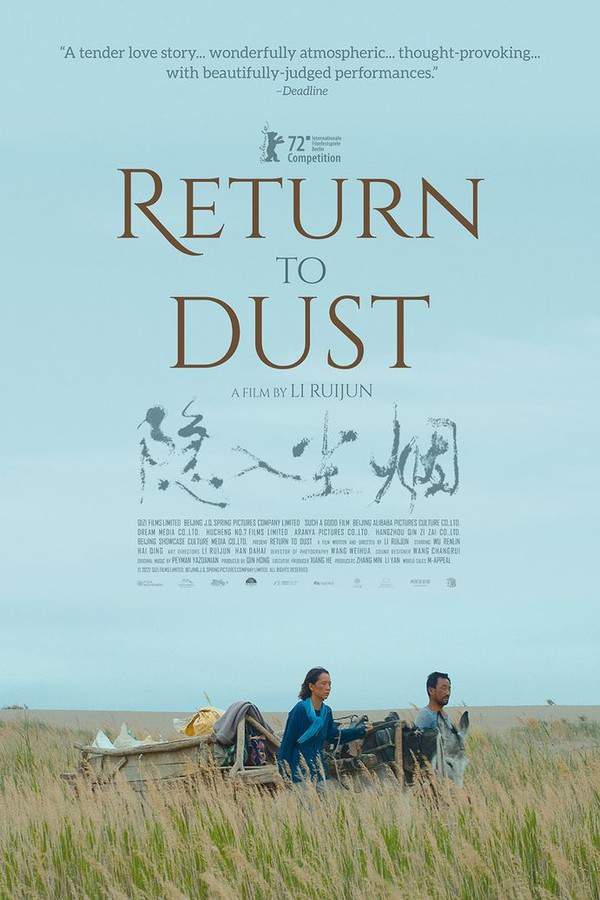
Return to Dust (2023) movie poster

Plot Summary

Return to Dust (2023) Plot Summary Explained

Release, runtime and language
2023 · 134 min · Chinese
Echo score 90
Loading streaming availability…
Directed by
Ruijun Li
Starring
Hai-Qing, Cailan Wang, Caixia Xu, Cuilan Wang, Dengping Zhao, Guangrui Yang

In rural Gaotai county, Ma and Cao, two individuals from different backgrounds, find themselves unexpectedly joined in a hastily arranged marriage. They build a simple home on harsh, barren land, and initially struggle to make a living. However, their crops surprisingly flourish, reflecting the gradual development of an unlikely connection between them. As time passes and seasons change, their bond deepens, but external forces and the inevitable march of progress threaten to disrupt their peaceful, burgeoning life.

On this page (4)
  1. 1 Where to watch
  2. 2 What happens: full plot
  3. 3 Movie threads
  4. 4 Every angle
Loading streaming availability…

Full plot summary · contains spoilers

What Happens in Return to Dust: Full Plot Summary

The whole story of Return to Dust (2023) explained, from the opening scene to the final frame: every key event, every twist and what it all adds up to. Read it as a quick recap before the sequel, to check a scene you missed, or to finally understand what really happened.

Set against the rustic and harsh landscape of rural Gansu during the year 2011, the story unfolds as a poignant exploration of love and hardship. It centers on the lives of Ma Youtie, played by Renlin Wu, a humble and impoverished farmer who lives a life of extreme simplicity, and Cao Guiying, portrayed by Hai-Qing. Guiying is a middle-aged woman who has faced a lifetime of adversity; she is disabled, incontinent, and infertile. Because of these challenges, she has suffered systemic mistreatment from her own family and has surpassed the traditional age for marriage in rural Chinese society.

Despite their societal standing, their families arrange a marriage between the two. What begins as a marriage of convenience gradually evolves into a deep emotional bond, characterized by genuine closeness and a rare tenderness that provides both of them with a sense of belonging. Together, they navigate their daily existence, farming the land with the help of their loyal donkey. Initially, the couple finds shelter in one of the many abandoned properties within their village. However, their stability is short-lived. The original owner of the house, who had long since migrated to Shenzhen for work, returns unexpectedly. His return is motivated by greed, as he discovers a government incentive offering substantial cash payments to homeowners whose poorly constructed, unoccupied houses are demolished.

Forced to move once again, Youtie and Guiying relocate to another vacant property before deciding to take their destiny into their own hands by building their own homestead. With a spirit of resilience, they construct a home using mud bricks they manufacture themselves and old wooden posts salvaged from the ruins of other demolished buildings.

Parallel to their domestic struggles, Youtie becomes entangled with a powerful local businessman who requires frequent blood transfusions. Because Renlin Wu's character shares a rare blood type with the businessman, he is repeatedly called upon to donate blood to save the wealthy man's life. In exchange for these life-saving donations, the businessman's family provides Youtie with cheap gifts. Demonstrating his integrity and lack of materialism, Youtie refuses to treat these as gifts, accepting them only as borrowed items. During this time, his brother, Zhanhong Ma, suggests that he and Guiying move into a modern high-rise public housing apartment. However, the couple finds this option completely impractical, as the apartment cannot accommodate the farm animals essential to their survival.

Tragedy strikes when Guiying falls ill. In an act of care, Youtie insists that she rest while he goes out to work. While out, he encounters a group of locals lounging unconcernedly by an irrigation canal. They casually inform him that Guiying had been searching for him to deliver some food, but that she felt dizzy and accidentally fell into the water, where she drowned. Devastated by the loss of his companion, Youtie desperately jumps into the canal to retrieve her lifeless body.

In the wake of this tragedy, Youtie moves through his days in a state of quiet grief. He finishes his harvest, frees his faithful donkey, and sells all his worldly possessions to clear his remaining debts. He departs from his usual habit of saving seeds for the next planting season, signaling a loss of hope for the future. Even in his final act of commerce, he is exploited; the buyer cheats him by rounding down the price, claiming it is simply “to make the bookkeeping easier.”

As he prepares Guiying's body for burial, Youtie performs a heartbreaking gesture, pressing grains of corn into her hand to leave a mark. He had previously explained that through this specific mark, he would always feel a connection to her. In a final, somber scene, Youtie lies down next to some smoldering charcoal, his body shaking uncontrollably, strongly implying that he has committed suicide.

The aftermath is cold and clinical. His few remaining belongings are hauled away in a handcart, and a government official pays Zhanhong Ma for the permission to demolish the small house that Youtie and Guiying had built with their own hands—the only place where they experienced true happiness. The loyal donkey is seen returning to the ruins of the house on its own, ignored and unwanted by everyone.

Due to strict censorship in China, the ending of the film was modified. In the revised version, the explicit act of taking poison is removed, though a bottle remains on the altar dedicated to Guiying. Furthermore, a confusing plot point was added where a character claims Youtie is moving to a city apartment, despite the implication of his death. A final line of text was eventually added to the credits to satisfy authorities, stating:

> "Ma Youtie moved to his new home in the winter of 2011 and started his new life with the help of the government and the warm-hearted villagers."
Last updated: October 19, 2026 at 19:41

Was this helpful?

Movie threads

More Movies Like Return to Dust, by Mood & Story

Curated lists built around what makes Return to Dust tick: the same mood, the same kind of story or the same emotional payoff. Each list explains why these movies belong together.

Tragic outcast romances like Return to Dust

Marginalized souls find each other, only for the world to tear them apart. If you loved Return to Dust's tender yet tragic love story, these are the movies like Return to Dust for you. They follow two overlooked, marginalized people who find brief, fragile happiness together before indifferent fate, exploitation, or systemic cruelty pulls them apart. These quiet, devastating love stories focus on connection over spectacle, dignity over romance, and shared labor over grand gestures.

  • doomed love
  • outcasts
  • rural poverty
  • fragile tenderness
  • bleak romance
  • quiet grief
  • Tone: bleak, melancholic
  • Pacing: slow
Why these movies?

The story pattern: Two people from society's margins — often disabled, poor, or otherwise considered unfit for normal life — are joined by circumstance, sometimes through an arranged or transactional bond. They slowly build a small, self-contained world through farming, building, or simple domestic care. The narrative traces their growing bond through small ordinary gestures rather than declarations. External forces then dismantle what they built: illness, economic shock, social violence, displacement. The romance arc is intimate rather than passionate, and the tragedy lies less in fate than in how easily the world ignores two people trying to live.

Why they belong together: They share protagonists the audience is invited to care about precisely because they have been told they do not matter, a slow accumulation of small kindnesses that constitutes the love story, and a sense that the wider world is indifferent or actively hostile. The settings are usually rural, impoverished, or otherwise off the grid of mainstream life, and the emotional arc almost always tilts toward grief.

Slow rural dramas like Return to Dust

Slow-burn rural dramas where seasons change and hope quietly dies. If you liked Return to Dust, try these slow, atmospheric rural dramas where quiet observation of agricultural life masks deep sadness. Movies like Return to Dust track people clinging to barren land, fighting poverty, exploitation, and displacement, with pacing that mirrors the changing seasons and emotional weight that builds toward devastating, unresolved conclusions.

  • rural poverty
  • seasonal
  • displacement
  • agricultural
  • melancholic
  • quiet devastation
  • Tone: bleak, mournful
  • Pacing: slow, meditative
Why these movies?

The story pattern: A rural community, family, or pair of individuals faces hardship — poverty, debt, illness, exploitation, the encroachment of modernization. The narrative unfolds slowly across seasons, marked by the rhythms of physical labor and the slow turning of the land. Conflicts creep in rather than explode: an unpaid loan, a relative's disability, a bulldozer on the horizon. Characters endure without dramatic confrontation, and endings tend toward resignation, loss, or unanswered grief. Beauty and brutality sit in the same frame.

Why they belong together: They share a meditative pacing that mirrors rural life, an emphasis on physical labor and landscape as emotional register, a focus on people outside the urban mainstream, and a willingness to let sadness accumulate rather than resolve. The experience is less about plot turns than about attunement to place, and to the people whose lives are bound to that place.

Every angle

Return to Dust (2023) Explained: Plot, Timeline & Characters

Everything about Return to Dust in one place: what happens in the plot summary, the timeline in chronological order, the characters and meaning and a spoiler-free summary. What's After the Movie adds the cast, box office and post-credit scenes.

Coming soon on iOS and Android

The Plot Explained Movie Summary App

Plot summaries, endings explained and timelines on your phone. Catch up on any movie in minutes, save your favorites and never miss a twist again.

Be the first to know when we launch. Your email stays private, always.

Learn more about the app