Plot Explained Spoilers guaranteed!
Plot Explained

Browse by genre

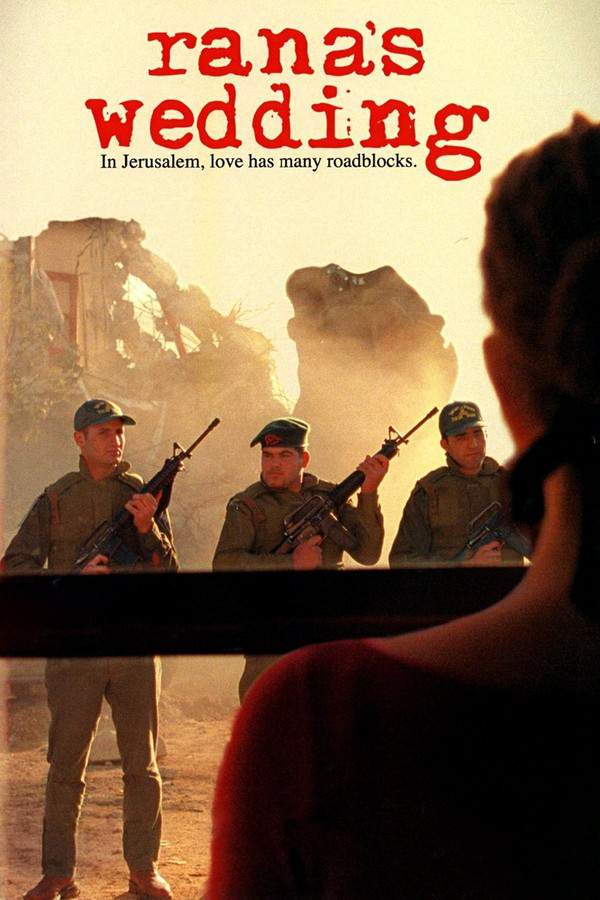
Rana's Wedding (2003) movie poster

Plot Summary

Rana's Wedding (2003) Plot Summary Explained

Release, runtime and language
2003 · 90 min · Arabic
Loading streaming availability…
Directed by
Hany Abu-Assad

Set against the backdrop of Jerusalem, a young woman named Rana is given a difficult choice: accept a marriage proposal or leave the city with her father to Egypt. Facing numerous obstacles, including Israeli checkpoints and the complexities of Islamic law, she embarks on a journey to discover her own independence and fight for her right to choose her own path and future.

On this page (5)
  1. 1 Where to watch
  2. 2 What happens: full plot
  3. 3 Plot questions answered
  4. 4 Movie threads
  5. 5 Every angle
Loading streaming availability…

Full plot summary · contains spoilers

What Happens in Rana's Wedding: Full Plot Summary

The whole story of Rana's Wedding (2003) explained, from the opening scene to the final frame: every key event, every twist and what it all adds up to. Read it as a quick recap before the sequel, to check a scene you missed, or to finally understand what really happened.

Rana, a 17-year-old girl residing in Palestine, finds her life turned upside down when her father makes a significant decision due to the chaotic living conditions. He chooses to relocate the family to Egypt to better support them financially. Upon waking one day, Rana discovers a letter from her father laying out two choices: she can either accompany him to Egypt and continue her education under his supervision or remain in Palestine and marry an approved suitor from a list he has provided. However, she has just 10 hours to decide before her father's departure.

Initially taken aback by the limited options, Rana feels a wave of disappointment. Determined to make her own choice, she decides instead to flee her home in search of her beloved Khalil, who has not made her father's list of acceptable partners. After an exhausting search, she finds him at a theater, where he is engaged in directing a play.

Rana urgently proposes marriage to Khalil, pushing for a prompt answer so they can wed prior to her father's trip. With the help of a sheikh, they plan to drive to her father's house to seek his consent. Much to her father’s surprise, he finds no justification under Islamic law to halt the marriage, ultimately relenting.

As the clock ticks down and Rana's father prepares to leave for Egypt, tensions escalate with the sheikh still absent for the ceremony. Desperate to find him, Rana, Khalil, and her father embark on a journey to locate the sheikh, who is delayed due to a roadblock. In a moment of urgency, they exchange vows inside the car, culminating in a vibrant celebration on the streets of Jerusalem.

The film elegantly concludes with the poignant words of Palestinian poet Mahmoud Darwish: > "In every act of failure, there’s an act of love."

Last updated: November 15, 2024 at 15:42

Was this helpful?

Plot questions answered

Rana's Wedding Plot Explained: Your Questions Answered

The questions people ask most about Rana's Wedding (2003): what happens in the confusing scenes, why the characters do what they do, the twists, hidden details and what the ending means. Each answer contains spoilers.

Q1

Why does Rana's father decide to move the family to Egypt?

Rana's father decides to relocate the family to Egypt because of the chaotic living conditions in Palestine. He believes moving will provide better financial support and a more stable future for his family. This decision creates the central conflict of the film, as it forces Rana to make a difficult choice within a very short timeframe.

Foreshadowing: Earlier scenes show the difficult daily life in Palestine, establishing why the father feels compelled to seek a better life elsewhere.

  • father
  • egypt
  • relocation
  • palestine
  • family
Q2

What is the significance of the 10-hour time limit?

The 10-hour deadline represents the window before Rana's father departs for Egypt. This tight timeframe creates urgency and drives the entire narrative forward, forcing Rana to make a life-altering decision quickly rather than having time to negotiate or delay.

Foreshadowing: The story establishes early that Rana's father is already packed and ready to leave, making the time constraint feel immediate.

  • time limit
  • deadline
  • urgency
  • departure
Q3

Why does Rana refuse to choose from her father's suitor list?

Rana refuses her father's list of approved suitors because she is already in love with Khalil, who is notably absent from that list. Rather than accept an arranged marriage or simply leave with her father to Egypt, she chooses to take control of her own fate and pursue the relationship that matters to her.

Foreshadowing: Rana's emotional reaction to the letter and her immediate determination to find Khalil reveal her refusal to accept her father's options.

  • khalil
  • love
  • arranged marriage
  • suitor list
  • independence
Q4

How does Islamic law factor into the father's approval of the marriage?

When Rana and Khalil approach Rana's father with the help of a sheikh, the father discovers there is no valid grounds under Islamic law to reject their marriage. This legal justification compels him to relent and give his consent, as he cannot justify refusing the marriage according to religious law.

Foreshadowing: The sheikh's involvement from the beginning suggests that religious authority will play a role in resolving the conflict.

  • islamic law
  • sheikh
  • religious approval
  • marriage consent
Q5

How does Rana manage to find Khalil at the theater?

After discovering her father's letter, Rana embarks on an exhaustive search for Khalil across Palestine. Despite the challenges of navigating through checkpoints and the difficulties of searching without modern communication, she eventually locates him at a theater where he is directing a play.

Foreshadowing: The earlier scene of Rana's desperation and determination sets up her willingness to go to great lengths to find him.

  • khalil
  • theater
  • search
  • director
Q6

Why is the sheikh delayed and unable to perform the ceremony on time?

The sheikh is delayed due to a roadblock that prevents him from reaching the agreed location. This delay creates mounting tension as Rana's father prepares to leave for Egypt, forcing the characters to make a desperate decision about how to proceed without the religious official.

Foreshadowing: The escalating time pressure and the sheikh's absence build throughout the latter part of the film.

  • sheikh
  • roadblock
  • delay
  • ceremony
Q7

Why does the wedding take place inside the car?

With the sheikh delayed and time running out before Rana's father must leave for Egypt, Rana, Khalil, and her father make the spontaneous decision to exchange vows inside the car. This desperate measure allows them to complete the marriage before the deadline, despite the absence of the sheikh.

Foreshadowing: The mounting pressure and ticking clock create the conditions for this improvised ceremony.

  • wedding
  • car
  • vows
  • spontaneous ceremony
Q8

Why does Rana's father ultimately agree to the marriage?

Rana's father agrees to the marriage after the sheikh explains that Islamic law provides no legitimate reason to block the union. Additionally, witnessing Rana's determination and her willingness to defy societal expectations to pursue love moves him to accept the marriage rather than force her to choose between losing her or leaving.

Foreshadowing: The father's initial shock at their request gradually gives way to recognition of their genuine connection.

  • father approval
  • marriage
  • khalil
  • acceptance
Q9

What role do Israeli checkpoints play in the story?

The Israeli checkpoints throughout Jerusalem create additional obstacles and tension during Rana's quest. These barriers represent the broader political reality of Palestinian life, adding external pressure to an already time-sensitive situation and highlighting the challenges faced by characters navigating the city.

Foreshadowing: The film's setting in Jerusalem establishes the political context from the opening scenes.

  • checkpoints
  • jerusalem
  • israeli barriers
  • obstacles
Q10

What does the Mahmoud Darwish quote at the end mean?

The closing quote from Palestinian poet Mahmoud Darwish states that "in every act of failure, there's an act of love." This poetic conclusion reflects the film's themes of perseverance and love triumphing over adversity, suggesting that despite the difficult circumstances and potential failures the characters faced, their love for each other and their pursuit of autonomy represents a meaningful victory.

Foreshadowing: The entire narrative buildup of obstacles and the characters' determination to overcome them prepares the viewer for this thematic resolution.

  • mahmoud darwish
  • quote
  • poem
  • ending
  • meaning

Movie threads

More Movies Like Rana's Wedding, by Mood & Story

Curated lists built around what makes Rana's Wedding tick: the same mood, the same kind of story or the same emotional payoff. Each list explains why these movies belong together.

Romantic races against time like Rana's Wedding

High-pressure journeys where love must conquer a ticking clock. Movies like Rana's Wedding that feature a fast-paced, urgent quest for love against a ticking clock. If you enjoyed the determined spirit and high-stakes obstacles in Rana's Wedding, you'll find similar romantic dramas and comedies where characters fight against time for their happy ending.

  • urgent
  • tense
  • romantic
  • determined
  • chaotic
  • hopeful
  • Tone: hopeful, tense, determined
  • Pacing: fast, urgent
Why these movies?

The story pattern: This narrative follows a linear 'mission' structure where the protagonist has a clear, time-sensitive objective, often related to love or commitment. The plot is propelled forward by a series of escalating challenges that test the character's resolve, culminating in a satisfying and earned resolution.

Why they belong together: Movies are grouped here by their shared high-stakes pacing, the central role of romance as the driving goal, and the unifying theme of a character's determined fight against external pressures for a personal victory.


Stories about personal choice and cultural barriers like Rana's Wedding

Stories of individuals asserting their independence within a restrictive societal framework. If you liked Rana's Wedding's theme of a young woman fighting for her future within a specific cultural context, explore these similar dramas. These movies focus on characters making pivotal life choices while navigating family pressure, tradition, and societal obstacles.

  • determined
  • hopeful
  • tense
  • thought-provoking
  • cultural
  • independent
  • Tone: hopeful, determined, tense
  • Pacing: steady, character-driven
Why these movies?

The story pattern: The narrative pattern is a coming-of-age journey where the central conflict is external societal pressure versus internal personal desire. The protagonist must learn to navigate or challenge the rules of their world, leading to a climax that affirms their autonomy and redefines their place within their community.

Why they belong together: These films share a focus on the universal struggle for individuality within a defined cultural system, blending medium emotional weight with a ultimately hopeful tone about the possibility of personal triumph.

Every angle

Rana's Wedding (2003) Explained: Plot, Timeline & Characters

Everything about Rana's Wedding in one place: what happens in the plot summary, the timeline in chronological order, the characters and meaning and a spoiler-free summary. What's After the Movie adds the cast, box office and post-credit scenes.

Coming soon on iOS and Android

The Plot Explained Movie Summary App

Plot summaries, endings explained and timelines on your phone. Catch up on any movie in minutes, save your favorites and never miss a twist again.

Be the first to know when we launch. Your email stays private, always.

Learn more about the app