Plot Explained Spoilers guaranteed!
Plot Explained

Browse by genre

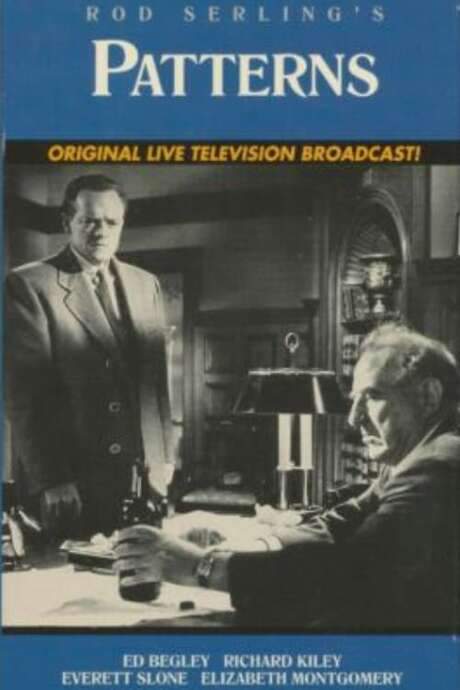
Patterns (1955) movie poster

Timeline

Patterns (1955) Timeline Explained – Every Event in Order

Release, runtime and language
1955 · 53 mins · English
Loading streaming availability…
Directed by
Fielder Cook
Starring
Joanna Roos, Ed Begley, Richard Kiley, Elizabeth Wilson, Everett Sloane, Helen Ludlam

“Patterns” began as an American live television play aired on January 12, 1955 and was adapted into a film the following year with several original cast members. Fred Staples, the newest executive at a large corporation, befriends Vice‑President Andy Sloane, his nominal supervisor. Their hard‑nosed president, Walter Ramsey, praises Staples’ performance, then offers him Sloane’s position—a role Sloane has sacrificed his family for. As Ramsey’s machinations become clear, Sloane refuses to resign, and a tragic crisis forces Staples to choose between ambition and conscience.

On this page (5)
  1. 1 Where to watch
  2. 2 Events in order (12)
  3. 3 Timeline questions answered
  4. 4 Movie threads
  5. 5 Every angle
Loading streaming availability…

12 events in order · contains spoilers

Patterns Timeline: Events in Chronological Order

Every key event of Patterns (1955) in order, scene by scene, with when and where it takes place. Use it to untangle flashbacks, time jumps and parallel storylines, to refresh your memory before the sequel or to find the exact scene you are thinking of.

  1. Ramsey takes command of Ramsey & Company

    Walter Ramsey ruthlessly oversees Ramsey & Company, continuing the legacy he inherited from his father. He runs the Manhattan-based industrial empire with a hard-edged, modern approach focused on profit and expansion. The film establishes his authority and sets the tone for the power struggles to come.

    Where
    Manhattan headquarters
  2. Staples joins as top executive

    Walter Ramsey brings Fred Staples, a young industrial engineer, into the top ranks after seeing his impressive performance at an Ohio factory Ramsey acquired. Staples is initially unaware of the true motive to groom him as Briggs' eventual replacement. Ramsey hopes Staples will be groomed to replace Briggs as second-in-command.

    Where
    Ramsey & Company headquarters
  3. Briggs, a 40-year veteran, is revered yet strained

    Briggs has dedicated four decades to the firm and still admires the founder. He values people and careful work, often clashing with Ramsey's ruthless, modern mindset. His loyalty to the old ways sets up the upcoming power struggle.

    Where
    Company offices
  4. Ramsey sabotages Briggs to push him toward resignation

    To avoid firing him outright, Ramsey undermines Briggs through tactics designed to erode his position and confidence. He tries to humiliate Briggs in front of the board and management during negotiations, widening the rift between them. The maneuvering foreshadows the personal and professional costs of the leadership battle.

    Where
    Ramsey & Company offices
  5. Stress takes a toll on Briggs' health

    The strain of the corporate power play leads Briggs to drink and further damages his health. He witnesses the creeping hostility from the leadership and refuses to give in to Ramsey's game. His deteriorating condition foreshadows the high personal stakes in the conflict.

    Where
    Briggs' home and hospital
  6. Staples torn between loyalty and ambition

    Staples sympathizes with Briggs and his ideals but is tempted by the offer of leadership. His wife supports him yet pressures him to weigh his choices carefully. The personal conflict pits his conscience against corporate advancement.

    Where
    Staples' home
  7. Boardroom confrontation and Briggs' legacy discussed

    Briggs and Staples present a report that balances old-fashioned ideals with practical needs. Ramsey publicly praises Staples for translating Briggs' ideas into feasible plans, signaling a test of Staples' loyalty. The heated exchange hints at the looming personal and professional stakes.

    Where
    Boardroom, Ramsey & Company HQ
  8. Briggs collapses after the room leaves

    Shortly after walking out of the meeting, Briggs collapses from the stress and is rushed to the hospital. His collapse is a direct result of the conflict and the pressure from Ramsey's tactics. He later dies in the hospital, removing the direct obstacle to Ramsey's plan.

    Where
    Hospital
  9. Staples considers quitting after Briggs' death

    Fed up with the toxic power struggle and the pressure from Ramsey, Staples contemplates telling Ramsey off and resigning. He weighs the personal and professional costs of staying in a role that may compromise his ethics. The moment marks a potential turning point in the leadership succession.

    Where
    Ramsey & Company offices
  10. Ramsey offers Briggs' job and rewards to Staples

    Ramsey doubles Staples' salary and stock options and grants an unlimited expense account, trying to secure his loyalty. He insists that Staples would be essential to the company's continued success and that he can reach his full potential under Ramsey's leadership. Staples faces a critical choice between power and principle.

    Where
    Ramsey's office
  11. Staples resists becoming a 'whipping boy'

    Staples rejects the idea of becoming a tool to bolster Ramsey's control and expresses his unwillingness to submit to the ruthless dynamic. He makes clear he would challenge Ramsey and pursue the presidency if needed. This exchange redefines the power balance and preserves his autonomy.

    Where
    Ramsey's office
  12. Staples commits to stay in hopes of reform

    Despite the ominous offer, Staples tells his wife that he will stay at Ramsey & Company, believing there is at least a chance to influence change from within. Ramsey, energized by a capable challenger, accepts this arrangement as a necessary spark. The film ends with the uneasy alliance as Staples prepares to navigate the future.

    Where
    Home and Ramsey & Company HQ

Last updated: October 09, 2025 at 10:46

Was this helpful?

Timeline questions answered

Patterns Timeline Explained: Your Questions Answered

When does it happen, and why in that order? The questions people ask about the chronology of Patterns (1955): time jumps, flashbacks, cause and effect between scenes and the correct order of events, each answered with spoilers.

Q1

Why did Walter Ramsey want to force Bill Briggs out of the company?

Walter Ramsey wanted Bill Briggs out because the veteran executive's humane, people-first approach clashed with Ramsey's ruthless, profit-driven business philosophy. Rather than firing Briggs outright after 40 years of service, Ramsey deliberately undermined him through humiliation and pressure, hoping to push him to resign rather than tarnish his own reputation by terminating a loyal employee.

Foreshadowing: Ramsey's initial praise of Staples at the Ohio factory hints at his strategy of replacing old-guard employees with younger, more compliant executives.

  • walter ramsey
  • bill briggs
  • corporate firing
  • power struggle
  • executive removal
Q2

What caused Bill Briggs to collapse and die?

Bill Briggs died from the cumulative stress of Ramsey's systematic campaign against him. After being humiliated at the board meeting where Ramsey praised Staples and implied Briggs' ideas were outdated, Briggs walked out, collapsed from the strain, and died at the hospital. His drinking had already weakened his health, making him vulnerable to the psychological toll of the corporate battle.

Foreshadowing: Earlier scenes show Briggs drinking at home and expressing frustration with Ramsey's tactics, indicating his deteriorating condition.

  • bill briggs death
  • stress
  • board meeting collapse
  • hospital
Q3

Why did Fred Staples decide to stay at Ramsey & Company?

Fred Staples decided to stay because he believed he could influence the company from within rather than simply walking away. Despite being offered double salary, stock options, and an unlimited expense account, the key factor was Ramsey's challenge that Staples could reach the presidency if he stayed and continued challenging Ramsey's methods.

Foreshadowing: Staples' earlier sympathy for Briggs and his willingness to challenge Ramsey in meetings foreshadow his belief that he can reform the company from inside.

  • fred staples stay
  • corporate ambition
  • reform from within
  • presidency
Q4

Why did Walter Ramsey bring in Fred Staples to replace Bill Briggs?

Walter Ramsey chose Fred Staples because he saw him as the ideal younger executive to implement his modern, heartless business approach. Staples had impressed Ramsey with his performance at an Ohio factory that Ramsey had acquired, where he demonstrated the ability to make hard decisions. Ramsey needed someone compliant enough to follow his ruthless methods but skilled enough to run the company effectively.

Foreshadowing: The opening scenes establishing Staples' reputation at the Ohio factory directly set up Ramsey's interest in recruiting him.

  • fred staples
  • walter ramsey
  • grooming successor
  • y executive
Q5

What offer did Walter Ramsey make to Fred Staples after Briggs died?

After Briggs' death, Walter Ramsey offered Fred Staples the now-vacant executive position at double his current salary, with double stock options and an unlimited expense account. When Staples hesitated, Ramsey escalated by suggesting Staples could eventually become president if he stayed and challenged Ramsey rather than simply becoming his "whipping boy."

Foreshadowing: Ramsey's earlier strategy of using financial incentives to secure loyalty predicts this elaborate offer designed to tie Staples to the company.

  • salary offer
  • stock options
  • unlimited expense account
  • corporate bribe
Q6

Why did Fred Staples almost quit before accepting the promotion?

Fred Staples nearly quit because he was deeply disturbed by how Ramsey had treated Bill Briggs and what the older man's death represented, the human cost of corporate ambition. Staples went to Ramsey's office intending to resign, repulsed by the toxic environment and Ramsey's manipulation. However, Ramsey's counteroffer and challenge caused Staples to reconsider and ultimately stay.

Foreshadowing: Scenes of Staples discussing the situation with his wife Fran and expressing sympathy for Briggs foreshadow his decision to confront Ramsey about his methods.

  • resignation
  • quit
  • conscience
  • briggs death impact
Q7

What was the conflict between Bill Briggs and Walter Ramsey about?

The conflict between Bill Briggs and Walter Ramsey centered on fundamentally opposed business philosophies. Briggs, who had worked for the company founder, believed in prioritizing people and careful, ethical work. Ramsey represented a modern, ruthless approach focused solely on profit and expansion. This clash made Briggs an obstacle to Ramsey's vision, leading Ramsey to systematically undermine him rather than work with someone whose values diametrically opposed his own.

Foreshadowing: The opening establishing Ramsey's hard-edged management style immediately sets up his inevitable conflict with the old-guard values Briggs represents.

  • bill briggs
  • walter ramsey
  • business philosophy conflict
  • values clash
Q8

Why was the board meeting significant in pushing Briggs out?

The board meeting was significant because Ramsey publicly used it to further humiliate Briggs while appearing reasonable. When Briggs and Staples presented their joint report, Ramsey praised Staples for transforming Briggs' "well-intentioned but unworkable" ideas into something practical. This publicly diminished Briggs' value, triggered a heated exchange, and directly contributed to the stress that caused Briggs' collapse shortly after leaving the meeting.

Foreshadowing: Ramsey's earlier private conversations with Staples about replacing Briggs foreshadow this public maneuver.

  • board meeting
  • humiliation
  • public criticism
  • report presentation
Q9

What moral dilemma did Fred Staples face throughout the movie?

Fred Staples faced a moral dilemma between his ambition and his conscience. He was torn between accepting the lucrative opportunity to rise in the company, a position that required him to essentially take Briggs' place in a corrupt system, or maintaining his ethical principles by leaving. His wife Fran reflected this tension, pressuring him to weigh his choices carefully while also representing the temptation of advancement.

Foreshadowing: Early scenes showing Staples' sympathy for Briggs versus his excitement about the new position establish this central conflict.

  • fred staples moral conflict
  • ambition vs conscience
  • ethical choice
  • corporate ethics

Movie threads

More Movies Like Patterns, by Mood & Story

Curated lists built around what makes Patterns tick: the same mood, the same kind of story or the same emotional payoff. Each list explains why these movies belong together.

Corporate Psychological Dramas like Patterns

Stories where professional ambition clashes with moral decay in high-stakes offices. If you liked the tense corporate pressure and moral conflict in Patterns, explore more movies like it. This collection features dramas and thrillers set in the workplace, focusing on power struggles, ambition, and the heavy cost of climbing the corporate ladder.

  • corporate pressure
  • morally conflicted
  • anxious
  • psychological manipulation
  • power struggle
  • workplace ethics
  • Tone: tense, morally complex
  • Pacing: steady, deliberate
Why these movies?

The story pattern: These stories typically follow a protagonist, often a newcomer or an idealist, entering a powerful organization. They quickly uncover a culture of ruthless competition and ethical compromise, often personified by a manipulative authority figure. The central conflict is internal—a battle between personal ambition and the conscience—as the character witnesses or is pressured to participate in the systematic destruction of a colleague.

Why they belong together: Movies in this thread are united by their setting—the corporate world—and their focus on psychological tension over physical action. They share a mood of professional anxiety, moral conflict, and the oppressive feeling of being trapped in a system that rewards ruthlessness. The pacing is often steady, methodically building dread through conversations and boardroom confrontations.

Movies with Bittersweet Moral Stands like Patterns

Narratives where a character chooses to fight a corrupt system from within, at a personal cost. For viewers who appreciated the complex ending of Patterns, where the hero stays to fight from within. These films feature similar narratives where characters make heavy moral choices, resulting in endings that are neither fully triumphant nor completely bleak.

  • morally ambiguous
  • bittersweet
  • institutional critique
  • personal sacrifice
  • ethical struggle
  • hopeful yet cynical
  • Tone: tense, bittersweet
  • Pacing: steady, building
Why these movies?

The story pattern: The narrative pattern involves a character confronted with the profound corruption of an institution they are part of. After a crisis that highlights the human cost of this corruption, they face a clear choice: escape or engage. Choosing to stay and reform the system from the inside is presented as a difficult, morally ambiguous path. The conclusion acknowledges the gravity of the compromise, offering a sliver of hope overshadowed by cynicism about the system's inherent flaws.

Why they belong together: These films are grouped by a specific character arc and a particular emotional payoff. They share a focus on internal conflict, the theme of institutional corrosion, and an ending feel that is decidedly bittersweet. The experience is one of thoughtful tension, leading to a conclusion that lingers due to its realistic ambiguity.

Every angle

Patterns (1955) Explained: Plot, Timeline & Characters

Everything about Patterns in one place: what happens in the plot summary, the timeline in chronological order, the characters and meaning and a spoiler-free summary. What's After the Movie adds the cast, box office and post-credit scenes.

Coming soon on iOS and Android

The Plot Explained Movie Summary App

Plot summaries, endings explained and timelines on your phone. Catch up on any movie in minutes, save your favorites and never miss a twist again.

Be the first to know when we launch. Your email stays private, always.

Learn more about the app