Plot Explained Spoilers guaranteed!
Plot Explained

Browse by genre

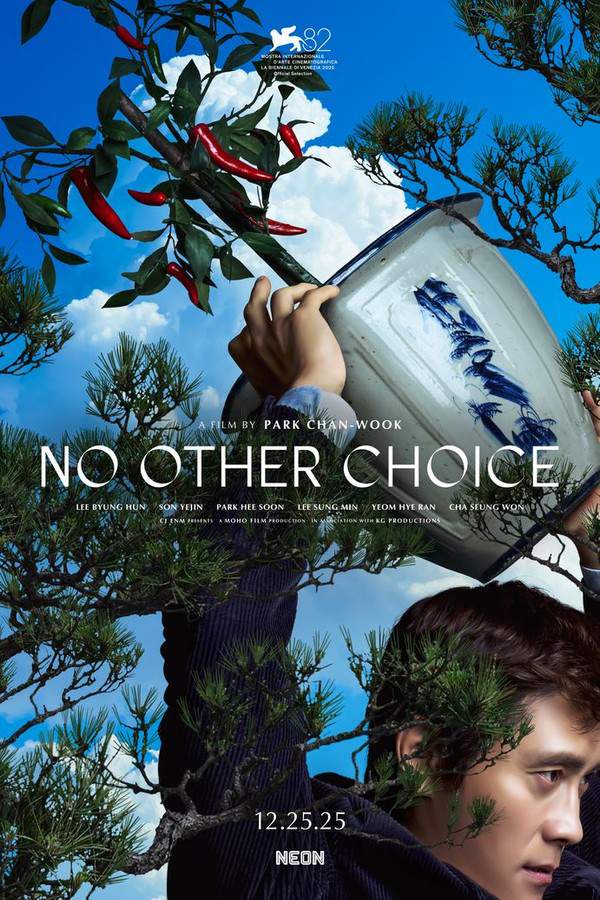
No Other Choice (2025) movie poster

Ending Explained

No Other Choice (2025) Ending Explained – Final Scene & Meaning

Release, runtime and language
2025 · 2 h 19 m · Korean
Echo score 87
Directed by
Park Chan-wook
Starring
Derek Chouinard, Lee Byung-hun, Lee Sung-min, Yoo Yeon-seok, Kim Hae-sook, Yeom Hye-ran
Budget
$12.2M

After 25 years as a paper mill supervisor, Man‑su loses his job when the plant is bought by foreign owners. Unable to find new work, he and his family must slash their lifestyle drastically. Desperate to impress at his next interview, Man‑su resorts to eliminating his rivals, wondering how far he will go when there is no other choice.

On this page (5)
  1. 1 What happens at the end
  2. 2 Final events in order
  3. 3 Ending questions answered
  4. 4 Movie threads
  5. 5 Every angle

Ending explained · contains spoilers

What Happens at the End of No Other Choice?

How No Other Choice (2025) ends, what the final scene means, which earlier moments set it up and how to read the ending if the film leaves it open. The full ending explained, with every spoiler.

Man‑Su finally succeeds in eliminating the last two rivals who threaten his precarious position at the paper mill. After a tense showdown in the greenhouse, he disposes of Seon‑Chul, buries the body in the front yard and covers it with an apple tree he and Mi‑Ri plant together. The camera lingers on the newly sprouted tree while a light, almost celebratory melody plays, giving the impression of a fresh start.

At the dinner table the family pretends everything is back to normal. Mi‑Ri smiles, the children chatter, and Man‑Su suggests a pork‑barbecue—yet the younger child, Ri‑One, nervously remarks that “the bugs are eating it alive,” hinting that the hidden corpse is still gnawing at their peace. The police, misled by Ah‑Ra’s testimony that the murder weapon belonged to her dead husband, focus their investigation on Bum‑Mo rather than Man‑Su, allowing him to walk away unscathed.

Meanwhile, the professional world that drove Man‑Su’s desperation has already moved on. The paper mill is now run by automated AI‑systems, leaving no workers for him to supervise. In the final interview at the rival company Moon Paper, he no longer clutches the red notes he once wrote on his palm; the camera shows his clean hands and a freshly grown moustache, signalling that he has shed his obsessive need to script every move. Yet the victory feels hollow—he has killed the competition, secured a superficial façade of stability, but the very job he coveted no longer exists, and the memory of the three murders will forever haunt him.

Thus the ending is both triumphant and tragic. Man‑Su achieves the “no other choice” he convinced himself he had, but the price is a family that lives with a secret, a career that has vanished, and a moral void that no celebratory music can erase. The smiles and cello music mask an underlying absurdity: he is free, yet bound by the invisible threads of guilt, loss, and an ever‑changing world that rendered his sacrifice meaningless.

Last updated: December 27, 2025 at 20:28

Was this helpful?

The last 4 events

How No Other Choice Ends: The Final Events in Order

The last events of No Other Choice (2025) in chronological order, the run-up to the ending explained above. The complete timeline has all 14 events, scene by scene.

Open the full timeline
  1. Si-jo on the highway; Man-su shoots

    Man-su visits Si-jo, who sells shoes; on a highway, Man-su reluctantly shoots Si-jo dead and hides the corpse in his car. This deepens the police’s suspicions and expands the body count.

    When
    On the highway after Beom-mo's death
    Where
    Highway and Man-su's car
  2. iPhones theft, arrest, and blackmail

    Si-one and Geon-ho steal iPhones from Geon-ho's father’s store but are arrested by the police. Man-su and Mi-ri later blackmail Geon-ho's father to take responsibility and let Si-one go.

    When
    Shortly after Si-jo's murder
    Where
    Geon-ho's father's store; home
  3. Detectives and the Beom-mo/Si-jo disappearances

    Detectives warn Man-su about Beom-mo and Si-jo’s disappearances, linking them to their shared circumstances. Si-one witnesses Man-su attempting to dismember Si-jo’s corpse and Mi-ri digs up Si-jo’s grave but lies to protect Si-one.

    When
    After the killings
    Where
    Home / police scene
  4. Moon Paper hire and final twist of suspicion

    Moon Paper hires Man-su to replace Seon-chul, securing his home and reuniting the family with their dogs as Ri-one’s behavior improves. Detectives later reveal that A-ra implicated Beom-mo as a gunowner, lifting residual suspicion from Man-su.

    When
    After the hiring
    Where
    Moon Paper; home

Ending questions answered

No Other Choice Ending: Your Questions Answered

The questions people ask most about the ending of No Other Choice (2025): what the final scene means, how the twist works, what happens to each character and how to read the ending. Each answer contains spoilers.

Q1

What happens to Seon-Chul in the ending?

Man-Su kills Seon-Chul during a tense showdown in the greenhouse. He disposes of the body by burying it in the front yard, then plants an apple tree over the grave with Mi-Ri, making the burial site appear to be a family project rather than a crime scene.

Foreshadowing: Earlier scenes show Man-Su methodically eliminating each rival, and the greenhouse confrontation follows his established pattern.

  • seon-chul death
  • greenhouse scene
  • burial
  • apple tree
Q2

Why does the police focus on Bum-Mo instead of Man-Su?

Ah-Ra testifies that the murder weapon belonged to her dead husband, leading investigators to incorrectly suspect Bum-Mo. Man-Su walks away completely unscathed because the police accept the false evidence and target the wrong person.

Foreshadowing: Ah-Ra had previously stolen the weapon from Man-Su's workshop, making her testimony inadvertently frame her husband.

  • police investigation
  • ah-ra testimony
  • bum-mo arrested
  • murder weapon
Q3

What happens to the job Man-Su killed for?

By the time Man-Su completes his final interview at Moon Paper, the paper mill has already transitioned to fully automated AI-run systems. The position he murdered three people to secure no longer exists, rendering his crimes meaningless.

Foreshadowing: The movie hints at technological changes in the industry throughout, showing Man-Su's desperation in an evolving job market.

  • moon paper
  • automation
  • ai systems
  • job loss
  • paper mill closure
Q4

What does the final dinner scene mean?

The family pretends normalcy at dinner while covering up Man-Su's crimes. The younger child Ri-One's comment that "the bugs are eating it alive" about the pork directly references the hidden corpse, symbolizing how the murder continues to haunt their household despite the表面的 normalcy.

Foreshadowing: The planted apple tree and the fresh soil in the yard foreshadow this moment of uneasy domesticity.

  • dinner scene
  • ri-one
  • bugs eating
  • family secret
  • 掩盖
Q5

What do Man-Su's clean hands and new moustache symbolize?

In the final interview at Moon Paper, Man-Su no longer clutches the red notes he used to write on his palm. His clean hands and freshly grown moustache represent his shedding of obsessive control. However, this personal growth is undercut by the hollow victory, he's evolved past his desperation, but for a job that no longer exists.

Foreshadowing: Throughout the film, Man-Su's palm notes symbolize his desperate need to script every move.

  • clean hands
  • moustache
  • red notes
  • palm writing
  • obsession
  • transformation
Q6

Why does the ending feel bittersweet?

Man-Su achieves his goal, he secured the job and saved his home, but the victory is hollow. He has three murders on his conscience, his family lives with a secret, his career has vanished due to automation, and the celebratory music masks a deep moral void. He got exactly what he wanted, but it means nothing.

Foreshadowing: The light, almost celebratory melody over the apple tree planting contrasts with the dark reality of what underlies that moment.

  • bittersweet ending
  • man-su victory
  • moral void
  • hollow success
  • tragedy
Q7

Why does Man-Su plant an apple tree over Seon-Chul's grave?

Planting the apple tree with Mi-Ri serves as both practical cover for the burial and a twisted symbol of "fresh start" for the family. The camera lingers on the newly sprouted tree with celebratory music, suggesting renewal, though this optimism is deeply corrupted by the murder beneath it.

Foreshadowing: The greenhouse confrontation leads directly to the burial scene, making the tree planting feel like a perverse culmination of Man-Su's deception.

Q8

What are the consequences of Man-Su's three murders?

Man-Su successfully eliminates his rivals and avoids legal consequences, but he loses his moral integrity. His family is now complicit in a secret that will haunt them, as evidenced by Ri-One's disturbing comment at dinner. The murders achieve nothing since the job market has already moved on to automation.

Foreshadowing: Each murder throughout the film tightens the psychological toll on Man-Su and his family.

  • three murders
  • consequences
  • guilt
  • family secret
  • Bum-Mo Seon-Chul
Q9

How does automation contribute to the ending's irony?

The automated AI systems running the paper mill represent the dystopian reality that mocks Man-Su's entire journey. He killed three people to compete in a job market that's already obsolete, highlighting the absurdity of his extreme measures in a world that no longer needs human workers.

Foreshadowing: The film consistently shows the economic pressures driving Man-Su to desperate measures.

  • automation
  • ai
  • job market
  • irony
  • technology
  • unemployment

Movie threads

More Movies Like No Other Choice, by Mood & Story

Curated lists built around what makes No Other Choice tick: the same mood, the same kind of story or the same emotional payoff. Each list explains why these movies belong together.

Movies about crime for survival like No Other Choice

Ordinary people commit dark acts to escape financial ruin. If you liked the dark premise of No Other Choice, explore these films about ordinary people driven to crime by desperation. Discover similar stories of moral compromise, high-stakes criminal plans, and the heavy emotional weight of doing the unthinkable to save yourself or your family.

  • desperate
  • tense
  • anxious
  • grim
  • unsettling
  • high-stakes
  • Tone: dark, tense, cynical
  • Pacing: steady, methodical
Why these movies?

The story pattern: Narratives in this thread typically follow a protagonist facing an insurmountable financial or social crisis. They devise a risky, often violent plan as their only perceived way out, leading to a steady escalation of tension as they execute their scheme while navigating the threat of exposure and their own crumbling conscience.

Why they belong together: These movies are grouped by their shared core premise: a desperate individual's turn to crime as a last resort. They share a dark tone, high emotional stakes, and a focus on the psychological unraveling that comes with crossing moral boundaries for survival.


Movies with bittersweet victories like the ending of No Other Choice

Stories where success is achieved, but at a profound personal price. Fans of the complex ending in No Other Choice will appreciate these films about pyrrhic victories. Find similar stories where characters achieve their goals but are left scarred by the journey, exploring themes of sacrifice, moral cost, and the true price of ambition.

  • bittersweet
  • contemplative
  • somber
  • costly win
  • moral ambiguity
  • emotional weight
  • Tone: bittersweet, grim, contemplative
  • Pacing: steady
Why these movies?

The story pattern: The narrative arc follows a character striving for a clear objective, often through morally questionable means. The climax sees them succeed in their aim, but the resolution emphasizes the destruction left in their wake—lost relationships, shattered morals, or a compromised future—leaving the audience with a poignant mix of relief and sorrow.

Why they belong together: These films are united by their emotionally complex, bittersweet endings. They resonate with viewers who appreciate stories that reject simple happy conclusions, instead focusing on the heavy, often tragic costs associated with ambition and survival.

Every angle

No Other Choice (2025) Explained: Plot, Ending, Timeline & Characters

Everything about No Other Choice in one place: what happens in the plot summary, the timeline in chronological order, the characters and meaning, the ending explained and a spoiler-free summary. What's After the Movie adds the cast, box office and post-credit scenes.

Coming soon on iOS and Android

The Plot Explained Movie Summary App

Plot summaries, endings explained and timelines on your phone. Catch up on any movie in minutes, save your favorites and never miss a twist again.

Be the first to know when we launch. Your email stays private, always.

Learn more about the app