Plot Explained Spoilers guaranteed!
Plot Explained

Browse by genre

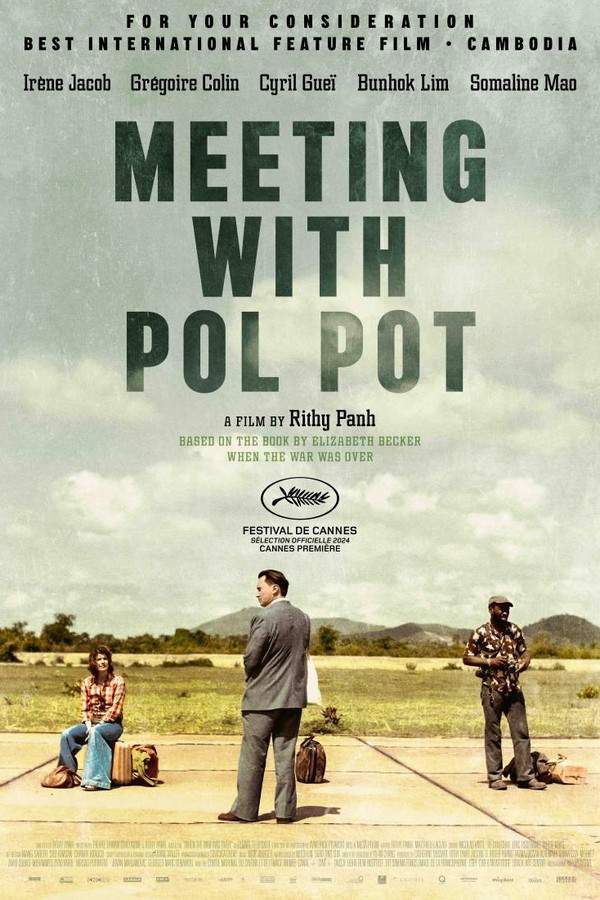
Meeting with Pol Pot (2025) movie poster

Timeline

Meeting with Pol Pot (2025) Timeline Explained – Every Event in Order

Release, runtime and language
2025 · 1 h 52 m · French
Echo score 78
Loading streaming availability…
Directed by
Rithy Panh
Starring
Irène Jacob, Grégoire Colin, Cyril Gueï, Bun-Hok Lim, Leng Thirith, Sovann Nhoeb

In 1978, three French journalists are granted a rare opportunity to interview Pol Pot, the leader of Democratic Kampuchea. Initially, the country appears to be a utopian ideal. However, the journalists soon discover a disturbing reality: the Khmer Rouge regime is facing a severe decline and is on the brink of invasion by Vietnam. The interview becomes a tense and revealing glimpse behind a carefully constructed facade, exposing the fragility of the regime and the suffering of the Cambodian people.

On this page (5)
  1. 1 Where to watch
  2. 2 Events in order (15)
  3. 3 Timeline questions answered
  4. 4 Movie threads
  5. 5 Every angle
Loading streaming availability…

15 events in order · contains spoilers

Meeting with Pol Pot Timeline: Events in Chronological Order

Every key event of Meeting with Pol Pot (2025) in order, scene by scene, with when and where it takes place. Use it to untangle flashbacks, time jumps and parallel storylines, to refresh your memory before the sequel or to find the exact scene you are thinking of.

  1. An Exclusive Invitation

    In 1978, three French journalists—Lise, Alain, and Paul—are invited by the Khmer Rouge to visit Democratic Kampuchea. The regime offers them the rare opportunity to conduct an exclusive interview with its leader, Pol Pot. The journalists arrive as guests of a government eager to control its image before the outside world.

    When
    1978
    Where
    Democratic Kampuchea (Cambodia)
  2. A Carefully Staged Tour

    In the days leading up to their meeting with Pol Pot, the journalists are led through a series of orchestrated encounters. Every stop is designed to present the revolutionary state as a resounding success. Their hosts closely control everything the visitors are permitted to see and hear.

    Where
    Democratic Kampuchea (Cambodia)
  3. Divided Perspectives

    The journalists react very differently to the regime's choreographed presentation. Alain, a communist, appears highly credulous of the government's claims of success. Lise and Paul, by contrast, grow deeply skeptical and begin to notice evidence of deception around them.

  4. Lise's Frustration Grows

    Lise becomes increasingly frustrated by the restrictions imposed on the visit. Their hosts refuse to let the group travel to the countryside or to meet specific individuals with whom she had contact prior to the revolution. The constant obstruction only deepens her suspicions about what is being hidden.

  5. Paul Slips Away

    Defying their escorts, Paul slips away from the group and ventures out alone. He walks through the jungle, far from the carefully managed itinerary. He is determined to witness the country's true conditions behind the staged facade.

    Where
    Cambodian jungle
  6. Evidence in the Jungle

    During his unauthorized walk, Paul comes across human remains and proof of the actual living conditions concealed by the government. The discovery confirms the deception that he and Lise had suspected all along. He documents the grim scene with his camera.

    Where
    Cambodian jungle
  7. Camera and Film Seized

    Soldiers confiscate Paul's camera and all of his film, attempting to erase the photographic evidence of the regime's atrocities. Unknown to them, one roll of film escapes their search. That roll will later surface in an unexpected place.

  8. The Hidden Roll of Film

    Lise discovers a roll of Paul's film hidden inside her typewriter. The photographs on it show the human remains that Paul found during his secret walk. The images become tangible proof of the horrors the regime is concealing from the world.

  9. Paul's Outburst

    Incensed by the blatant staging of the visit, Paul lashes out at the guards. His open confrontation with their hosts marks a dangerous escalation in the trip. It is the last time he is seen in the film.

  10. Paul Vanishes

    Paul disappears following his confrontation with the guards, and it is strongly implied that he was killed for his defiance. Lise and Alain are left to continue the visit without him, under the watchful eyes of their hosts. His fate casts a dark shadow over the remainder of their stay.

  11. Conflicting Explanations

    Cambodian party officials offer the two remaining journalists contradictory accounts of Paul's disappearance. They variously claim that he became lost in the jungle, was a spy for the CIA or KGB, or was a counterrevolutionary. The shifting stories make it clear the truth is being deliberately obscured.

  12. The Interview with Pol Pot

    Lise and Alain finally meet the regime's leader, Pol Pot, for their exclusive interview. The meeting is brief and heavily controlled, leaving little room for genuine scrutiny or challenging questions. Despite the constraints, the journalists come face to face with the man behind the regime.

  13. Alain's Private Audience

    Alain is granted a second, private audience with Pol Pot. During the conversation, he expresses ideological support for the aims of the Khmer Rouge. However, he also voices concerns about the regime's practices and doubts about the state's ability to succeed.

  14. Alain Is Silenced

    Later that night, Alain is shot by a soldier in his bedroom. The murder comes shortly after his private meeting with Pol Pot, in which he had raised concerns about the regime. His death leaves Lise as the only surviving journalist of the three.

    When
    Night
    Where
    Alain's bedroom
  15. Lise Departs Alone

    With both of her colleagues gone, Lise leaves the country alone. She carries with her the hidden photographs documenting the atrocities the regime tried to conceal. Her departure marks the grim end of the ill-fated press trip to Democratic Kampuchea.

    Where
    Democratic Kampuchea (Cambodia)

Last updated: October 20, 2026 at 01:18

Was this helpful?

Timeline questions answered

Meeting with Pol Pot Timeline Explained: Your Questions Answered

When does it happen, and why in that order? The questions people ask about the chronology of Meeting with Pol Pot (2025): time jumps, flashbacks, cause and effect between scenes and the correct order of events, each answered with spoilers.

Q1

Why did Paul disappear after confronting the Khmer Rouge guards?

Paul vanished because he openly lashed out at the guards once he understood the entire visit was a staged performance. He had already slipped away from the group to photograph human remains in the jungle, and his camera and film had been confiscated. His public defiance directly threatened the regime's carefully controlled narrative, making him too dangerous to leave alive. Cambodian officials later offered contradictory cover stories to disguise what was almost certainly his execution.

Foreshadowing: Paul's decision to slip away from his escorts earlier in the trip already marked him as a journalist willing to break the rules of the controlled visit.

  • paul disappearance
  • khmer rouge execution
  • journalist killed cambodia
  • controlled narrative
Q2

Why was Alain shot in his bedroom after meeting Pol Pot?

Alain was killed because his private audience with Pol Pot went beyond acceptable ideological praise. Although he expressed support for the Khmer Rouge's aims, he also voiced concerns about their practices and doubts about whether the state could survive. Those criticisms, voiced directly to the regime's leader, made him a liability despite his sympathies. The murder sent a clear signal that even partial dissent would not be tolerated, especially as the regime faced collapse.

Foreshadowing: Alain's willingness to engage sincerely with Pol Pot during the first interview foreshadowed his decision to speak more openly in the private meeting.

  • alain shot bedroom
  • private audience pol pot
  • khmer rouge silencing dissent
Q3

How did the roll of film from the jungle end up inside Lise's typewriter?

Soldiers confiscated Paul's camera and all of his film after his unauthorized walk, but they missed one roll. Paul had hidden it inside Lise's typewriter, and she discovered it there after his disappearance. The photographs it contained showed the human remains he had found in the jungle, giving Lise tangible proof of the atrocities the regime was trying to conceal. The hidden roll becomes the only surviving evidence of what Paul witnessed.

Foreshadowing: The film roll was concealed before Paul knew he was in immediate danger, suggesting he had been preparing for the possibility that his camera would be seized.

  • hidden film roll
  • lise typewriter
  • evidence khmer rouge atrocities
  • photographic proof
Q4

Why did the Khmer Rouge invite foreign journalists to interview Pol Pot in 1978?

The invitation was a propaganda tool. In 1978 the regime was facing a severe decline and the looming threat of a Vietnamese invasion, and it needed to project an image of success and stability to the outside world. By granting access to sympathetic or controllable foreign journalists, the Khmer Rouge hoped to generate favorable coverage that masked the reality of famine, forced labor, and mass killings. The tightly scripted nature of the visit reveals that the interview was meant as performance, not genuine transparency.

Foreshadowing: The very first staged encounters with the journalists already hinted that the visit was designed to manage perception rather than reveal truth.

  • khmer rouge propaganda
  • 1978 pol pot interview
  • regime image control
  • vietnamese invasion threat
Q5

Why were the journalists forbidden from visiting the countryside or specific individuals?

The countryside and Lise's pre-revolution contacts were off limits because they would expose the gap between the regime's propaganda and reality. Outside the choreographed tour route, the journalists could see the forced labor camps, emptied villages, and mass graves that defined Democratic Kampuchea. Restricting their access to figures Lise had known before 1975 would have revealed how many intellectuals, former officials, and ordinary Cambodians had already been purged. The refusals were therefore a defensive measure, not a logistical one.

Foreshadowing: Early refusals to let the group deviate from the itinerary already foreshadowed how tightly the regime controlled every aspect of the visit.

  • restricted access cambodia
  • khmer rouge countryside
  • journalist movement controls
  • lise contacts
Q6

Why did Cambodian officials give contradictory explanations for Paul's disappearance?

The shifting stories were meant to prevent the truth from ever being pinned down. Officials variously claimed Paul got lost in the jungle, was a CIA or KGB spy, or was simply a counterrevolutionary. Each explanation served a different purpose: the jungle story deflected blame onto nature, the spy allegations recast his curiosity as foreign subversion, and the counterrevolutionary label criminalized his defiance. The contradictions themselves reveal that the regime was improvising a cover story in real time rather than reporting facts.

Foreshadowing: The confiscation of Paul's camera and film earlier had already shown how far the regime would go to control what the journalists could prove.

  • paul disappearance explanations
  • khmer rouge cover story
  • counterrevolutionary label
  • spy accusations
Q7

Why did Lise survive while Paul and Alain were killed?

Lise survived because she had already been neutralized as a journalistic threat. The Khmer Rouge had seized Paul's camera and most of his film, and they did not yet know that Lise was carrying the hidden roll of evidence. Her hosts may also have calculated that killing all three foreign journalists would have caused an international incident they could not afford. By contrast, Paul had directly challenged the guards and Alain had openly raised doubts with Pol Pot, making both men immediate liabilities.

Foreshadowing: Lise's decision to keep her concerns largely private, in contrast to Paul's outburst, foreshadowed her survival.

  • lise survival
  • meeting with pol pot ending
  • journalist left alive cambodia
Q8

Why did Alain raise concerns about the regime during his private audience with Pol Pot?

Alain used the private meeting as a rare opening to speak honestly with the regime's leader, precisely because he had already established himself as ideologically sympathetic. As a committed communist, he believed the Khmer Rouge's revolutionary goals were worth defending, but he had also witnessed enough during the staged tour to question their methods. The private format gave him the illusion of safety, allowing him to push further than the brief public interview permitted. That openness is what made him dangerous in the eyes of the regime.

Foreshadowing: Alain's credulity during the staged tour had paradoxically earned him a second meeting, but it also meant his concerns would carry weight when he finally voiced them.

  • alain communist
  • pol pot private audience
  • ideological support khmer rouge
  • doubts about regime
Q9

What evidence of deception did Lise and Paul notice during the staged tour?

Lise and Paul picked up on several signs that the encounters were manufactured. The same groups of people seemed to reappear at different staged stops, rehearsed answers came back from interviewees, and officials deflected every request to deviate from the itinerary. The denial of access to the countryside and to individuals Lise had known before 1975 reinforced the sense that the regime was hiding something. These small inconsistencies accumulated into the conclusion that the entire visit was a performance rather than an honest introduction to Democratic Kampuchea.

  • staged encounters
  • khmer rouge propaganda tour
  • evidence of deception
  • orchestrated encounters
Q10

Why was the actual interview with Pol Pot so brief and tightly controlled?

The interview was deliberately kept short and scripted to avoid any unscripted revelations. By limiting the time, restricting the questions, and surrounding the encounter with officials, the regime ensured Pol Pot could present a polished image without being challenged on specific policies or atrocities. The format also denied the journalists the follow-up questions that could have exposed contradictions. In effect, it was a controlled performance staged for foreign audiences rather than a genuine press engagement.

Foreshadowing: The heavily chaperoned days before the interview already foreshadowed that the meeting itself would be tightly managed rather than open.

  • pol pot interview format
  • controlled press meeting
  • khmer rouge media management
Q11

Why does Lise leave Cambodia alone at the end of the film?

Lise leaves alone because her two colleagues are gone: Paul has been disappeared and Alain has been shot in his bedroom. With no remaining journalistic partners and no possibility of continuing the investigation inside the country, her only option is to carry out the hidden evidence and escape. Her solitary departure underscores how completely the regime has eliminated the press delegation, leaving her as the sole witness to bring the photographs back to the outside world.

Foreshadowing: The moment Lise discovered the hidden roll of film in her typewriter already foreshadowed that she, not her colleagues, would be the one to carry the story outward.

  • lise departure cambodia
  • final scene meeting with pol pot
  • solo journalist escape

Movie threads

More Movies Like Meeting with Pol Pot, by Mood & Story

Curated lists built around what makes Meeting with Pol Pot tick: the same mood, the same kind of story or the same emotional payoff. Each list explains why these movies belong together.

Journalists uncovering brutal regimes like in Meeting with Pol Pot

Outsiders witness atrocities the powerful want buried forever. If you were gripped by Meeting with Pol Pot, discover more political dramas and historical thrillers about journalists, foreign correspondents, or outsiders granted rare access to authoritarian regimes. These films follow investigators who peel back carefully constructed facades to expose genocide, oppression, and ideological delusion, often at great personal cost.

  • investigative
  • political
  • paranoid
  • oppressive
  • chilling
  • somber
  • Tone: dark, bleak, tense
  • Pacing: slow burn, methodical
Why these movies?

The story pattern: A small group of outsiders enters a tightly controlled environment believing they will witness a story or a cause. At first the surface appears coherent, even admirable, but each day of observation reveals small, then unmistakable cracks: disappeared people, staged encounters, contradictory accounts, and casual brutality. The protagonist's understanding shifts gradually from curiosity or sympathy to horror and complicity. The arc ends with a choice between speaking the truth and surviving, often resolved in tragedy or quiet escape.

Why they belong together: These films share an investigative journalism spine wrapped in political danger. They feature outsiders confronting ideology, restricted movement, surveillance, and the slow discovery that official narratives are lies. Pacing is deliberately methodical to mirror the process of uncovering truth, and the emotional register is heavy, somber, and often bleak. Viewers who want the experience of witnessing history from inside the nightmare will find their match here.

Oppressive slow burn dread like in Meeting with Pol Pot

Trapped in a hostile place where every glance is watched and every silence costs something. Looking for movies like Meeting with Pol Pot that deliver a claustrophobic, paranoid atmosphere? These are slow burn dramas set in hostile, surveilled, or politically dangerous territory, where characters are trapped under constant threat. Expect grim tension, oppressive mood, and the slow suffocation of hope as the walls close in.

  • claustrophobic
  • paranoid
  • oppressive
  • grim
  • anxious
  • chilling
  • Tone: dark, anxious, somber
  • Pacing: slow burn, suffocating
Why these movies?

The story pattern: Characters arrive at or awaken inside a place they cannot leave. The rules of the environment are unclear but enforced absolutely. Early scenes establish a fragile normalcy that is gradually stripped away as the protagonist notices absences, hears coded warnings, and survives encounters that feel choreographed. Tension builds not from action set pieces but from waiting, watching, and the slow recognition that the danger is total. Climaxes are quiet rather than explosive, and endings tend toward bleakness or moral injury rather than triumph.

Why they belong together: These films are linked by atmosphere more than plot: an unrelenting sense of being watched, an oppressive setting, and pacing that stretches tension to its breaking point. They share a slow, deliberate rhythm, dark or bleak tonal palette, and a focus on psychological rather than physical danger. Viewers who want to feel the weight of being trapped inside a hostile system will recognize the same suffocating rhythm in each of these stories.

Every angle

Meeting with Pol Pot (2025) Explained: Plot, Timeline & Characters

Everything about Meeting with Pol Pot in one place: what happens in the plot summary, the timeline in chronological order, the characters and meaning and a spoiler-free summary. What's After the Movie adds the cast, box office and post-credit scenes.

Coming soon on iOS and Android

The Plot Explained Movie Summary App

Plot summaries, endings explained and timelines on your phone. Catch up on any movie in minutes, save your favorites and never miss a twist again.

Be the first to know when we launch. Your email stays private, always.

Learn more about the app