Plot Explained Spoilers guaranteed!
Plot Explained

Browse by genre

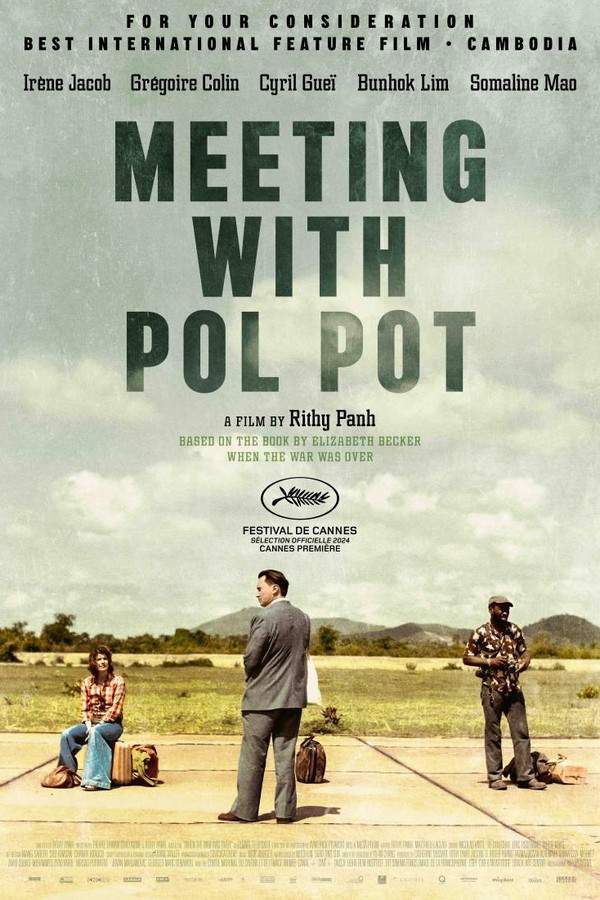
Meeting with Pol Pot (2025) movie poster

Characters & Themes

Meeting with Pol Pot (2025) Characters, Setting & Themes Explained

Release, runtime and language
2025 · 1 h 52 m · French
Echo score 78
Loading streaming availability…
Directed by
Rithy Panh
Starring
Irène Jacob, Grégoire Colin, Cyril Gueï, Bun-Hok Lim, Leng Thirith, Sovann Nhoeb

In 1978, three French journalists are granted a rare opportunity to interview Pol Pot, the leader of Democratic Kampuchea. Initially, the country appears to be a utopian ideal. However, the journalists soon discover a disturbing reality: the Khmer Rouge regime is facing a severe decline and is on the brink of invasion by Vietnam. The interview becomes a tense and revealing glimpse behind a carefully constructed facade, exposing the fragility of the regime and the suffering of the Cambodian people.

On this page (6)
  1. 1 Where to watch
  2. 2 Characters explained (3)
  3. 3 Where & when it takes place
  4. 4 Themes & meaning (2)
  5. 5 Movie threads
  6. 6 Every angle
Loading streaming availability…

3 main characters · contains spoilers

Meeting with Pol Pot Characters Explained: Who Is Who

The main characters of Meeting with Pol Pot (2025), heroes and villains: what drives them, how they change over the course of the story and what each of them reveals about the film's bigger ideas.

  • Lise Delbo (Irène Jacob)

    Lise is a determined and skeptical journalist who seeks the truth amidst the propaganda of the Khmer Rouge. Her frustration grows as she witnesses the staging of events designed to deceive foreign media and protect the regime's image. Lise embodies the struggle for integrity in journalism, often at great personal risk.

    • 📰 Journalist
    • 🔍 Truth-Seeker
    • 🇫🇷 French
  • Alain Cariou (Grégoire Colin)

    Alain is a communist journalist who is initially credulous toward the Khmer Rouge's claims of success. His ideological beliefs cloud his judgment, leading to a conflict with his more skeptical colleagues. The culmination of his experience is marked by his tragic end, forcing a reevaluation of loyalty to ideology over personal safety.

    • 📰 Journalist
    • 🇫🇷 French
    • 💔 Tragic Figure
  • Paul Thomas (Cyril Gueï)

    Paul is a skeptical journalist whose curiosity leads him to uncover the grim realities hidden by the Khmer Rouge. His disappearance highlights the dangers faced by those who seek to expose the truth. Paul represents the extreme risks journalists face in oppressive regimes, ultimately sacrificing his safety for the pursuit of truth.

    • 📰 Journalist
    • 🚨 Danger
    • 💔 Sacrificial

Last updated: October 20, 2026 at 00:31

Was this helpful?

Setting

Where and When Does Meeting with Pol Pot Take Place?

The setting of Meeting with Pol Pot (2025): the year and time period, the places and locations, and how they shape the characters, the mood and the tension of the story.

Time period

1978

The late 1970s in Cambodia were marked by the oppressive rule of the Khmer Rouge, a time when the regime sought to transform the country into an agrarian socialist society. This period was defined by extreme measures, including widespread purges and human rights violations, as the government sought to eliminate perceived threats to its ideology. The events of this era have left an indelible mark on the nation's history.

Location

Cambodia

Cambodia, particularly during the era of Democratic Kampuchea, is known for its complex history and the Khmer Rouge regime. The jungle landscapes conceal both the beauty of the country and the tragic remnants of its violent past. This setting serves as a backdrop to the journalists' exploration, highlighting the disconnection between the Khmer Rouge's propaganda and the actual living conditions experienced by its people.

  • 🇰🇭 Cambodia
  • 🏞️ Jungle
  • 📜 Historical Site

Last updated: October 20, 2026 at 00:31

Was this helpful?

2 major themes

Meeting with Pol Pot Meaning: Themes & Message Explained

What is Meeting with Pol Pot (2025) really about? The emotional, social and philosophical themes the film keeps returning to, its symbolism and the message beneath the surface.

  • Media and Truth

    The film explores the challenges faced by journalists trying to uncover the truth in a heavily controlled and staged environment. It raises questions about the role of media in society and the ethical dilemmas reporters encounter when faced with propaganda. The suppression of genuine inquiry reflects the broader issue of censorship and the manipulation of information.

  • Deception

    Deception is a central theme, illustrated by the deliberate staging of events to present a false image of success. The journalists' struggle to navigate through lies while seeking the truth encapsulates the challenges of confronting a regime built on manipulation. Lise's frustration symbolizes the quest for authenticity and the difficulty of revealing hidden atrocities.

Last updated: October 20, 2026 at 00:31

Was this helpful?

Movie threads

More Movies Like Meeting with Pol Pot, by Mood & Story

Curated lists built around what makes Meeting with Pol Pot tick: the same mood, the same kind of story or the same emotional payoff. Each list explains why these movies belong together.

Journalists uncovering brutal regimes like in Meeting with Pol Pot

Outsiders witness atrocities the powerful want buried forever. If you were gripped by Meeting with Pol Pot, discover more political dramas and historical thrillers about journalists, foreign correspondents, or outsiders granted rare access to authoritarian regimes. These films follow investigators who peel back carefully constructed facades to expose genocide, oppression, and ideological delusion, often at great personal cost.

  • investigative
  • political
  • paranoid
  • oppressive
  • chilling
  • somber
  • Tone: dark, bleak, tense
  • Pacing: slow burn, methodical
Why these movies?

The story pattern: A small group of outsiders enters a tightly controlled environment believing they will witness a story or a cause. At first the surface appears coherent, even admirable, but each day of observation reveals small, then unmistakable cracks: disappeared people, staged encounters, contradictory accounts, and casual brutality. The protagonist's understanding shifts gradually from curiosity or sympathy to horror and complicity. The arc ends with a choice between speaking the truth and surviving, often resolved in tragedy or quiet escape.

Why they belong together: These films share an investigative journalism spine wrapped in political danger. They feature outsiders confronting ideology, restricted movement, surveillance, and the slow discovery that official narratives are lies. Pacing is deliberately methodical to mirror the process of uncovering truth, and the emotional register is heavy, somber, and often bleak. Viewers who want the experience of witnessing history from inside the nightmare will find their match here.

Oppressive slow burn dread like in Meeting with Pol Pot

Trapped in a hostile place where every glance is watched and every silence costs something. Looking for movies like Meeting with Pol Pot that deliver a claustrophobic, paranoid atmosphere? These are slow burn dramas set in hostile, surveilled, or politically dangerous territory, where characters are trapped under constant threat. Expect grim tension, oppressive mood, and the slow suffocation of hope as the walls close in.

  • claustrophobic
  • paranoid
  • oppressive
  • grim
  • anxious
  • chilling
  • Tone: dark, anxious, somber
  • Pacing: slow burn, suffocating
Why these movies?

The story pattern: Characters arrive at or awaken inside a place they cannot leave. The rules of the environment are unclear but enforced absolutely. Early scenes establish a fragile normalcy that is gradually stripped away as the protagonist notices absences, hears coded warnings, and survives encounters that feel choreographed. Tension builds not from action set pieces but from waiting, watching, and the slow recognition that the danger is total. Climaxes are quiet rather than explosive, and endings tend toward bleakness or moral injury rather than triumph.

Why they belong together: These films are linked by atmosphere more than plot: an unrelenting sense of being watched, an oppressive setting, and pacing that stretches tension to its breaking point. They share a slow, deliberate rhythm, dark or bleak tonal palette, and a focus on psychological rather than physical danger. Viewers who want to feel the weight of being trapped inside a hostile system will recognize the same suffocating rhythm in each of these stories.

Every angle

Meeting with Pol Pot (2025) Explained: Plot, Timeline & Characters

Everything about Meeting with Pol Pot in one place: what happens in the plot summary, the timeline in chronological order, the characters and meaning and a spoiler-free summary. What's After the Movie adds the cast, box office and post-credit scenes.

Coming soon on iOS and Android

The Plot Explained Movie Summary App

Plot summaries, endings explained and timelines on your phone. Catch up on any movie in minutes, save your favorites and never miss a twist again.

Be the first to know when we launch. Your email stays private, always.

Learn more about the app