Plot Explained Spoilers guaranteed!
Plot Explained

Browse by genre

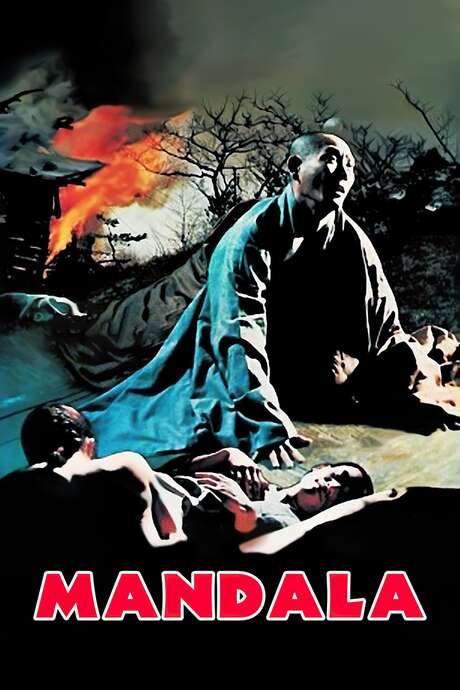
Mandala (1981) movie poster

Plot Summary

Mandala (1981) Plot Summary Explained

Release, runtime and language
1981 · 111 mins · Korean
Directed by
Im Kwon-taek
Starring
Ahn Sung-ki, Park Jeong-ja, Jeon Moo-song, Gi Jeong-su, Park Am, Ra Jeong-ok

A story that follows the lives and interactions of two Buddhist monks living in South Korea.

On this page (5)
  1. 1 What happens: full plot
  2. 2 Plot questions answered
  3. 3 Movie threads
  4. 4 Movies like Mandala
  5. 5 Every angle

Full plot summary · contains spoilers

What Happens in Mandala: Full Plot Summary

The whole story of Mandala (1981) explained, from the opening scene to the final frame: every key event, every twist and what it all adds up to. Read it as a quick recap before the sequel, to check a scene you missed, or to finally understand what really happened.

At a tense border checkpoint, a bus is halted and soldiers begin a careful search of every passenger. Monk Ji-san is found without proper ID, and the young monk Beop-woon quietly trails behind, watching the soldiers’ orders unfold. He is released after Ji-san chants Buddha’s name, a small ritual that the authorities accept in place of formal documentation.

Later, Beop-woon encounters Ji-san again at a temple, where Ji-san drinks and speaks with quiet gravity. He says that Buddha is not found only in Buddhist temples, a line that unsettles Beop-woon and makes him see that six years of practice may not have yielded the spiritual certainty he hoped to gain.

The two men keep moving, their paths repeatedly crossing and separating as they set off once more. Their journey leads them to a modest hermitage tucked away in the mountains, where a simple, shared life begins to form amid the surrounding silence and austere routines.

Ji-san, who also aids a shaman with the traditional ritual of “opening the eyes,” reflects on who will do the same for him. He drinks, assumes a lotus position, and, in a stark moment of surrender, freezes to death. The community around him grieves in quiet reverence, and Beop-woon undertakes the difficult duty that follows.

Beop-woon performs Ji-san’s cremation, honoring him with a ceremony. He passes along a Buddha statue that had belonged to Ji-san to Ok-sun, a woman the late monk could never forget, preserving a fragile memory within a ritual act.

In the aftermath, Beop-woon finally meets his mother, who abandoned him as a child. This reunion marks the start of a long, arduous road of suffering, testing his resolve and shaping the rest of his journey as he moves forward with a deeper, more tempered sense of faith.

Last updated: February 18, 2026 at 23:45

Was this helpful?

Plot questions answered

Mandala Plot Explained: Your Questions Answered

The questions people ask most about Mandala (1981): what happens in the confusing scenes, why the characters do what they do, the twists, hidden details and what the ending means. Each answer contains spoilers.

Q1

Why does Ji-san freeze to death at the hermitage?

Ji-san chooses to sit in a lotus position and deliberately exposes himself to the freezing mountain cold until he dies. This act represents his complete surrender to mortality and his belief that he has not achieved true enlightenment. Before this moment, he asks who will perform the 'opening the eyes' ritual for him, revealing his fear of being forgotten. His death is both a physical and spiritual choice, a final rejection of worldly attachment and a desperate attempt to find transcendence through self-sacrifice.

  • ji-san death
  • freeze to death
  • monk suicide
  • spiritual surrender
  • mountain hermitage
Q2

What does Ji-san mean when he says Buddha is not found only in Buddhist temples?

When Ji-san declares that Buddha exists beyond Buddhist temples, he is challenging Beop-woon's assumption that spiritual truth can only be found through formal religious practice. This statement reveals Ji-san's spiritual crisis, he has spent years in temples but feels he has achieved nothing genuine. It suggests that enlightenment might exist in everyday life, in nature, or in human connections outside structured religious institutions. This realization unsettles Beop-woon and marks a turning point in his understanding of faith.

Foreshadowing: Earlier at the checkpoint, the soldiers' acceptance of chanting Buddha's name as valid identification already hints that spiritual practice can function in unexpected places.

  • spiritual truth
  • temple
  • enlightenment
  • ji-san philosophy
  • buddhism meaning
Q3

Why does Ji-san drink alcohol despite being a monk?

Ji-san's drinking represents his profound spiritual crisis and rejection of rigid religious formalism. After years of practice, he feels he has gained nothing meaningful from temple life. Alcohol becomes his way of coping with existential despair and the fear that he has failed in his spiritual quest. His drinking is not hedonistic pleasure but rather a desperate attempt to numb his awareness of mortality and his sense of spiritual failure. This behavior contrasts sharply with traditional monastic discipline and signals his descent into personal despair.

  • ji-san drinking
  • monk alcohol
  • spiritual crisis
  • temple life failure
Q4

What is the 'opening the eyes' ritual that Ji-san performs for the shaman?

The 'opening the eyes' is a traditional Korean shamanic ritual believed to invoke spiritual presence or divine vision into a shrine or idol. Ji-san assists a shaman with this ceremony, demonstrating his willingness to engage with spiritual practices outside formal Buddhist temples. This scene highlights the syncretic nature of Korean spirituality, where Buddhist and shamanic traditions intersect. The ritual also prompts Ji-san to reflect on his own spiritual state, leading him to wonder who will perform this same ritual for him when he dies.

  • shaman ritual
  • opening eyes ceremony
  • korean shamanism
  • syncretic spirituality
Q5

Who is Ok-sun and why does Ji-san have a Buddha statue for her?

Ok-sun is a woman from Ji-san's past whom he could never forget. The Buddha statue represents his lingering attachment to worldly love and human connection despite his monastic vows. Ji-san asks Beop-woon to deliver this statue to Ok-sun after his death, showing that even in his final moments, he remained connected to human emotions and relationships rather than achieving complete spiritual detachment. This act reveals the tension between Buddhist ideals of non-attachment and the powerful human need for connection and remembrance.

  • ok-sun
  • buddha statue
  • ji-san love
  • attachment
  • human connection
Q6

Why do the soldiers accept chanting Buddha's name as identification at the checkpoint?

At the border checkpoint, Ji-san is without proper identification but is released after chanting Buddha's name, which satisfies the soldiers. This scene demonstrates how religious practice can function as a form of identity in a society where spiritual commitment carries social weight. The soldiers' acceptance shows that religious devotion provides a recognized place within the community, even without official documentation. This moment establishes the movie's central tension between outward religious observance and inner spiritual truth.

  • checkpoint
  • buddha chant
  • soldiers
  • korea border
  • religious identity
Q7

What causes Beop-woon to decide to follow Ji-san after their temple meeting?

Beop-woon decides to follow Ji-san after hearing his declaration that Buddha exists beyond temples. This statement shatters Beop-woon's belief that six years of formal practice have brought him spiritual progress. Confronted with the possibility that his temple training has been meaningless, Beop-woon seeks a different path by attaching himself to Ji-san, who represents a more authentic, questioning approach to faith. This decision marks his transition from solitary study to a shared spiritual journey.

Foreshadowing: The checkpoint scene already showed Beop-woon quietly trailing behind Ji-san, indicating an early attraction to his path.

  • beop-woon follows ji-san
  • spiritual journey
  • temple meeting
  • decision
Q8

Why does Beop-woon finally reunite with his mother at the end of the film?

Beop-woon reunites with his mother after Ji-san's death, confronting the unresolved abandonment from his childhood. This meeting represents the final test of his spiritual resilience, the weight of personal suffering and emotional pain that he must now face. The reunion is not a resolution but rather the beginning of his own 'long road of suffering,' suggesting that his spiritual transformation requires him to confront worldly attachments and past trauma rather than escape them through monastic withdrawal.

  • beop-woon mother
  • reunion
  • abandonment
  • childhood
  • suffering road
Q9

What is the significance of Ji-san's cremation ceremony?

Beop-woon performs Ji-san's cremation at the hermitage, fulfilling the traditional Buddhist practice of honoring the dead through fire. This ceremony represents Beop-woon's acceptance of his role as a spiritual heir and his willingness to engage with death as part of the monastic duty. The act of cremation symbolizes the transmutation of physical existence into spiritual essence, and Beop-woon's performance of this ritual marks his transition from student to teacher in the spiritual lineage.

  • cremation ceremony
  • ji-san death
  • beop-woon duty
  • buddhist funeral
Q10

What does the 'long road of suffering' represent at the end of the movie?

After Ji-san's death and his mother's reunion, Beop-woon embarks on a long road of suffering, carrying his memories and spiritual learnings forward. This ending represents the Buddhist understanding that earthly existence involves inherent suffering, and true spiritual growth requires enduring rather than escaping this pain. The road symbolizes Beop-woon's transformed understanding, he no longer seeks enlightenment through withdrawal but through active engagement with life's hardships. His journey suggests that spiritual transformation comes through endurance and acceptance rather than escape.

  • road of suffering
  • ending meaning
  • spiritual journey
  • beop-woon transformation
  • buddhism theme

Movie threads

More Movies Like Mandala, by Mood & Story

Curated lists built around what makes Mandala tick: the same mood, the same kind of story or the same emotional payoff. Each list explains why these movies belong together.

Spiritual dramas about existential doubt like Mandala

A quiet exploration of faith, doubt, and the search for meaning in isolation. Explore movies like Mandala that follow characters on a contemplative spiritual journey. These films share a melancholic tone, slow pacing, and heavy emotional weight, focusing on themes of faith, loss, and existential crisis.

  • contemplative
  • spiritual
  • existential
  • somber
  • austere
  • lonely
  • Tone: melancholic, contemplative
  • Pacing: slow, meditative
Why these movies?

The story pattern: These narratives typically follow a protagonist's internal journey through doubt and spiritual questioning, often set against a stark, isolating backdrop. The conflict is internal rather than external, focusing on the slow, painful process of seeking meaning amidst suffering and loss. The journey is more important than a tidy resolution.

Why they belong together: Movies in this thread are grouped by their shared focus on the spiritual and existential realm. They create a cohesive experience through slow, deliberate pacing, a melancholic and somber mood, and a heavy emotional weight derived from themes of grief, ritual, and the search for purpose.
Slow burn movies about grief and loss like Mandala

Stories where sorrow unfolds slowly, emphasized by a stark and lonely atmosphere. Discover atmospheric slow burns similar to Mandala, where a melancholic tone and heavy emotional weight explore themes of grief, loss, and human connection against a stark backdrop.

  • somber
  • grief
  • lonely
  • contemplative
  • austere
  • emotional
  • Tone: melancholic, somber
  • Pacing: slow, deliberate
Why these movies?

The story pattern: The narrative pattern involves characters processing profound loss or confronting mortality in a reflective manner. The pacing is intentionally slow, allowing the emotional impact of events to resonate fully. The setting often acts as a character itself, with landscapes mirroring the internal desolation or peace of the characters.

Why they belong together: These films are connected by their shared mood of solemn contemplation and their commitment to a slow, immersive pace. They prioritize emotional authenticity and the gradual unfolding of grief over conventional plot mechanics, creating a uniquely poignant and resonant viewing experience.

If you liked this

Movies Like Mandala

Similar movies to Mandala: the same genre, themes or kind of story. Each one comes with its own plot summary, timeline and ending explained.

Browse all movie summaries

Every angle

Mandala (1981) Explained: Plot, Timeline & Characters

Everything about Mandala in one place: what happens in the plot summary, the timeline in chronological order, the characters and meaning and a spoiler-free summary. What's After the Movie adds the cast, box office and post-credit scenes.

Coming soon on iOS and Android

The Plot Explained Movie Summary App

Plot summaries, endings explained and timelines on your phone. Catch up on any movie in minutes, save your favorites and never miss a twist again.

Be the first to know when we launch. Your email stays private, always.

Learn more about the app