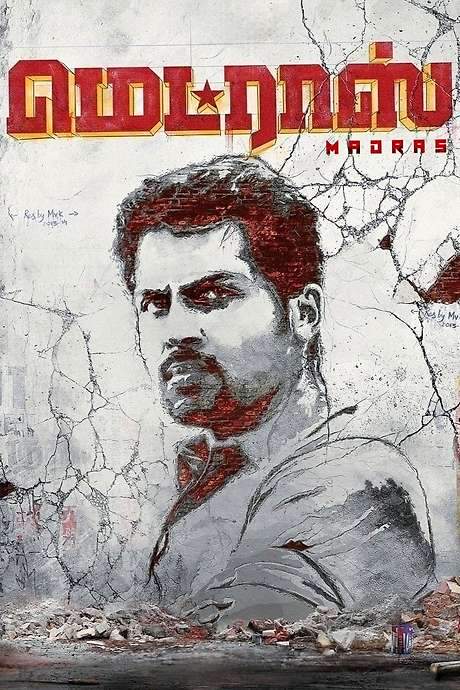
Kaali is a hot-headed, hard-working man from a tight-knit community in North Chennai who loves football and keeps life balanced between his IT job and his friends in the aging housing blocks of Vyasarpadi. His closest ally is Anbu, a young political hopeful, and together they navigate the everyday tensions of a neighborhood where families, friends, and rival factions collide over a single, contested wall.
Two political factions fight over that wall, a stage for the portraits of their leaders. On one side, Anbu operates under the local guidance of Maari, who aims to claim the wall for their party. On the other, Kannan and his son, Perumal, are determined to keep the rival’s influence at bay. The wall itself bears a long-standing symbol: the portrait of Krishnappan painted there for two decades, marking the deep-rooted feud that shapes everyone’s choices.
As the feud intensifies, Kalaiarasi, a daughter of a politician, captures Kaali’s interest, though she remains emotionally distant at first. In the heat of the election season, Anbu moves to reserve the wall for their party, prompting the opposition to demand that the portrait be left untouched. The tension is fueled by a history of violence—three deaths related to the wall have unsettled the community and hardened nerves on both sides. When Anbu refuses to back down, a goon aligned with Kannan menaces him, and Kaali’s quick temper erupts in a moment that makes Anbu’s plight seem even more perilous in the eyes of their rivals.
The stakes rise as the plan to eliminate Anbu and Kaali takes shape. Kalaiarasi’s confession of love to Kaali adds a personal edge to the looming danger. When the would-be assassins strike, the two friends flee and hide behind a passing van, where they overhear Perumal speaking on the phone and ordering Anbu’s death at any cost. In a brutal moment, Kaali uses a crowbar to strike Perumal down, a decision that spirals their lives toward even darker consequences.
At the courthouse in Kanchipuram, Anbu accepts responsibility for the crime in a bid to secure a lighter fate, but the plan backfires as Kannan’s henchmen attack him in the corridor, leaving Kaali gravely wounded and Anbu dead. The loss drives Kaali into a deep guilt-ridden funk, and with his parents and Maari urging him to rebuild his life, he begins to seek a new path. Maari promises revenge, and Kalaiarasi stands by Kaali as the two of them work to pick up the pieces of their lives. Soon after, they marry, choosing to forge ahead together.
A startling turn comes when, during a restaurant encounter, Kaali spots one of Maari’s henchmen and learns the truth: Maari had secretly allied with the rival party to become MLA of RK Nagar and was orchestrating Anbu’s assassination. Kalaiarasi supports Kaali’s decision to pursue justice, and at a public gathering where Maari is being honored, Kaali exposes the conspiracy, prompting a crowd to turn against Maari. The wall itself becomes a canvas for the public’s reaction, as Kaali splashes new paint and reshapes the symbol on the wall, drawing the community toward a shared act of defiance.
Maari retaliates with a new plan, but his bid to kill Kaali is foiled by a betrayal from within the rival camp. In a final confrontation, Kaali defeats the henchmen and leaves Maari grievously injured; Maari dies, removed from the power struggle that once defined the neighborhood.
In the aftermath, Kaali and Kalaiarasi redirect their energies toward education and community healing. They teach in the very building that once sparked the violent feud, transforming the wall into a mural celebrating children’s education and hopeful futures. Yet the legacy of the wall lingers—the stubborn desire of Kannan to hang his father’s portrait on that same wall remains a lingering thread in the story’s closing image.