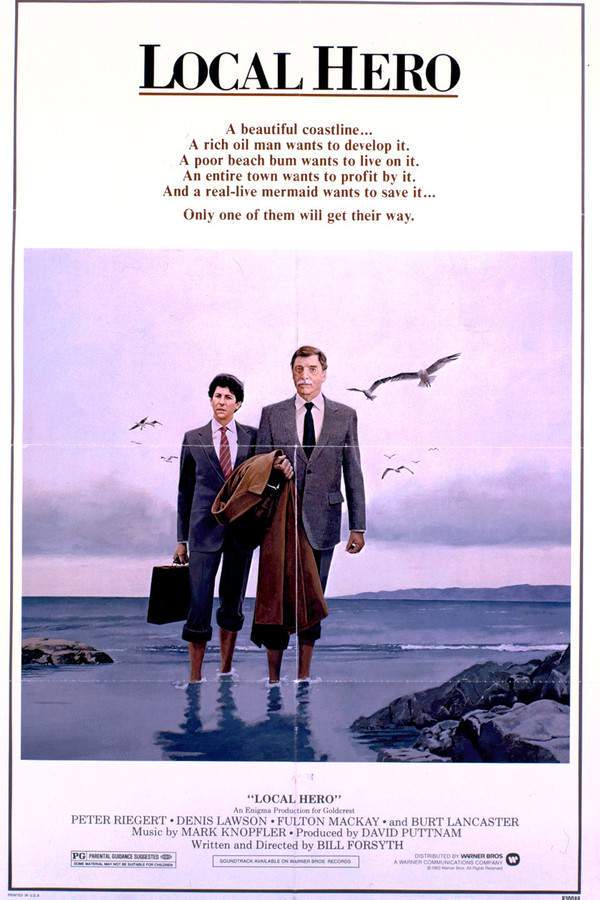
MacIntyre, Peter Capaldi, is an ambitious Knox Oil and Gas executive in Houston, Texas. Felix Happer, Burt Lancaster, the company’s eccentric owner, chooses Mac for a delicate mission: to acquire Ferness, a windswept village in the Scottish Highlands, so a massive refinery can be built where the sea meets the hills. Mac, who is actually of Hungarian extraction, is told to observe the sky and report anything unusual, a subtle nudge toward a higher purpose than merely closing a deal. He would rather handle things from afar, via telex and phone, but the assignment pulls him into a land where people live with the weather, the tides, and old grievances as part of daily life.
Mac arrives in Ferness and teams with Danny Oldsen, Alex Norton. They tour Knox’s research facility in Aberdeen, where Dr Geddes, Norman Chancer, lays out the plan to replace Ferness with a refinery and, perhaps, to site a future research center on the same coast. They also meet Marina, Jenny Seagrove, a woman who seems at home in the water and who stirs new questions about what the company intends to build. The village’s atmosphere grows more complex as Mac begins to slip from the role of outsider and into the fabric of Ferness’ sleepy routines, where the locals’ simple rhythms begin to feel like a measure of something larger—community, memory, and the cost of progress.
In Ferness, Mac slowly grows fond of Gordon Urquhart, Denis Lawson, the hotel owner who also serves as an informal accountant for the village, and his wife Stella Urquhart, Jennifer Black. He hears their stories, shares their meals, and witnesses how deeply the villagers have learned to endure a hard life. The more he gets to know them, the more his resolve to push the deal fades, even as the villagers themselves pretend indifference as a calculated ploy to squeeze a larger offer from Knox. Yet there is a strange beacon of support for him in the most unlikely of places: Victor, Peter Riegert, a capitalistic Soviet fishing-boat captain who visits Ferness and checks in on his investment portfolio managed by Gordon, a reminder that money and ambition move through many currents.
Back in the United States, the story returns to Happer, whose life becomes a study in mounting pressure and fragile control. He grows increasingly disillusioned with his therapist, whose relentless abuse shifts from phone calls to a dramatic, almost theatrical intrusion into Happer’s personal space. The scene climbs to the point where the therapist reaches Happer’s window, and the powerful moment lands in memory with a blunt, blistering declaration: > Happer, you're a motherfucker. The confrontation illustrates a man who can’t escape the push-pull between control and collapse, even as he contemplates a different course for Ferness.
As the deal approaches its culmination, Ben Knox, Fulton Mackay, the stubborn old beachcomber who literally owns the beach by grant from the Lord of the Isles, becomes the crucial hinge on which everything turns. Mac tries every angle to entice Ben to sell, including offering more money than Ferness has ever seen. Ben refuses to be bought, testing Mac’s resolve with a philosophical challenge: he samples the sand, counting the grains, and insists there could not have been more than ten thousand grains in his hand. The moment crystallizes the tension between land and value, between the intangible sense of place and the measured wealth of a ledger.
When Happer finally arrives to negotiate directly with Ben, the encounter reveals a shared humanity that cuts through the corporate brutal logic. Moved by Ben’s steadfastness and the Irreducible charm of Ferness, Happer shifts course: he proposes relocating the refinery offshore and establishing an astronomical observatory instead. The plan reflects Happer’s own passion for the skies and for the kind of scientific curiosity that Ferness already embodies in its quiet coastline and its people. Mac returns to Houston to implement the revised vision, wrestling with the idea that he may be leaving behind a life he has come to love.
Danny’s ongoing flirtation with Marina grows into a partnership of shared dreams: Marina longs for an oceanographic research facility, and Danny suggests combining that dream with the newly envisioned observatory—together, they imagine the “Happer Institute,” a fusion of science, sea, and sky that might honor both the land and the stars. The film ends on a reflective note as a somber MacIntyre fills his Houston apartment with small tokens from Ferness—pebbles and shells arranged on a work surface—while back in Ferness a local phone box rings, signaling that the village’s story, like the tide, is never truly over.