Plot Explained Spoilers guaranteed!
Plot Explained

Browse by genre

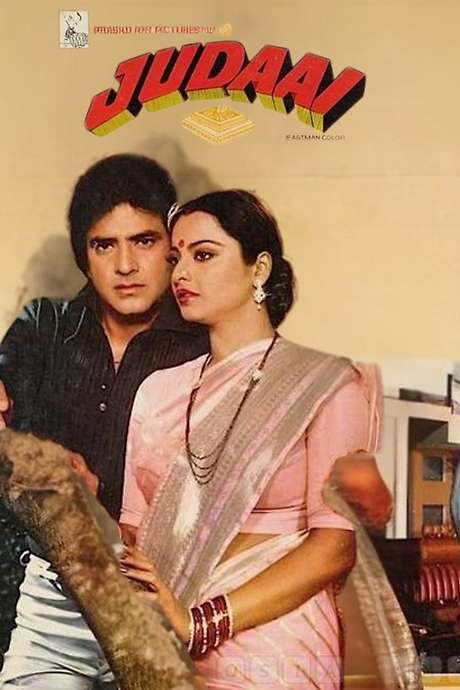
Judaai (1997) movie poster

Plot Summary

Judaai (1997) Plot Summary Explained

Release, runtime and language
1997 · 167 mins · Hindi
Directed by
Raj Kanwar
Starring
Anil Kapoor, Saeed Jaffrey, Paresh Rawal, Johnny Lever, Upasna Singh, Dinesh Hingoo

A greedy wife sells her husband to a wealthy woman but soon realizes that, with a luxurious life, she must pay a heavy price.

On this page (6)
  1. 1 Where to watch
  2. 2 What happens: full plot
  3. 3 Plot questions answered
  4. 4 Movie threads
  5. 5 Movies like Judaai
  6. 6 Every angle

Where to watch

Where to Watch Judaai (1997)

Where can you watch Judaai? Stream, rent or buy it in the US, including on Amazon Video: current JustWatch availability with up-to-date prices.

Streaming availability powered by JustWatch

Full plot summary · contains spoilers

What Happens in Judaai: Full Plot Summary

The whole story of Judaai (1997) explained, from the opening scene to the final frame: every key event, every twist and what it all adds up to. Read it as a quick recap before the sequel, to check a scene you missed, or to finally understand what really happened.

Kajal Verma marries Raj Verma, an engineer she believes to be wealthy and corrupt. The reality, however, is quite the opposite: Raj is neither rich nor corrupt, and this misunderstanding gnaws at Kajal from the start. She carries her illusion of a glamorous life into their home, where the couple soon has twin children, Romi and Preeti Verma. Despite the arrival of their kids, Kajal’s mindset remains fixed on status and material comfort, leaving a rift between her desires and the simpler, more affectionate life Raj longs to provide.

Kajal’s discomfort deepens when she reconnects with an old, wealthy friend named Nisha. The two share a ride, and Kajal’s world begins to slip further from reality as she points to a bungalow she claims as her own. The truth comes out in a painful moment: that bungalow belongs to Nisha. The encounter shatters Kajal’s carefully built facade and foreshadows the personal costs of chasing wealth.

From overseas arrives Jahnvi Sahni, Randhir’s niece, who discovers that Raj is an engineer working for Randhir’s construction company. Jahnvi’s presence tests the boundaries of loyalty and desire, especially as Vikram Khanna, Randhir’s business partner, tries to assault Jahnvi. Raj intervenes and saves her, and the two form a bond despite the complication of his marital status. Jahnvi’s feelings grow even as she learns that Raj is a married man, yet she remains determined.

Jahnvi’s path intersects with Kajal’s in a tense, fateful moment when she unknowingly encounters Kajal and discovers the truth about Raj’s life. Jahnvi confesses her love to both Kajal and Raj, which ignites anger and defensiveness on both sides. The situation escalates when Jahnvi makes a bold offer: 2 crore rupees for the right to marry Raj. Kajal recognizes a chance to secure even greater wealth and accepts the proposition, insisting on control over the arrangement. She pushes Raj into a formal agreement, and he reluctantly agrees to marry Jahnvi. To comply with the Hindu Marriage Act, Kajal then divorces him, hoping that she and Jahnvi can share Raj.

With the money from the bargain, Kajal buys a sprawling mansion and a fleet of cars, and the dream she chased begins to take shape—though at a steep personal cost. The bungalow she buys happens to be Nisha’s former home, a bitter twist that underscores the hollowness of her pursuit. Kajal also revisits her old life briefly, stealing a moment to snatch back a picture of her husband, flaunting the supposed prosperity she has attained while hinting at the emptiness inside. She taunts Nisha with the thought that she has achieved her dreams; Nisha reminds Kajal of the price already paid by others, including the husband Kajal traded away.

Kajal’s transformation into a socialite further distances her from the family she once cherished. Raj, meanwhile, feels rejected and objectified, caught between two wives who vie for his attention and affection. Yet the children and Raj eventually find solace and warmth in Jahnvi, who embraces them with genuine care. Jahnvi sheds her privileged upbringing, choosing to live as a housewife, traveling by crowded buses and autos to keep life grounded and ensure that Raj and the kids feel secure and connected. The children begin calling Jahnvi “Maa,” a term Kajal had demanded they reserve for her, highlighting the emotional shift in the family dynamic.

As time passes, Kajal begins to realize how far she has drifted from the family she once loved. She forgets their wedding anniversary and hosts a birthday gathering for her daughter without understanding Raj’s disdain for lavish extravagance. This growing disconnect pushes Kajal toward a desperate attempt at reconciliation. Reminders from her mother finally provoke her to try to mend the rift, but her efforts fall short. In a moment of anger, Kajal slaps Jahnvi and accuses her of stealing Raj, attempting to eject her from the home. She offers Jahnvi all her money to buy Raj back, but Raj bluntly tells Kajal that she is impoverished despite all the wealth she wields—the richest person in appearance only, not in spirit.

Legal advisors reinforce Kajal’s realization: the only way for her to legally reclaim Raj would require a divorce between Raj and Jahnvi. She makes a bold, but futile, attempt to remove Jahnvi from the household. Yet Raj chooses to leave with Jahnvi, while the children decide to stay with Jahnvi and their father, cementing a new, unconventional family unit.

Kajal, overwhelmed by separation from her family, donates all her riches. When she learns that Raj and the kids are hours away from boarding a flight to the United States, she rushes to the airport in a final bid to reclaim them. The moment of truth arrives: Jahnvi announces that she will travel to the US alone, but she’s not alone—she is pregnant with Raj’s child. Jahnvi’s quiet acceptance of the situation reveals a complex sense of justice; she acknowledges that Kajal’s decision to sold her husband was, in a way, a mutual choice—one that warrants its own consequence. The ending brings Kajal back to a realization of the true value of family over fortune, and Jahnvi’s departure for New York marks a new chapter for everyone involved.

In the end, the family reunion isn’t about wealth or status but about the bonds that hold them together. Kajal learns the hard way that money cannot replace the warmth of a loving family, while Jahnvi’s presence softens the edges of the conflict, offering a path toward reconciliation. The narrative closes on a note that emphasizes that love, responsibility, and belonging endure beyond material gains, and that sometimes the most imperfect roads lead to the most meaningful outcomes.


Last updated: October 09, 2025 at 09:18

Was this helpful?

Plot questions answered

Judaai Plot Explained: Your Questions Answered

The questions people ask most about Judaai (1997): what happens in the confusing scenes, why the characters do what they do, the twists, hidden details and what the ending means. Each answer contains spoilers.

Q1

Why did Kajal agree to sell her husband to Jahnvi?

Kajal agreed because she was obsessed with wealth and status. When Jahnvi offered 2 crore rupees for the right to marry Raj, Kajal saw it as an opportunity to secure the luxurious life she had always wanted. She believed she could keep control of the arrangement and even share Raj with Jahnvi, not realizing the emotional cost her decision would have on her family.

  • kajal
  • raj
  • jahnvi
  • 2 crore
  • married
  • selling husband
Q2

Why did Raj agree to marry Jahnvi after being sold?

Raj reluctantly agreed to the marriage primarily to ease the financial burden on his family. Although he loved Kajal, the arrangement would provide security for his children. Additionally, Raj felt rejected and objectified by Kajal's transaction, which made him more willing to go along with the plan despite his reservations.

  • raj
  • jahnvi
  • marriage
  • reluctant
  • family
Q3

Why did Kajal have to divorce Raj to marry Jahnvi?

Under the Hindu Marriage Act, a married person cannot legally marry someone else while still married. Since Jahnvi wanted a legitimate marriage to Raj, Kajal was required to divorce him first. This legal requirement is what enabled the formal arrangement between the three of them.

  • divorce
  • hindu marriage act
  • legal
  • raj
  • jahnvi
  • kajal
Q4

Why did Kajal's children start calling Jahnvi "Maa"?

The children began calling Jahnvi "Maa" because she genuinely cared for them and spent quality time with them, unlike Kajal who had become obsessed with wealth and social status. Jahnvi gave up her privileged lifestyle, traveling by bus and auto to be closer to the family, which earned the children's love and trust.

Foreshadowing: Earlier in the film, Kajal had demanded the children reserve "Maa" only for her, but her neglect of the family created an emotional void that Jahnvi filled.

  • children
  • maa
  • jahnvi
  • adoption
  • love
  • family
Q5

Why was the bungalow Kajal bought Nisha's property?

The bungalow Kajal purchased with her money turned out to belong to her wealthy friend Nisha, whom she had lied to about Raj's wealth earlier. This coincidence was a cruel twist of fate that highlighted the hollowness of Kajal's pursuit, she had achieved material success but at the cost of her integrity and family.

Foreshadowing: Earlier, Kajal had pointed to Nisha's bungalow and claimed it as her own, establishing the irony of her eventual purchase.

  • bungalow
  • nisha
  • wealth
  • irony
  • purchase
Q6

Why did Raj choose to stay with Jahnvi instead of returning to Kajal?

Raj chose Jahnvi because she had proven her love through actions, not transactions. While Kajal had literally sold him, Jahnvi had embraced his children and simplified her lifestyle to be with the family. Raj also felt degraded by Kajal's transaction and found genuine companionship with Jahnvi.

  • raj
  • jahnvi
  • kajal
  • choice
  • love
  • companionship
Q7

Why did Jahnvi reveal her pregnancy at the airport?

Jahnvi revealed her pregnancy at the airport to show that she too would face consequences for her actions. By acknowledging she was carrying Raj's child, she demonstrated that Kajal's decision to sell her husband had created a situation where everyone must bear a price, herself included.

  • jahnvi
  • pregnancy
  • airport
  • consequence
  • reveal
Q8

Why did Kajal donate all her wealth at the end?

Kajal donated her wealth because she finally realized that money could not replace the warmth of a loving family. After losing her husband and children to Jahnvi, she understood that her material pursuits had cost her everything that truly mattered.

  • donation
  • wealth
  • regret
  • family
  • realization
Q9

Why did Kajal forget her wedding anniversary?

Kajal forgot her wedding anniversary because she had become consumed by her new socialite lifestyle and obsession with status. Her priorities had shifted away from family bonds to material achievements, causing her to neglect important family milestones.

Foreshadowing: Earlier events showed Kajal prioritizing lavish parties and wealth over family relationships.

  • anniversary
  • neglect
  • status
  • socialite
  • kajal
Q10

Why did Kajal slap Jahnvi and accuse her of stealing Raj?

Kajal slapped Jahnvi in a moment of desperation and anger when she realized she was losing Raj to the very woman she had arranged to marry him. Despite initiating the transaction, Kajal couldn't accept the emotional distance that had grown between her and her husband.

  • slap
  • jahnvi
  • anger
  • desperation
  • accusation
Q11

Why did Jahnvi leave for New York alone without Raj?

Jahnvi left for New York alone because she wanted to allow Kajal to reunite with her family. Despite being pregnant with Raj's child, she chose to sacrifice her place in the family, believing it was the just consequence of the original transaction, everyone must pay a price for their choices.

  • jahnvi
  • new york
  • pregnancy
  • sacrifice
  • departure
Q12

Why did the children choose to stay with Jahnvi instead of Kajal?

The children chose to stay with Jahnvi because she had been the one present for them emotionally, taking them on buses, helping with homework, and showing genuine maternal love. Kajal's transformation into a wealthy socialite had made her emotionally distant from her children.

  • children
  • jahnvi
  • kajal
  • choice
  • loyalty
  • emotional bond
Q13

Why did Raj intervene to save Jahnvi from Vikram?

Raj saved Jahnvi because he witnessed Vikram Khanna attempting to assault her at Randhir's construction company. As an employee and a decent person, Raj couldn't stand by while someone was being attacked, which also marked the beginning of his bond with Jahnvi.

  • raj
  • jahnvi
  • vikram
  • rescue
  • protection
Q14

Why did Kajal initially believe Raj was wealthy and corrupt?

Kajal believed Raj was wealthy and corrupt because she had imagined a glamorous life for herself before marriage. When she married an engineer, she assumed he must have significant wealth and connections, projecting her own desires onto reality rather than accepting his honest, modest circumstances.

  • kajal
  • raj
  • misunderstanding
  • wealth
  • assumption

Movie threads

More Movies Like Judaai, by Mood & Story

Curated lists built around what makes Judaai tick: the same mood, the same kind of story or the same emotional payoff. Each list explains why these movies belong together.

Movies about marital transactions like Judaai

Stories where love is treated as a commodity, leading to devastating emotional fallout. Explore movies like Judaai where marriage becomes a bargaining chip. If you were captivated by the painful premise of a spouse being 'sold' and the heavy price of materialism, these similar dramas, romances, and family stories explore the devastating consequences of treating love as a transaction.

  • regretful
  • tense
  • materialistic
  • unsettling
  • poignant
  • emotional turmoil
  • Tone: melancholic, tense, regretful
  • Pacing: steady, deliberate
Why these movies?

The story pattern: The narrative follows a predictable yet emotionally potent arc: a character, often disillusioned with their current life, makes a selfish choice that commodifies their relationship. This choice leads to a period of material gain but spiritual emptiness, culminating in a crisis that forces a painful confrontation with the consequences. The endings are often bittersweet, emphasizing the permanent scars left by the initial betrayal.

Why they belong together: Movies in this thread are grouped by their shared focus on a central, morally complex premise: a marital relationship is fundamentally altered by a business-like arrangement. They share a heavy emotional weight, a steady, reflective pacing that allows the regret to simmer, and a tone that blends tension with profound melancholy.

Movies with bittersweet reckonings like Judaai

Journeys where characters regain what they lost, but the victory is stained by irreversible consequences. Discover films with endings similar to Judaai, where reconciliation is achieved but feels bittersweet. If you appreciated the heavy emotional journey and the finale where the family reunites only after enduring great personal loss, these movies explore the complex, costly nature of redemption and second chances.

  • bittersweet
  • poignant
  • regretful
  • reflective
  • emotional loss
  • costly victory
  • Tone: bittersweet, melancholic, poignant
  • Pacing: steady, reflective
Why these movies?

The story pattern: Narratives in this thread follow characters who, after a grave error in judgment, embark on a painful path toward reclaiming what they cherished. The resolution is not a simple return to happiness; instead, it's a hard-won reunion overshadowed by the sacrifices made—often by the protagonist or an innocent party. The emotional journey is defined by remorse and the acceptance that some wounds never fully heal.

Why they belong together: These films are united by their specific emotional payoff: a bittersweet ending following a story of heavy emotional weight. They share a melancholic and reflective tone, a steady pacing that builds toward the emotional climax, and a focus on the theme that some mistakes forever alter the shape of happiness.

If you liked this

Movies Like Judaai

Similar movies to Judaai: the same genre, themes or kind of story. Each one comes with its own plot summary, timeline and ending explained.

Browse all movie summaries

Every angle

Judaai (1997) Explained: Plot, Timeline & Characters

Everything about Judaai in one place: what happens in the plot summary, the timeline in chronological order, the characters and meaning and a spoiler-free summary. What's After the Movie adds the cast, box office and post-credit scenes.

Coming soon on iOS and Android

The Plot Explained Movie Summary App

Plot summaries, endings explained and timelines on your phone. Catch up on any movie in minutes, save your favorites and never miss a twist again.

Be the first to know when we launch. Your email stays private, always.

Learn more about the app