Plot Explained Spoilers guaranteed!
Plot Explained

Browse by genre

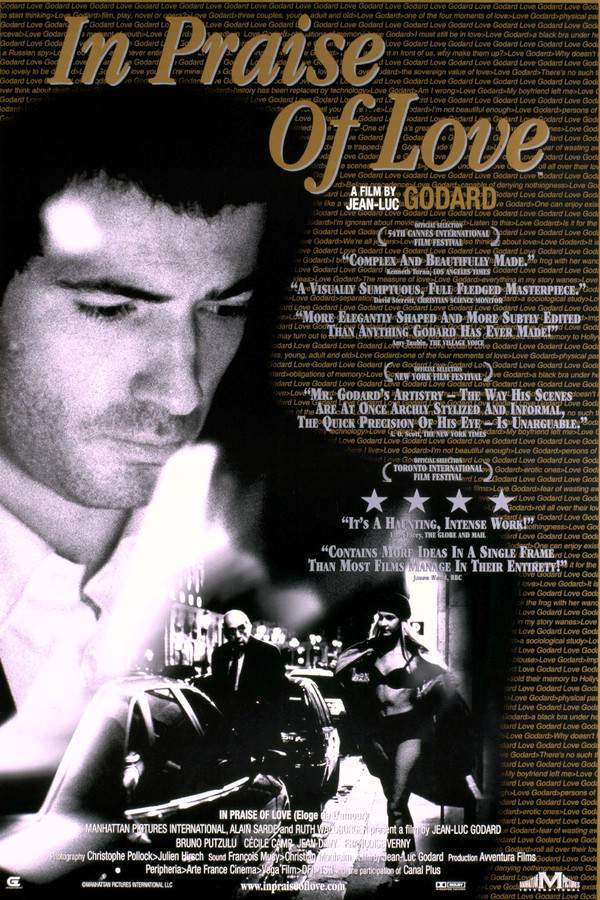
In Praise of Love (2002) movie poster

Timeline

In Praise of Love (2002) Timeline Explained – Every Event in Order

Release, runtime and language
2002 · 97 min · French
Directed by
Jean-Luc Godard
Starring
Bruno Putzulu, Cecile Camp

A moving story explores the complexities of love across different stages of life, focusing on three interconnected couples. A writer’s work intertwines with his relationship with a lawyer who is also navigating her own family history. Her past includes a surprising connection to a film project about her grandparents’ courageous actions during a difficult period in France. The narrative delves into the challenges and joys of relationships, revealing personal secrets and unexpected opportunities along the way.

On this page (5)
  1. 1 Events in order (13)
  2. 2 Timeline questions answered
  3. 3 Movie threads
  4. 4 Movies like In Praise of Love
  5. 5 Every angle

13 events in order · contains spoilers

In Praise of Love Timeline: Events in Chronological Order

Every key event of In Praise of Love (2002) in order, scene by scene, with when and where it takes place. Use it to untangle flashbacks, time jumps and parallel storylines, to refresh your memory before the sequel or to find the exact scene you are thinking of.

  1. Edgar's Mysterious Project

    The film opens with Edgar, a man deeply invested in an enigmatic project exploring the four stages of love. He is consumed by thoughts of how to express these concepts, leaving him with an empty book full of blank pages.

    Where
    Paris
  2. Meeting Berthe

    Edgar reflects on a significant encounter with Berthe, a bold woman he met two years earlier. He craves a deeper connection with her, believing she holds the key to his creative process.

    Where
    Paris
  3. Interviews with the Misérables

    In pursuit of inspiration, Edgar conducts interviews with marginalized individuals in Paris, inspired by Victor Hugo's characters. Despite his efforts, he struggles to capture the essence of adulthood, stemming from his desire for an emotional connection.

    Where
    Paris
  4. Finding Berthe at Work

    Encouraged by his financial backer, Mr. Rosenthal, Edgar tracks down Berthe at her night job. Though she recognizes him and appreciates their past encounter, she is focused on supporting her young son and declines to assist him.

    Where
    Train station
  5. Mark Hunter's Lecture

    During a chance encounter, Edgar attends a lecture by journalist Mark Hunter on the Kosovo War. This event surprisingly rekindles his connection with Berthe, leading to a stroll through the vibrant streets of Paris.

    Where
    Paris
  6. Contemplating a Future Together

    While walking, Edgar and Berthe discuss their lives and the historical significance of the city around them. Their conversation culminates at an abandoned Renault plant as they ponder the impact of the workers' movement.

    Where
    Renault plant, Paris
  7. Emotional Phone Call

    Their connection intensifies during a poignant phone call, where they reflect on their unresolved feelings. Edgar feels the tension of his unfinished project weighing heavily on him, adding complexity to their relationship.

  8. Tender Moment at the Shelter

    Seeking creative authenticity, Edgar visits a homeless shelter where he carefully selects a man for a tender shower scene. Mr. Rosenthal observes this scene, indicating heightened expectations for Edgar's project.

    Where
    Homeless shelter, Paris
  9. Edgar's Journey to Brittany

    Transitioning back in time, Edgar arrives in Brittany, where he meets a minister of culture. This encounter introduces him to Jean Lacouture and sets him on a path to deeper understanding of the French Resistance.

    Where
    Brittany
  10. Meeting the Elderly Couple

    In Brittany, Edgar encounters an elderly couple whose love story captures the attention of 'Spielberg Associates.' Their granddaughter Berthe feels their story may be compromised by exploitation in the film industry.

    Where
    Brittany
  11. Berthe's Struggles Against Corporate Forces

    As their relationship develops, Berthe struggles against the unseen corporate forces that threaten her family's legacy. Her challenges reflect her search for identity amidst a changing world.

  12. Edgar's Paradox of Thought

    Upon returning to Paris, Edgar reflects on the paradox of perception—the tension between the familiar and new experiences. This contemplation deepens, as he remains unaware of the impending dark fate that awaits Berthe.

    Where
    Paris
  13. Dark Fate Looms

    Unbeknownst to Edgar, Berthe faces a grim future that threatens the course of their relationship. This looming tragedy casts a shadow over Edgar's already tumultuous creative journey.

Last updated: November 15, 2024 at 16:28

Was this helpful?

Timeline questions answered

In Praise of Love Timeline Explained: Your Questions Answered

When does it happen, and why in that order? The questions people ask about the chronology of In Praise of Love (2002): time jumps, flashbacks, cause and effect between scenes and the correct order of events, each answered with spoilers.

Q1

Why can't Edgar complete his project about the four stages of love?

Edgar struggles to capture the essence of adulthood in his work. While the stages of youth and old age seem clear to him, adulthood remains elusive. This reflects his own emotional disconnection - he has never fully experienced the depth of adult love, which is why he keeps returning to Berthe, believing she holds the key to understanding what he's missing.

Foreshadowing: Earlier, Edgar admits he spends his time staring at blank pages, unable to find inspiration.

  • edgar
  • project
  • four stages of love
  • adulthood
  • creative block
Q2

Why does Berthe refuse to help Edgar with his project?

Berthe is focused on survival rather than artistic endeavors. She works multiple jobs, including cleaning trains at night, to provide for her young son. She recognizes Edgar and appreciates that he remembered her, but she cannot afford to take time away from her responsibilities to participate in his creative pursuit.

Foreshadowing: The timeline notes she is 'focused on supporting her young son' when Edgar finds her.

  • berthe
  • jobs
  • son
  • refusal
  • project
Q3

What is the connection between Berthe and the elderly couple in Brittany?

The elderly couple in Brittany are Berthe's grandparents. Their lifelong partnership is being adapted into a film by 'Spielberg Associates,' and Berthe is fighting to protect their legacy from what she perceives as corporate exploitation. This family connection is why Edgar meets her when he travels to Brittany to research the French Resistance.

Foreshadowing: Edgar meets the couple in Brittany and learns their granddaughter is named Berthe.

  • berthe
  • grandparents
  • brittany
  • spielberg
  • family
Q4

Why does Edgar visit a homeless shelter for his project?

Edgar seeks authentic human connection and emotional truth for his work. By selecting a homeless man for a tender shower scene, he attempts to capture raw, unguarded human moments - the kind of genuine emotion and vulnerability that eludes him in his own life and prevents him from completing his project about adult love.

Foreshadowing: Edgar is perpetually dissatisfied with his work and yearns for authentic emotional connection.

  • homeless shelter
  • authenticity
  • emotional truth
  • project
Q5

What is Mr. Rosenthal's role in the story?

Mr. Rosenthal is Edgar's financial backer and an art dealer connected to Edgar's family legacy. He pushes Edgar to find Berthe and monitors his progress on the project. His presence at the homeless shelter scene suggests he has significant expectations for the final work and a personal interest in Edgar's success.

Foreshadowing: Mr. Rosenthal encourages Edgar to track down Berthe and observes his creative process.

  • mr rosenthal
  • art dealer
  • backer
  • family legacy
Q6

How do Edgar and Berthe reconnect after their initial meeting?

Edgar encounters Berthe again at a lecture by journalist Mark Hunter about the Kosovo War. This chance meeting allows them to reconnect, leading to a stroll through Paris and deeper conversations about their lives and the city's history.

Foreshadowing: Edgar attends the lecture seeking inspiration, and the event unexpectedly brings him back to Berthe.

  • mark hunter
  • kosovo lecture
  • paris
  • reunion
Q7

Why does the film switch between black-and-white and color cinematography?

The black-and-white sequences depict the present day in Paris, where Edgar is struggling with his project and pursuing Berthe. The color sequences flash back two years earlier to Brittany, showing how Edgar first met the elderly couple (Berthe's grandparents) and began his research. This non-linear structure reflects Edgar's own fragmented memory and creative process.

Foreshadowing: The timeline explicitly indicates which events are present and which are two years earlier.

  • cinematography
  • non-linear
  • flashback
  • visual style
Q8

What happens to Berthe at the end of the film?

The film hints at a dark fate awaiting Berthe, though the exact details remain ambiguous. This looming tragedy casts a shadow over Edgar's creative journey and their relationship. The ending leaves their story unresolved, with Edgar unaware of what awaits her.

Foreshadowing: The meta notes confirm the ending is ambiguous with unresolved tension around character relationships.

  • berthe
  • dark fate
  • ending
  • tragedy
Q9

Why does Edgar interview marginalized people for his project?

Edgar believes the individuals whom Victor Hugo termed 'les misérables' are essential to understanding the full spectrum of human love and experience. He draws a parallel between his artistic exploration and Hugo's social exploration, seeking authentic stories from those on society's margins.

Foreshadowing: Edgar is inspired by Victor Hugo's characters and seeks diverse perspectives for his work.

  • les misérables
  • interviews
  • marginalized
  • authentic stories
Q10

What drives Edgar's obsession with finding the right form for his project?

Edgar questions whether his work about the four stages of love should become a novel, play, opera, or film. His uncertainty reflects a deeper artistic crisis - he cannot determine how to express something he hasn't fully experienced. The blank pages symbolize his emotional emptiness, particularly regarding adult love.

Foreshadowing: Edgar spends his time flicking through an empty book with blank pages, awaiting inspiration.

  • creative inspiration
  • artistic form
  • blank pages
  • four stages of love
Q11

What is the significance of Mark Hunter's Kosovo War lecture?

The lecture represents Edgar's search for meaning and connection beyond his personal artistic concerns. The Kosovo War discussion contrasts with his introspective journey and serves as a catalyst that unexpectedly brings Berthe back into his life, showing how global events can intersect with personal narratives.

Foreshadowing: Edgar is described as seeking inspiration from diverse sources, including current events.

  • mark hunter
  • kosovo war
  • lecture
  • global events
Q12

What does the abandoned Renault plant represent in the film?

The Renault plant symbolizes the decline of the workers' movement and France's industrial past. Edgar and Berthe's conversation there connects their personal relationship to larger themes of historical change, loss, and the passage of time - all relevant to Edgar's meditation on love's stages.

Foreshadowing: Edgar and Berthe discuss the historical significance of the city and its monuments.

  • renault plant
  • workers movement
  • historical change
  • paris

Movie threads

More Movies Like In Praise of Love, by Mood & Story

Curated lists built around what makes In Praise of Love tick: the same mood, the same kind of story or the same emotional payoff. Each list explains why these movies belong together.

Movies about memory and melancholy like In Praise of Love

Stories where love is intertwined with the haunting weight of the past. If you enjoyed the reflective, melancholic tone of In Praise of Love, you'll find similar movies here. These films explore interconnected stories of love and the past, often with a slow, thoughtful pace and an ambiguous, emotionally resonant feel.

  • melancholic
  • contemplative
  • existential
  • reflective
  • atmospheric
  • lonely
  • Tone: melancholic, contemplative, existential
  • Pacing: slow, deliberate, atmospheric
Why these movies?

The story pattern: The narrative pattern often involves fragmented timelines, connecting personal relationships to broader historical or philosophical themes. Characters are frequently artists or intellectuals grappling with how memory shapes identity and connection, leading to journeys of discovery rather than clear resolutions.

Why they belong together: Movies are grouped here for their shared focus on a slow, melancholic tone, complex narrative structures that play with time, and a primary interest in love as an existential concept intertwined with memory, rather than a simple plot device.

Movies with interwoven narratives of art and life like In Praise of Love

Films where the creative process mirrors the messy complexities of human connection. For viewers who liked how In Praise of Love wove together a writer's project with stories of love and resistance. This collection features similar films where artistic endeavors are intricately linked to the characters' emotional and historical journeys.

  • reflective
  • intellectual
  • interconnected
  • artistic
  • thoughtful
  • complex
  • Tone: reflective, intellectual, melancholic
  • Pacing: slow, thoughtful, character-driven
Why these movies?

The story pattern: The narrative structure typically involves multiple storylines that echo or comment on each other, often centering on a protagonist who is an artist. Their creative struggle parallels their personal relationships, blurring the lines between their work and their life, leading to revelations about both.

Why they belong together: These films share a focus on the theme of artistic creation, using it as a framework to explore interconnected human stories. They possess a similar intellectual weight, medium intensity, and a tendency towards ambiguous endings that provoke thought rather than provide closure.

If you liked this

Movies Like In Praise of Love

Similar movies to In Praise of Love: the same genre, themes or kind of story. Each one comes with its own plot summary, timeline and ending explained.

Browse all movie summaries

Every angle

In Praise of Love (2002) Explained: Plot, Timeline & Characters

Everything about In Praise of Love in one place: what happens in the plot summary, the timeline in chronological order, the characters and meaning and a spoiler-free summary. What's After the Movie adds the cast, box office and post-credit scenes.

Coming soon on iOS and Android

The Plot Explained Movie Summary App

Plot summaries, endings explained and timelines on your phone. Catch up on any movie in minutes, save your favorites and never miss a twist again.

Be the first to know when we launch. Your email stays private, always.

Learn more about the app