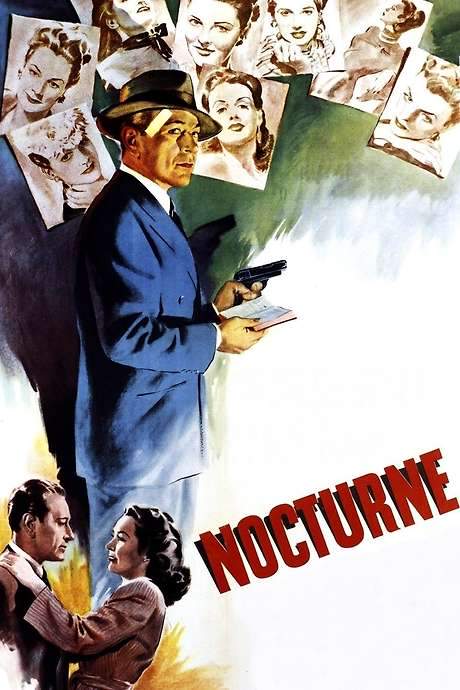
In a moody, noir-tinged New York thrill ride, the story unfolds largely through flashbacks as New York sports promoter Frankie Christopher, [Victor Mature], is interrogated at a police station about the murder of a rising young actress, Vicky Lynn, [Carole Landis]. The narrative takes shape as Christopher recounts how he first met Vicky in a lively restaurant, where she worked as a waitress, and how his friends challenged him to try to turn her into a star. The tale then spirals through the glamour and grit of show business, where ambition, jealousy, and danger collide.
Christopher’s recollection centers on a bold dare: to transform Vicky from a hopeful to a headline-name with their help. He teams up with two friends whose roles in this scheme are as much about ego as opportunity. Robin Ray, [Alan Mowbray], a fading actor, and Larry Evans, [Allyn Joslyn], a sharp-tongued gossip columnist, throw themselves into the plan with a mix of bravado and genuine belief that they can craft Vicky’s destiny. Their early efforts are bright with possibility—concerted auditions, calculated appearances, and a carefully staged path that makes Vicky’s ascent plausible within the bustling, scrutinizing world of Hollywood-bound fame. Yet even at this promising dawn, the seeds of trouble begin to sprout, hinted at in the tensions that simmer beneath the surface of showbiz dreams.
Vicky’s momentum grows, but so do the costs. She signs with a powerful Hollywood producer, a step that ratchets up the stakes for everyone involved. At the apartment she shares with her sister Jill Lynn, [Betty Grable], the tension cracks open. Vicky makes a startling confession to Christopher: she is leaving him as she readies for a new chapter in her career. The words land like a blunt instrument, and a heated confrontation follows. The next morning, Jill returns to the apartment to discover Vicky dead beside her sister’s belongings, with Christopher standing nearby. The scene establishes a murder that is not only personal but embedded in the larger machine of celebrity culture, where loyalties shift and the line between success and manipulation can be deadly.
Detective Ed Cornell, [Laird Cregar], becomes the force that drives the case—relentless and unbending, yet increasingly aggressive in method. With little concrete evidence to hold Christopher, Cornell releases him but remains absolutely certain of the promoter’s guilt. His approach is coercive and invasive, as he infiltrates Christopher’s home and other places without warrants, using power as a weapon in a bid to squeeze a confession from a man who insists he is innocent. The tension between a man fighting for his life and a detective who believes he already has the truth becomes a central axis of the story, highlighting themes of justice, prejudice, and the costs of chasing certainty in a city where appearances can be meticulously manufactured.
As the investigation twists forward, Jill—who hadn’t always seen eye to eye with Christopher—begins to see him in a new light. The two quietly grow closer, not out of romance alone but out of a shared motive to uncover what happened to Vicky. They follow Vicky’s past movements, retracing the steps of her recent life: the meetings, the suggestive entanglements, the small evidence that points toward a more complicated killer than a single, obvious suspect. In this search, the pair moves from suspicion to collaboration, their uneasy alliance gradually turning into trust even as danger closes in around them. The emotional stakes are high, and the bond between Jill and Frankie becomes a counterweight to Cornell’s unyielding pursuit of a straightforward culprit.
Their investigation begins to crack the veil around the building where Vicky spent much of her last days. It is here that the trio—Christopher, Jill, and the sprawling, shadow-filled chain of witnesses—narrow the focus to a person who has easy access and motive: Harry Williams, the front desk manager of the building, a figure who knows the rhythms of the place and the people who pass through. Williams, [Elisha Cook Jr.], is pressed with questions and awkward truths, and he eventually admits to the crime. Yet his confession alone doesn’t end the case, because Cornell’s earlier insinuations have already cast a longer shadow across Christopher’s name. Williams’ admission seems genuine, but it also unfolds against Cornell’s insinuations that he already knew of the culpability, a detail that raises questions about the detective’s methods and the cost of freeing an innocent man in a system that can be as dangerous as the crime.
With Williams’ admission in hand, the story hurtles toward a final confrontation that reveals the deeper web of jealousy, ambition, and manipulation that defined the case from the outset. Christopher travels to Cornell’s apartment and discovers walls plastered with posters of Vicky, a stark reminder of how a life can be commodified and consumed by the pursuit of notoriety. What follows is a culminating moment in which Cornell finally confesses to attempting to frame Christopher, a crime born from jealousy over Vicky’s growing star power and the competitive hunger that pervades the police, the press, and the performers themselves. The truth emerges not simply as a confession of murder, but as an exposé of a system where power—whether in law, media, or celebrity—can distort justice and threaten the innocent.
Across this labyrinth of flashbacks, interrogations, and quiet alliances, the film keeps its focus on the human costs of stardom and the uneasy alliances formed in its wake. Frankie Christopher’s persistence in the face of an aggressive, biased investigation becomes a testament to tenacity and hope, even as the mystery settles into a carefully reasoned resolution. Jill’s loyalty, too, deepens into a genuine partnership forged in the shadow of tragedy, illustrating how personal relationships can be a counterforce to the cold machinery of fame and law. In the end, the truth about Vicky’s death is laid bare, the corrupting influence of jealousy exposed, and the characters—each with their own ambitions and flaws—are left to reckon with what the case has demanded of them.