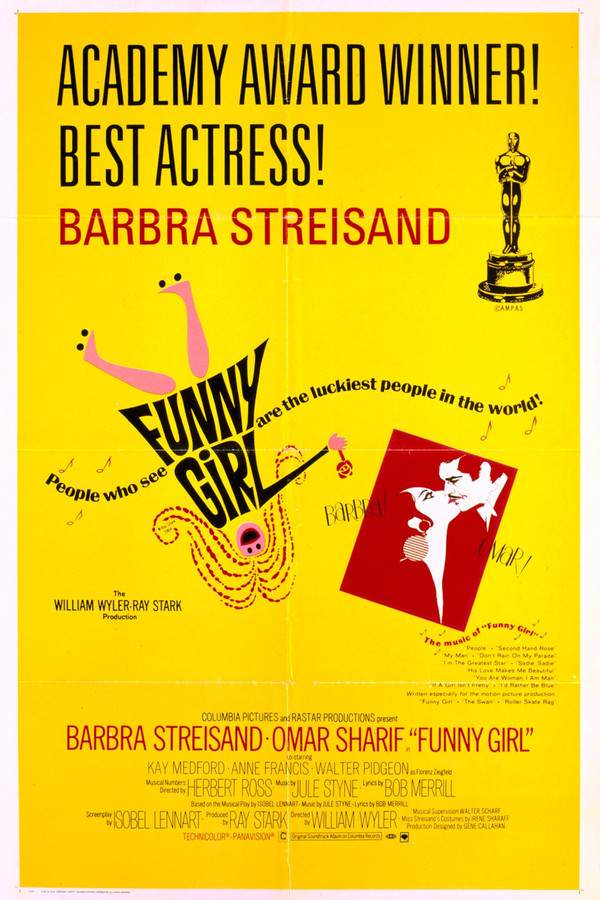
Year: 1968
Runtime: 151 min
Language: English
Director: William Wyler
A spirited young woman named Fanny Brice overcomes a challenging upbringing to achieve stardom as a vaudeville performer and Broadway sensation. Her talent and infectious energy captivate audiences, but her personal life becomes complicated by a passionate and troubled relationship with Nick Arnstein. As Fanny rises to fame within the dazzling world of Ziegfeld’s Follies, she must navigate the complexities of love and ambition.
Warning: spoilers below!
Haven’t seen Funny Girl yet? This summary contains major spoilers. Bookmark the page, watch the movie, and come back for the full breakdown. If you're ready, scroll on and relive the story!
Read the complete plot breakdown of Funny Girl (1968), including all key story events, major twists, and the ending explained in detail. Discover what really happened—and what it all means.
Set in and around New York City just before and after World War I, this sparkling, character-driven portrait follows Fanny Brice, Barbra Streisand, as she chases a dream of stage stardom and the unpredictable path that love can take. A young Jewish girl with a quick wit and a gift for song, Fanny lands her first job in vaudeville amid a chorus of doubts from her mother and her mother’s card-playing friends, who question whether she’s truly cut out for the spotlight. When a rehearsal goes awry and her dancing seems out of step, she keeps going, turning a botched roller-skating act into a moment of genuine laughter that greases the wheels of her eventual rise. After this rocky start, fate intervenes in the most delightful way—she crosses paths with Nicky Arnstein, a suave and magnetic man who will become the pivot of her life, even as he remains a volatile force in her world.
Months pass, and Fanny’s dream begins to take shape. She earns a spot in the legendary Ziegfeld Follies, where she experiments with her act—portraying a pregnant bride in a wedding gown to introduce a comic twist that turns out to be perfectly timed and irresistibly charming. The reaction from audiences is electric, and even a wary Florenz Ziegfeld can’t help but applaud the spark she brings to the stage. Nicky Arnstein, the man who first teased out her smile, is there to toast her success; his presence marks the start of a complex, high-stakes romance that will pull her through the tougher days and brighter nights to come.
In short order, Fanny becomes a Broadway sensation. On a tour that briefly separates them, a Baltimore reunion rekindles their romance, though the flame is soon tested by misfortune: Nicky’s racehorse loses big, leaving him financially strapped. He heads to Europe to gamble, and Fanny, driven by devotion and momentum, abandons the tour to chase him aboard a tugboat that takes her to his ship as it sails away. The gamble pays off for a time, and a marriage follows, bringing with it a banked wealth, a grand home, and a daughter—moments that seem to promise a life of triumph as the Follies silhouette fades into the background and a family life takes center stage. Yet the pressures of money and ambition cast long shadows, and Fanny’s comeback on stage becomes a lifeline she fights to protect.
As Nicky’s business ventures falter, he leans back into gambling to recover losses, and the strain of missed premieres—especially Fanny’s joy at a new Wurlitzer-filled performance—creeps in. Her mother offers blunt counsel: love him less, but help him more. The couple’s finances become tangled—Nicky is drawn into a lucrative but risky scheme that he soon realizes Fanny is funding, prompting a turn toward a dangerous bond-smuggling venture. The morning matinee that follows becomes a turning point: Florenz Ziegfeld himself informs Fanny that Nicky has been arrested for embezzlement. He urges her to stay away from the courthouse, a request she bravely defies. At the hearing, Nicky doesn’t mount a defense; instead, the judge invites him to his chambers for a private moment with Fanny, where the gambler’s fate is sealed with an 18-month sentence for embezzlement. In that stark moment, he urges her to stay true to her calling with a memorable line that lingers: “keep on being a Funny Girl.”
Back in the present timeline, Fanny sits in the wings, waiting for news of Nicky’s return from prison. When he finally arrives, the reunion is both tender and painful, a poignant reminder that love’s glow can coexist with the ache of separation. The couple ultimately chooses to part ways, leaving Fanny with a heartfelling sense of what might have been, yet with the resolve to carry on as a performer who has already changed the face of entertainment.
Throughout, the story intertwines ambition, romance, triumph, and circumstance in a way that honors the era—the glitter of the Ziegfeld Follies, the texture of a bustling New York, and the fragile, enduring pull of love under pressure. This portrait captures not only a spectacular performer’s ascent but also the personal costs of fame, the stubborn resilience required to keep smiling when the world weighs heavy, and the quiet, stubborn truth that sometimes the bravest thing you can do is keep performing, even when the curtain falls.
Last Updated: November 22, 2025 at 15:58
Discover curated groups of movies connected by mood, themes, and story style. Browse collections built around emotion, atmosphere, and narrative focus to easily find films that match what you feel like watching right now.
Stories of women who conquered the stage but found heartbreak off it.Dive into more movies like Funny Girl that explore the bittersweet lives of female entertainers. If you enjoyed the story of Fanny Brice's rise to fame amidst romantic woes, you'll find similar tales of glamour, ambition, and personal sacrifice in these acclaimed biographical dramas and musicals.
Stories in this thread typically follow a 'rise and fall' emotional arc, charting a woman's journey from obscurity to stardom while a central, often flawed, romantic relationship deteriorates. The narrative contrasts public triumphs with private despair, creating a poignant tension between celebration and loss.
These movies are grouped by their shared exploration of a specific emotional paradox: the joy of artistic achievement versus the pain of personal compromise. They share a glamorous, nostalgic setting, a bittersweet tone, and a focus on resilient yet vulnerable female protagonists.
When achieving a dazzling dream means paying a heavy personal price.Discover more films similar to Funny Girl that grapple with the theme of ambition versus love. If you were captivated by Fanny Brice's struggle to balance her Broadway stardom with her troubled marriage, you'll appreciate these stories of characters facing the difficult choice between a dazzling career and a fulfilling personal life.
The narrative pattern revolves around a protagonist pursuing a grand goal (fame, power, artistic perfection) while their most important relationship suffers, often due to neglect, competing priorities, or the protagonist's own driven nature. The story structure juxtaposes scenes of professional ascent with the slow unraveling of personal bonds.
Movies here share a core thematic tension: the conflict between public achievement and private happiness. They are united by a bittersweet or melancholic mood, a steady pacing that allows for character development, and a medium emotional weight that balances triumph with loss.
Don't stop at just watching — explore Funny Girl in full detail. From the complete plot summary and scene-by-scene timeline to character breakdowns, thematic analysis, and a deep dive into the ending — every page helps you truly understand what Funny Girl is all about. Plus, discover what's next after the movie.
Track the full timeline of Funny Girl with every major event arranged chronologically. Perfect for decoding non-linear storytelling, flashbacks, or parallel narratives with a clear scene-by-scene breakdown.
Discover the characters, locations, and core themes that shape Funny Girl. Get insights into symbolic elements, setting significance, and deeper narrative meaning — ideal for thematic analysis and movie breakdowns.
Get a quick, spoiler-free overview of Funny Girl that covers the main plot points and key details without revealing any major twists or spoilers. Perfect for those who want to know what to expect before diving in.
Visit What's After the Movie to explore more about Funny Girl: box office results, cast and crew info, production details, post-credit scenes, and external links — all in one place for movie fans and researchers.
Discover movies like Funny Girl that share similar genres, themes, and storytelling elements. Whether you’re drawn to the atmosphere, character arcs, or plot structure, these curated recommendations will help you explore more films you’ll love.
Funny Girl (1968) Scene-by-Scene Movie Timeline
Funny Girl (1968) Movie Characters, Themes & Settings
Funny Girl (1968) Spoiler-Free Summary & Key Flow
Movies Like Funny Girl – Similar Titles You’ll Enjoy
Florence Foster Jenkins (2016) Complete Plot Breakdown
Funny Face (2021) Full Movie Breakdown
42nd Street (1933) Complete Plot Breakdown
Who's That Girl (1987) Plot Summary & Ending Explained
Funny Face (1957) Film Overview & Timeline
Fame (2009) Full Movie Breakdown
Girl Crazy (1943) Plot Summary & Ending Explained
Girls Just Want to Have Fun (1985) Story Summary & Characters
Ziegfeld Follies (1945) Film Overview & Timeline
Dance, Girl, Dance (1940) Plot Summary & Ending Explained
Funny Lady (1975) Story Summary & Characters
Ziegfeld Girl (1941) Complete Plot Breakdown
Blondie of the Follies (1932) Full Summary & Key Details
Show Girl (1928) Story Summary & Characters
Glorifying the American Girl (1929) Movie Recap & Themes