








Plot Explained Spoilers guaranteed!
Plot Explained

Browse by genre

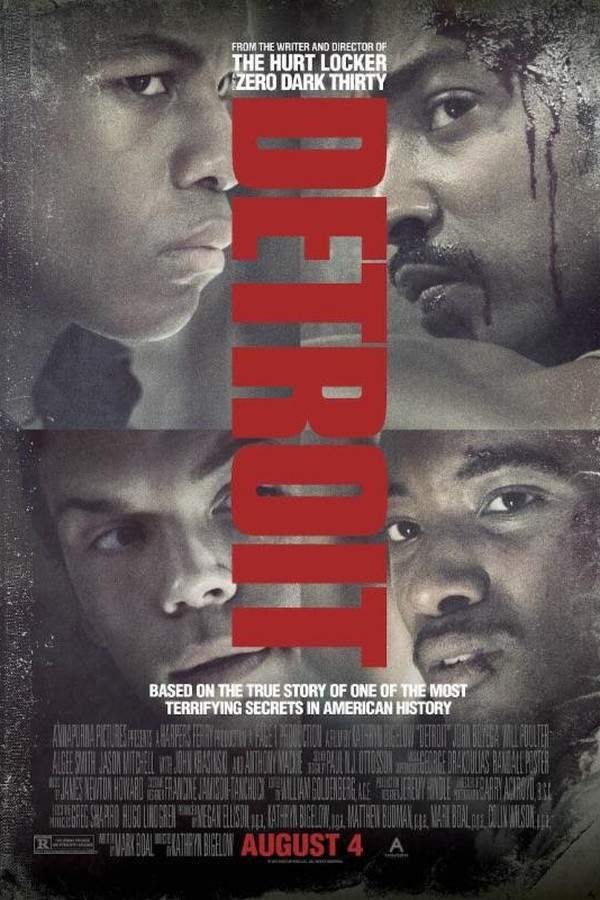
Detroit (2017) movie poster

Timeline

Detroit (2017) Timeline Explained – Every Event in Order

Release, runtime and language
2017 · 143 min · English
Echo score 68
JustWatch #7,873 243
Directed by
Kathryn Bigelow
Starring
Jason Mitchell, Jack Reynor, Anthony Mackie, Will Poulter, John Boyega, Algee Smith
Budget
$34M

During the Detroit riots of 1967, a tense situation escalates at the Algiers Motel. Following reports of gunfire, police and a militia group raid the motel, leading to a night of terror for its occupants. As officers abandon protocol, they resort to violence and intimidation, demanding confessions from the frightened residents. The events culminate in the deaths of three unarmed men and leave others severely beaten, exposing a shocking display of brutality and injustice.

On this page (6)
  1. 1 Where to watch
  2. 2 Events in order (15)
  3. 3 Timeline questions answered
  4. 4 Movie threads
  5. 5 Movies like Detroit
  6. 6 Every angle

Where to watch

Where to Watch Detroit (2017)

Where can you watch Detroit? Stream, rent or buy it in the US, including on ALLBLK, fuboTV and The CW: current JustWatch availability with up-to-date prices.

Streaming availability powered by JustWatch

15 events in order · contains spoilers

Detroit Timeline: Events in Chronological Order

Every key event of Detroit (2017) in order, scene by scene, with when and where it takes place. Use it to untangle flashbacks, time jumps and parallel storylines, to refresh your memory before the sequel or to find the exact scene you are thinking of.

  1. Racial Tensions in 1960s America

    The 1960s in America were marked by intense racial tensions, especially in urban centers like Detroit. With a significant African American population living in segregated neighborhoods, there was a palpable friction between the communities and the aggressive police force overseeing them.

    When
    1960s
    Where
    Detroit
  2. July 23, 1967: Police Raid

    On July 23, 1967, Detroit police raided an unlicensed bar celebrating the return of African American veterans from military service. This unfortunate event sparked outrage, and a mob quickly gathered, escalating the situation as they began to protest and loot local businesses.

    When
    July 23, 1967
    Where
    Detroit
  3. Start of the 12th Street Riot

    The raid on the bar ignited the 12th Street Riot, which would become one of the most devastating riots in American history. People expressed their anger with violence and unrest, marking the start of widespread civil disorder in the city.

    When
    July 23, 1967
    Where
    12th Street, Detroit
  4. Mobilization of the National Guard

    In response to the chaos of the riots, Michigan Governor George W. Romney mobilized the Michigan National Guard and Army paratroopers to restore order in Detroit. This decision underscores the severity of the situation and the inability of local authorities to manage the unrest.

    Where
    Detroit
  5. Fatal Shooting of a Looting Suspect

    During the second day of the riots, officer Philip Krauss shot a fleeing looter, ignoring orders to refrain from firing. This incident further inflamed tensions and raised questions about police conduct amidst the crisis that was unfolding.

    When
    July 24, 1967
    Where
    Detroit
  6. The Dramatics Arrive in Detroit

    Meanwhile, the renowned African American R&B group, The Dramatics, arrived in Detroit, hoping to secure a recording contract. Their excitement quickly turned to despair when police closed down the venue where they were set to perform, forcing them to leave the city.

    When
    July 1967
    Where
    Detroit
  7. Rioters Attack Tour Bus

    As The Dramatics attempted to leave, their tour bus was attacked by rioters, forcing the group to splinter and seek safety. Larry Reed and Fred Temple found refuge at the Algiers Motel, a temporary safe haven during the unrest.

    When
    July 1967
    Where
    Algiers Motel, Detroit
  8. A Night at the Algiers Motel

    At the Algiers Motel, Larry and Fred met two white girls, Julie and Karen, and shared a bittersweet experience amidst the chaos. However, after a prank went awry, tensions arose, prompting the girls to decide to switch rooms, setting the stage for the ensuing tragedy.

    When
    July 1967
    Where
    Algiers Motel, Detroit
  9. Carl Cooper Provokes Police

    In a misguided attempt to play a prank, Carl Cooper fired several blanks outside, inadvertently convincing police that they were under sniper fire. This dangerous miscalculation led to a catastrophic response from the police, heightening the already volatile situation.

    Where
    Algiers Motel, Detroit
  10. Police Arrive at the Motel

    Following the blank shots fired by Cooper, police, led by Krauss, raided the Algiers Motel. In the chaos, Krauss fatally shot Carl as he attempted to flee, disgracefully planting a knife near him to fabricate evidence and cover up the misconduct.

    Where
    Algiers Motel, Detroit
  11. Torture and Coercion

    Following the shooting, the police rounded up the motel’s guests, threatening violence to extract confessions regarding the supposed shooter. This horrific event unfolded as the guests endured psychological torture under the guise of a 'game', leading to tragic outcomes.

    Where
    Algiers Motel, Detroit
  12. Death of Aubrey Pollard

    In the turmoil of that night, Aubrey Pollard was killed as police brutality escalated. The ensuing chaos left the remaining guests in fear and distrust, further highlighting the systemic violence that permeated the situation.

    Where
    Algiers Motel, Detroit
  13. Dismukes Wrongfully Charged

    As the riots began to subside, Melvin Dismukes was wrongfully arrested and charged with murder after Julie mistakenly identified him. This incident illustrated the tragic flaws in the justice system and the racial injustices that persisted post-riot.

    Where
    Detroit
  14. Trial and Acquittal

    In the aftermath of the investigations, multiple officers were questioned, but an all-white jury ultimately acquitted both Dismukes and Krauss, despite the evidence of misconduct. This not only highlighted systemic racism but also left Dismukes confronting the unjust outcomes of the events.

    Where
    Detroit
  15. Aftermath for the Survivors

    In closing, the aftermath of the riot left deep scars on all involved. Dismukes relocated to escape potential retaliation, while Krauss remained on the force, albeit never returning to active duty. Other survivors like Julie and Larry attempted to rebuild their lives, shaped forever by the horror of that night.

    Where
    Detroit

Last updated: November 15, 2024 at 19:18

Was this helpful?

Timeline questions answered

Detroit Timeline Explained: Your Questions Answered

When does it happen, and why in that order? The questions people ask about the chronology of Detroit (2017): time jumps, flashbacks, cause and effect between scenes and the correct order of events, each answered with spoilers.

Q1

Why did police raid the unlicensed bar that sparked the Detroit riots?

Police raided an unlicensed club where African American veterans were celebrating their return from the Korean and Vietnam Wars. The raid was conducted because the club lacked a liquor license, but the timing, targeting a joyous celebration of Black veterans, inflamed racial tensions already present in the city, triggering the 12th Street Riot.

Foreshadowing: The film establishes early that Detroit in 1967 was a deeply segregated city with high racial tensions between the African American community and the aggressive white police force.

  • 12th street riot
  • police raid
  • 1967 detroit
  • unlicensed bar
  • african american veterans
Q2

Why did Carl Cooper fire blanks at the Algiers Motel?

Carl Cooper fired blank rounds from a gun as a prank, intending to scare the National Guard troops stationed outside. He did not realize that blank cartridges would be indistinguishable from real gunfire in the chaotic environment, leading troops to believe they were under sniper attack.

Foreshadowing: Earlier scenes show Carl as a reckless young man eager to assert himself during the riots, setting up his dangerous decision-making.

  • carl cooper
  • blank shots
  • algiers motel
  • national guard
  • sniper fire
Q3

Why did Officer Krauss shoot and kill Carl Cooper at the motel?

When police stormed the motel following the blank shot incident, Carl Cooper attempted to flee. Officer Philip Krauss pursued and fatally shot Carl, disregarding any attempt to arrest him. The killing was unjustified and represented the escalation of police violence that characterized the entire night.

Foreshadowing: Earlier, Krauss is shown shooting a fleeing looter on the second day of the riots, demonstrating his pattern of disregarding orders and using lethal force.

  • philip krauss
  • carl cooper
  • police shooting
  • algiers motel
  • excessive force
Q4

Why was a knife planted near Carl Cooper's body?

After shooting Carl Cooper, Officer Krauss planted a knife next to the body to fabricate evidence suggesting Carl was armed and dangerous. This was an attempt to justify the unjustified killing and cover up the misconduct, demonstrating the extent to which police would manipulate evidence to protect themselves.

Foreshadowing: This incident reflects the broader pattern of police corruption and fabrication seen throughout the film, where authority figures manipulate the narrative to escape consequences.

  • knife
  • evidence planting
  • cover up
  • philip krauss
  • police misconduct
Q5

Why did police force the motel guests to play games during the interrogation?

After rounding up the guests, police subjected them to psychological torture disguised as a 'game' called 'Simon Says.' This was designed to intimidate, humiliate, and psychologically break the guests into confessing or implicating each other. The so-called game was actually a method of extracting confessions through fear and mental abuse.

Foreshadowing: The film establishes early that the police operation at the motel operates outside any legal framework, with officers abandoning protocol in favor of brute force and psychological terror.

  • simon says game
  • psychological torture
  • interrogation
  • algiers motel
  • police brutality
Q6

Why was Melvin Dismukes arrested and charged with murder?

Melvin Dismukes, a private security guard who was at the motel attempting to protect a grocery store, was wrongfully arrested after Julie Ann, one of the white girls at the motel, mistakenly identified him as one of the shooters. Her identification, made under extreme duress and trauma, led to Dismukes being charged with murder despite his innocence.

Foreshadowing: Julie had been traumatized by the night's events and her identification of Dismukes reflects the混乱 and confusion that characterized the entire night.

  • melvin dismkues
  • wrongful arrest
  • julie ann
  • mistaken identity
  • murder charge
Q7

Why were the officers acquitted at trial despite the evidence of misconduct?

Both Officer Krauss and Melvin Dismukes were acquitted by an all-white jury. Despite evidence of Krauss planting the knife and the brutal torture of guests, the jury refused to convict. This outcome highlighted the systemic racism in Detroit's justice system, where white police officers were rarely held accountable for violence against Black citizens.

Foreshadowing: The film foreshadows this outcome through the repeated scenes of police operating without consequence and the all-white composition of the jury pool.

  • acquittal
  • trial
  • all-white jury
  • systemic racism
  • police accountability
Q8

What happened to Larry Reed after the Algiers Motel incident?

Larry Reed, one of the members of The Dramatics who sought shelter at the motel, was deeply traumatized by the night's events. After the riots ended, he eventually became a choir singer and continued living in Detroit, finding solace in music while carrying the psychological scars of that night.

Foreshadowing: Larry's trauma is evident in his demeanor following the incident, as the film shows him withdrawing into silence after the interrogation.

  • larry reed
  • dramatics
  • choir singer
  • detroit
  • aftermath
Q9

Why did Julie mistakenly identify Dismukes as the shooter?

Julie Ann was subjected to extreme psychological trauma and violence throughout the night at the motel. Under such intense stress and fear, her ability to accurately identify her attackers was severely compromised. She mistakenly identified Dismukes, who had been present at the motel but was not one of the shooters, due to the confusion and trauma of the ordeal.

Foreshadowing: The film shows Julie being berated and threatened by Krauss during the interrogation, leaving her in a state of terror and confusion.

  • julie ann
  • melvin dismkues
  • misidentification
  • trauma
  • algiers motel
Q10

How did the 12th Street Riot lead to the events at Algiers Motel?

The 12th Street Riot created the chaotic environment that brought all the characters to Algiers Motel. The Dramatics' tour bus was attacked by rioters, forcing Larry and Fred to seek shelter there. The riot also prompted the massive police and National Guard presence that responded to Carl Cooper's blank shots, ultimately leading to the motel raid.

Foreshadowing: The film explicitly connects these events, showing how the broader civil unrest directly caused the specific tragedy at the motel.

  • 12th street riot
  • algiers motel
  • connection
  • detroit riots 1967
  • cause and effect

Movie threads

More Movies Like Detroit, by Mood & Story

Curated lists built around what makes Detroit tick: the same mood, the same kind of story or the same emotional payoff. Each list explains why these movies belong together.

True-life historical tragedies like Detroit

Gripping, dramatized accounts of real-world events where systemic injustice prevails. Movies like Detroit that are based on true stories of systemic injustice and historical tragedy. If you were gripped by the harrowing realism and social commentary of Detroit, you'll find similar powerful dramas here that expose real-world failures and their devastating human impact.

  • sobering
  • grim
  • infuriating
  • historical
  • documentary-style
  • unsettling
  • Tone: dark, sobering, grim
  • Pacing: steady, deliberate
Why these movies?

The story pattern: The narrative pattern follows a linear, often procedural, recounting of a true event. The focus is on exposing a chain of actions and their consequences, typically culminating in a bleak or bittersweet ending where justice is rarely served. The emotional journey is one of witnessing helplessness and the crushing weight of an unfair system.

Why they belong together: These films are grouped by their commitment to historical veracity, a dark and heavy tone, and a shared thematic focus on exposing real societal flaws. They prioritize emotional impact and social commentary over traditional entertainment, creating a cohesive experience of sobering reflection.
Claustrophobic thrillers of sustained terror like Detroit

Stories where characters are trapped in a single location, facing escalating psychological horror. If you liked the intense, single-location terror of Detroit, explore these claustrophobic thrillers. These movies trap characters in confined spaces, creating a similar feeling of escalating dread, powerless victims, and oppressive antagonists that make for a uniquely tense and unsettling viewing experience.

  • claustrophobic
  • tense
  • anxious
  • oppressive
  • unrelenting
  • psychological terror
  • Tone: tense, oppressive, dark
  • Pacing: relentless, steady
Why these movies?

The story pattern: Narratives typically begin with a triggering event that confines the characters. The plot then unfolds in real-time or over a compressed period, focusing on the psychological battle between the trapped and the tormentors. The structure is straightforward, emphasizing the raw, visceral experience of fear and survival over complex plotting.

Why they belong together: These movies share a specific cinematic vibe defined by a confined setting, high and sustained intensity, and a dark, oppressive tone. The similarity lies in the feeling of being trapped and the relentless pacing that creates a continuous state of anxiety for the viewer.

If you liked this

Movies Like Detroit

Similar movies to Detroit: the same genre, themes or kind of story. Each one comes with its own plot summary, timeline and ending explained.

Browse all movie summaries

Every angle

Detroit (2017) Explained: Plot, Timeline & Characters

Everything about Detroit in one place: what happens in the plot summary, the timeline in chronological order, the characters and meaning and a spoiler-free summary. What's After the Movie adds the cast, box office and post-credit scenes.

Coming soon on iOS and Android

The Plot Explained Movie Summary App

Plot summaries, endings explained and timelines on your phone. Catch up on any movie in minutes, save your favorites and never miss a twist again.

Be the first to know when we launch. Your email stays private, always.

Learn more about the app