Plot Explained Spoilers guaranteed!
Plot Explained

Browse by genre

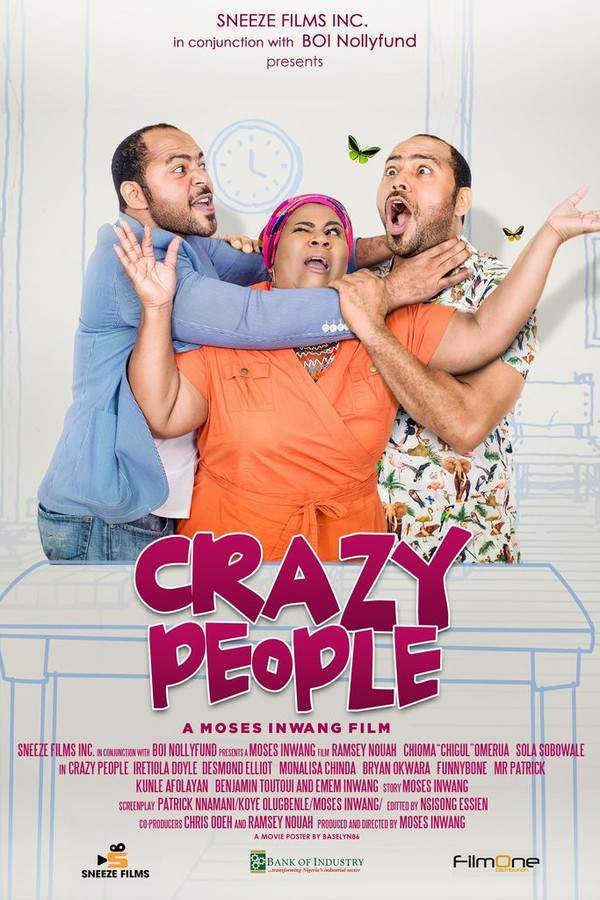
Crazy People (1990) movie poster

Plot Summary

Crazy People (1990) Plot Summary Explained

Release, runtime and language
1990 · 90 min · English
Directed by
Barry L. Young
Starring
Paul Reiser, J.T. Walsh, Bill Smitrovich, Dudley Moore, Daryl Hannah, Danton Stone

Chaos descends upon the entertainment industry when a lookalike begins impersonating actor Ramsey Nouah. As the imposter's antics escalate, Nouah must race against time to uncover the doppelganger's motives and reclaim his reputation. The situation spirals into a comical battle of identity, forcing Nouah to confront the bizarre side of fame and the lengths people will go to for attention. It's a funny and ultimately touching story about finding yourself amidst the absurdity of celebrity.

On this page (6)
  1. 1 Where to watch
  2. 2 What happens: full plot
  3. 3 Plot questions answered
  4. 4 Movie threads
  5. 5 Movies like Crazy People
  6. 6 Every angle

Where to watch

Where to Watch Crazy People (1990)

Where can you watch Crazy People? Stream, rent or buy it in the US, including on Hoopla, Amazon Video and Apple TV Store: current JustWatch availability with up-to-date prices.

Streaming availability powered by JustWatch

Full plot summary · contains spoilers

What Happens in Crazy People: Full Plot Summary

The whole story of Crazy People (1990) explained, from the opening scene to the final frame: every key event, every twist and what it all adds up to. Read it as a quick recap before the sequel, to check a scene you missed, or to finally understand what really happened.

In the midst of a professional meltdown, Emory Leeson, portrayed by Dudley Moore, plunges into a bout of anxiety and begins discarding his customary flair for advertising. Instead, he experiments with a range of transparently honest advertisements that challenge the status quo of his industry. This drastic shift shocks his coworkers, including J.T. Walsh as Stephen Bachman, who, seeing Emory's rapid descent, intervenes by having him committed to a psychiatric hospital.

Upon arriving at the hospital, Emory finds himself immersed in a new and bewildering environment. Here, he meets intriguing fellow patients, such as the complex Kathy Burgess, played by Daryl Hannah, whose apparent fragility masks a fierce resilience. Another noteworthy character is George, whose charmingly limited vocabulary consists only of the word "Hello!"

Things take a surprising twist when Emory's unorthodox advertisements are accidentally released and shockingly gain acclaim, disrupting the advertising world as his boss, Drucker, claims credit for the groundbreaking idea. Meanwhile, Emory's creativity doesn’t go unnoticed; his hospital connections thrive as he and a handful of patients, including Paul Bates as Kathy's brother, start innovating outside the conventional bounds of their illness.

Despite the corporate meddling by Drucker, who employs Bill Smitrovich and others to replicate Emory's success, none can capture the original's magic. While confined to the hospital, Emory insists on involving his fellow patients in crafting new advertisements, ensuring they receive their share of recognition and pay. This unique collaboration transforms the hospital into an unlikely hub for advertising ingenuity, as they brainstorm quirky slogans like, >"Forget Paris. The French can be annoying. Come to Greece. We're nicer!" and "Come… IN the Bahamas" for tourism.

As confidence builds within the group, so too do the strides the patients make in their recovery, with George evolving from his singular phrase into a more loquacious individual. However, not everyone welcomes these changes—Drucker and the administration grow increasingly antagonistic, seeking to cut Emory off from his creative team. Yet, steadfast in her support, Dr. Baylor, Emory's therapist, champions the patients’ artistic pursuits.

Amidst this creative renaissance, a romance blossoms between Emory and Kathy. Together, they hatch a daring plan to escape the confines of the hospital aboard an army helicopter piloted by Kathy's brother. Joined by their fellow patients, including Sony who serves as their first client with a cheeky campaign slogan, they venture into a new chapter in life enriched by creativity, empathy, and an abundance of humor.

Last updated: November 17, 2024 at 21:04

Was this helpful?

Plot questions answered

Crazy People Plot Explained: Your Questions Answered

The questions people ask most about Crazy People (1990): what happens in the confusing scenes, why the characters do what they do, the twists, hidden details and what the ending means. Each answer contains spoilers.

Q1

Why was Emory committed to a psychiatric hospital?

Emory's coworker Stephen Bachman intervened after witnessing Emory's rapid professional meltdown. Emory had abandoned his successful advertising style and began creating brutally honest advertisements that challenged industry norms. Bachman, concerned by Emory's sudden erratic behavior and mental decline, arranged for him to be involuntarily committed to a psychiatric hospital.

Foreshadowing: Earlier scenes show Emory's increasing anxiety and his radical departure from his usual creative approach, hinting at his psychological break.

  • emory leeson
  • psychiatric hospital
  • stephen bachman
  • mental breakdown
  • commitment
Q2

How did Emory's honest advertisements become successful?

The advertisements were accidentally released to the public and unexpectedly gained acclaim. The brutal honesty of Emory's approach resonated with audiences who were tired of typical advertising hyperbole. His slogans like 'Forget Paris. The French can be annoying. Come to Greece. We're nicer!' stood out precisely because they broke from the industry's standard deception.

Foreshadowing: Emory's decision to abandon his usual flair was driven by anxiety about the honesty of advertising, foreshadowing his breakthrough approach.

  • honest advertisements
  • advertising success
  • creative breakthrough
  • emery leeson
Q3

Why did Drucker claim credit for Emory's work?

Drucker, Emory's boss, saw the accidental success of the honest advertisements and attempted to appropriat the credit for himself. When the ads gained acclaim, Drucker wrongly claimed the groundbreaking idea as his own, attempting to benefit from Emory's creative work despite being in a psychiatric hospital.

Foreshadowing: Drucker's early interactions with Emory established his focus on profit and corporate success over creative integrity.

  • drucker
  • advertising boss
  • credit theft
  • corporate greed
Q4

How did Emory and the patients collaborate on advertisements?

While confined to the hospital, Emory involved his fellow patients in creating new advertisements. He ensured they received recognition and pay for their contributions. The group brainstormed quirky slogans like 'Come… IN the Bahamas' for tourism, transforming the psychiatric hospital into an unlikely hub of advertising ingenuity.

Foreshadowing: Emory's arrival at the hospital introduced him to patients like George and Kathy, establishing the creative team that would form.

  • patient collaboration
  • advertising team
  • creative group
  • kathy burgess
  • george
Q5

Why did George's communication improve at the hospital?

George, who initially could only say 'Hello!', began expressing himself more freely as the patients gained confidence through their advertising work. The creative collaboration and personal growth they experienced as a group contributed to George's improvement, showcasing the therapeutic power of meaningful work and community.

Foreshadowing: George's limited vocabulary was established early, making his later development a notable character arc.

  • george patient
  • communication improvement
  • recovery
  • growth
Q6

How did Emory and Kathy escape from the psychiatric hospital?

Emory and Kathy devised a bold escape plan using an army helicopter piloted by Kathy's brother, who was also a patient. They escaped alongside their fellow patients, marking both a physical liberation from the institution and a metaphorical leap toward their new creative futures.

Foreshadowing: The romance between Emory and Kathy develops throughout their collaboration, building toward their joint escape.

  • escape plan
  • helicopter
  • kathy brother
  • hospital escape
Q7

What happened to the advertising venture after leaving the hospital?

After escaping, the group successfully secured their first client and launched their own advertising venture. Sony became their first customer with a cheeky campaign slogan. They embraced their potential as a creative team, stepping into a new chapter enriched by creativity, empathy, and humor.

Foreshadowing: The group's success at creating advertisements while in the hospital foreshadowed their ability to continue outside its confines.

  • advertising venture
  • first client
  • sony
  • new beginning
  • partnership
Q8

Why did Dr. Baylor support Emory's advertising work?

Dr. Baylor, Emory's therapist, championed the patients' artistic pursuits throughout their time at the hospital. She advocated for their creativity and believed in their potential, contrasting sharply with the corporate interests that sought to undermine their success. Her support was instrumental in enabling the patients to pursue their creative endeavors.

Foreshadowing: Dr. Baylor's supportive role was established early as she worked with Emory and the other patients.

  • dr baylor
  • therapist support
  • patient advocacy
  • creative encouragement
Q9

Why couldn't Drucker replicate Emory's advertising success?

Despite hiring others to replicate Emory's honest advertising style, Drucker and his team failed to capture the original's magic. The authenticity and personal touch that Emory brought through his collaboration with fellow patients could not be artificially reproduced. The genuine creativity and emotional resonance of their work stemmed from real human experience and connection, which corporate imitation could not duplicate.

Foreshadowing: Drucker's earlier attempts to claim credit established his pattern of trying to profit from others' work without understanding its essence.

  • drucker failure
  • imitation
  • corporate sabotage
  • advertising authenticity
Q10

What motivated Stephen Bachman to have Emory committed?

Stephen Bachman, Emory's coworker, was genuinely concerned by the rapid decline in Emory's mental state. Seeing Emory abandon his successful advertising approach and descend into what appeared to be a breakdown, Bachman believed that involuntary commitment was necessary for Emory's welfare. However, his intervention also reflected the corporate world's discomfort with Emory's radical departure from professional norms.

Foreshadowing: Bachman's concern appeared genuine at first, though the movie later questions whether institutional intervention was truly the best solution.

  • stephen bachman
  • intervention
  • motivation
  • co-worker concern

Movie threads

More Movies Like Crazy People, by Mood & Story

Curated lists built around what makes Crazy People tick: the same mood, the same kind of story or the same emotional payoff. Each list explains why these movies belong together.

Movies about creative found families like Crazy People

Outsiders band together to build an unconventional family through shared creative expression. If you liked the heartwarming story of misfits finding purpose together in Crazy People, you'll enjoy these similar movies. This list features comedies and dramas where an unconventional group bands together through creativity, defying expectations to form a unique and supportive family.

  • hopeful
  • quirky
  • touching
  • creative
  • uplifting
  • bittersweet
  • Tone: hopeful, whimsical, touching
  • Pacing: steady, character-driven
Why these movies?

The story pattern: The narrative typically follows a protagonist who feels isolated or out of place, finding belonging with a group of fellow eccentrics. Their shared creative endeavor—be it art, music, or a business—becomes the catalyst for personal growth, challenging the status quo and proving that true family is found, not given. The central conflict often involves overcoming societal or institutional pressures to celebrate their unique identities.

Why they belong together: These films are grouped together because they share a core theme of empowerment through community and creativity. They blend comedy with heartfelt emotion, maintaining a hopeful tone and a light-to-medium emotional weight, ensuring the journey is ultimately uplifting and affirming.

Satirical comedies with heart like Crazy People

Sharp, funny critiques of society that never lose their warmth and humanity. Looking for more funny and touching satires like Crazy People? This list features movies that blend sharp, whimsical humor with genuine heart. If you enjoyed the critique of advertising mixed with heartfelt character moments, these similar stories offer a perfect balance of silly and sincere.

  • satirical
  • silly
  • touching
  • absurd
  • uplifting
  • quirky
  • Tone: hopeful, silly, touching
  • Pacing: steady
Why these movies?

The story pattern: Stories in this thread often place relatable characters within a bizarre or exaggerated system (like corporate culture or an institution). The plot uses their interactions with this system to generate both comedy and poignant insights. The satire is never mean-spirited; instead, it highlights human follies to ultimately affirm individuality, connection, and hope.

Why they belong together: This thread groups movies that masterfully balance satire with sincerity. They share a specific tonal mix: the pacing is steady, the intensity is medium, and the emotional weight is light, creating an experience that is intellectually amusing and emotionally satisfying without being heavy or bleak.

If you liked this

Movies Like Crazy People

Similar movies to Crazy People: the same genre, themes or kind of story. Each one comes with its own plot summary, timeline and ending explained.

Browse all movie summaries

Every angle

Crazy People (1990) Explained: Plot, Timeline & Characters

Everything about Crazy People in one place: what happens in the plot summary, the timeline in chronological order, the characters and meaning and a spoiler-free summary. What's After the Movie adds the cast, box office and post-credit scenes.

Coming soon on iOS and Android

The Plot Explained Movie Summary App

Plot summaries, endings explained and timelines on your phone. Catch up on any movie in minutes, save your favorites and never miss a twist again.

Be the first to know when we launch. Your email stays private, always.

Learn more about the app