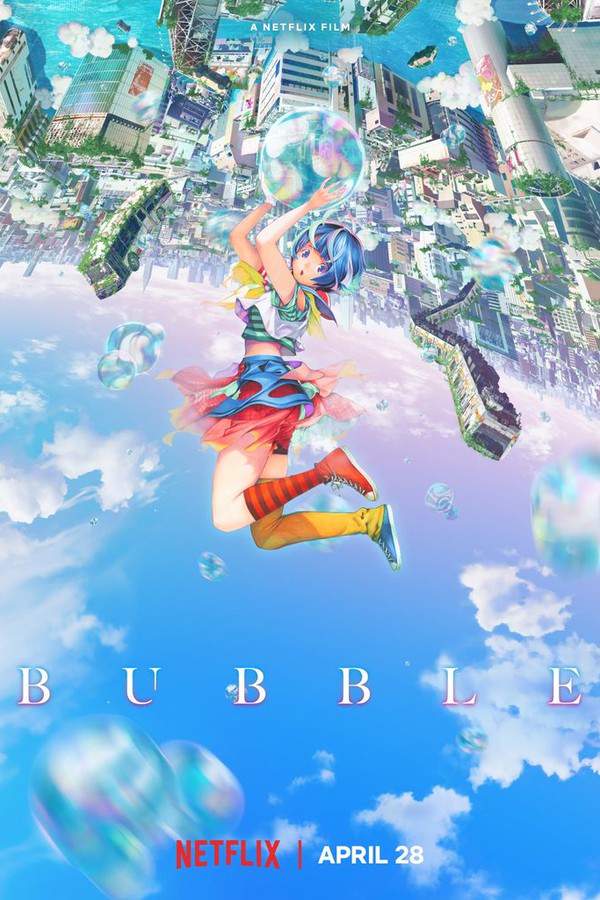
In the near future, a surreal phenomenon unfolds as countless bubbles bend the very laws of reality around the world. An explosion at Tokyo Tower concentrates these bubbles into Tokyo itself, transforming it into an uninhabitable landscape where only the bold and defiant dare to survive. In this fractured city, young people carve out a risky life by trading supplies through parkour tournaments, turning gravity-defying runs into a currency of resilience. Within this dangerous backdrop, a parkour squad called the Blue Blazes stands out, and at its heart is an 18-year-old Hibiki, a prodigy whose extraordinary skill on the rooftops masks a quiet isolation caused by a heightened hearing sensitivity.
As the city becomes increasingly hostile, Tokyo Tower remains an almost mythical obstacle, its reach blocked by persistent gravity anomalies that make access feel like a forbidden dream. Hibiki continues to push himself, moving with a precision that makes the impossible look effortless, yet he keeps others at a distance, preferring the solitary focus that his condition demands. The thrill of the chase and the lure of the tower pull him toward a hidden truth: he is drawn to a sound—a woman’s song that seems to float through the bubbles and call him upward. On a daring climb, he almost reaches a figure he believes is a boy, but tragedy strikes when he falls into the ocean that surrounds the tower. It is there, in the moment of his final breath mingling with the bubbles, that a new life begins: a young girl appears, seemingly born from the air itself, as if the sea and the bubbles conspired to create a human presence from the exhale Hibiki releases.
This girl is named Uta, a name he gives her because she somehow knows the song he hears in his head. She is unmistakably new to humanity, yet she rapidly learns from the people around her, absorbing their ways and movements with an instinctive grace. Together, they train in parkour, their bond growing as they push their limits side by side. The duo quickly rises through the ranks, taking on and besting a rival clan known as the Morticians or Undertakers, whose own rules and rituals echo the morbid symmetry of a world built on fragile, dissolving certainties. In the heat of competition and companionship, a pivotal moment arrives when Uta’s touch on Hibiki triggers a painful revelation: her arm fades away into the very bubbles that birthed her. The threat of rising bubble activity forces Tokyo’s residents to flee once more, but Uta remains determined to act.
Driven by an urgent purpose, Uta journeys toward Tokyo Tower to halt the catastrophe she senses there, while Hibiki sets out to rescue her from whatever dangers lie ahead. In the film’s defining sequence, the two push each other to the brink, and their sacrifice becomes a mutual salvation. They save one another as the world around them seems to collapse into a final, luminous breath. Yet, in a nod to a timeless fairy tale, Uta dissolves back into bubbles, her fate echoing Hans Christian Andersen’s The Little Mermaid. In her final moment, she tells Hibiki that their time together was worth everything it cost to make her human.
With the immediate threat gone and the bubbles receding, Tokyo’s citizens begin to rebuild their lives, and the parkour teams resume their routines, forever marked by what they shared. The end credits offer a lingering note: Hibiki keeps moving through his cityscape, a lone figure still in motion, followed by a bubble whose origin hints at Uta’s presence—an afterimage that blurs the line between memory and myth, reality and dream.