















Plot Explained Spoilers guaranteed!
Plot Explained

Browse by genre

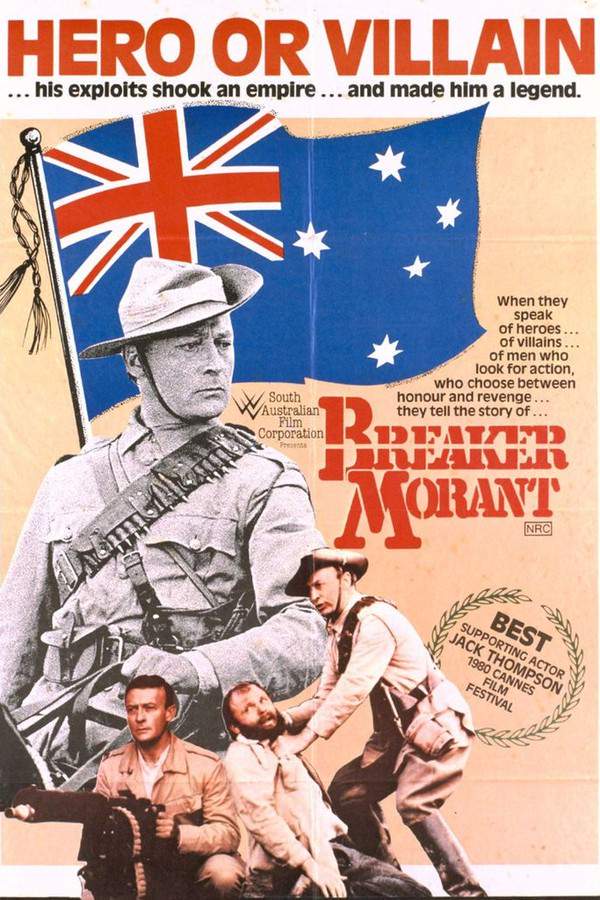
Breaker Morant (1980) movie poster

Timeline

Breaker Morant (1980) Timeline Explained – Every Event in Order

Release, runtime and language
1980 · 107 min · English
JustWatch #12,194 547
Directed by
Bruce Beresford
Starring
Bryan Brown, John Waters, Jack Thompson, Charles 'Bud' Tingwell, Chris Haywood, Edward Woodward

During the Second Boer War in South Africa, Australian soldiers Harry "Breaker" Morant, Peter Handcock, and George Witton are accused of committing war crimes. They find themselves in a desperate situation, facing a court-martial and the formidable Lord Kitchener, the British Commander-in-Chief. Kitchener is determined to secure their convictions, even if it means compromising justice, to strengthen his position during peace negotiations with the Boer forces.

On this page (6)
  1. 1 Where to watch
  2. 2 Events in order (14)
  3. 3 Timeline questions answered
  4. 4 Movie threads
  5. 5 Movies like Breaker Morant
  6. 6 Every angle

Where to watch

Where to Watch Breaker Morant (1980)

Where can you watch Breaker Morant? Stream, rent or buy it in the US, including on Amazon Prime Video, HBO Max and Fawesome: current JustWatch availability with up-to-date prices.

Streaming availability powered by JustWatch

14 events in order · contains spoilers

Breaker Morant Timeline: Events in Chronological Order

Every key event of Breaker Morant (1980) in order, scene by scene, with when and where it takes place. Use it to untangle flashbacks, time jumps and parallel storylines, to refresh your memory before the sequel or to find the exact scene you are thinking of.

  1. Murder Trial Begins

    The film opens with the start of the murder trial of three Australian soldiers, Harry 'Breaker' Morant, Peter Handcock, and George Witton. They are accused of murdering a Boer prisoner, which sets the stage for the unfolding legal and moral complexities of the case.

  2. Accusations and Charges

    The accused soldiers face serious charges, including the murder of six additional Boer prisoners. The prosecution consists of military officials who underscore the gravity of the accusations, highlighting the implications for soldiers in wartime.

  3. Lord Kitchener's Involvement

    Lord Kitchener, determined to end the Boer War, uses the trial to showcase military accountability. His goal is to emphasize that even his own soldiers must face justice if they violate wartime ethics, placing significant pressure on the trial proceedings.

  4. Morant's Motivations

    The narrative delves into Morant's motivations, revealing his fierce desire for revenge after the death of his commanding officer, Captain Hunt. This personal loss drives him to take extreme actions against Boer captives, shaping the story's tragic trajectory.

  5. Brutal Attack on Boer Camp

    In retaliation for Captain Hunt's mutilation, Morant leads a brutal attack on a Boer camp. This violent act results in capturing a Boer wearing Captain Hunt's uniform, culminating in Morant executing him without hesitation, illustrating the raw emotions driving him.

  6. Execution of Boer Prisoners

    Morant's rationale for executing six Boer prisoners highlights his belief that they posed a threat. He claims orders from higher authorities allowed for such actions, illustrating his moral justifications amidst the chaos of war and personal loss.

  7. Death of Rev. Hesse

    The plot thickens with the involvement of the German missionary, Rev. Hesse. Suspecting him of espionage, Morant's fury leads to Hesse's murder, a decision that weighs heavily on the court's trial as both Morant and Handcock navigate their culpability.

  8. The Trial's Bias

    As the trial progresses, the biases of the court become glaringly evident. Major Thomas argues that unrecorded orders existed to execute Boer prisoners, yet the informal nature of communications complicates the defense, showcasing the intertwined politics of the trial.

  9. Murder of Hesse Acquittal

    Despite the evidence against Morant and Handcock regarding Hesse's murder, the court acquits them of this charge. However, they are found guilty on other counts, emphasizing the moral ambiguities that underpin their actions during the war.

  10. Verdict and Sentences

    The trial concludes with devastating outcomes. While Witton's sentence is reduced to life imprisonment, Morant and Handcock face execution, highlighting the cruel ironies of a wartime justice system that prioritizes accountability over individual lives.

    When
    The following morning
  11. Execution Day

    On the day of their execution, an ironic twist of fate occurs; Handcock's coffin is too small for his body. This grotesque moment underscores the tragic consequences of the soldiers' actions and the toll of war on their lives.

  12. Aftermath of the Trial

    The aftermath of the trial reveals the fates of the soldiers. Major Thomas returns to Australia to continue his law practice, while Witton endures a lengthy prison sentence, ultimately finding a controversial avenue for storytelling.

    Where
    Australia
  13. Witton's Publication

    Witton writes *Scapegoats of the Empire*, a book detailing the events surrounding the Breaker Morant affair. However, the book's content is so inflammatory that it is suppressed during the World Wars, reflecting societal tensions over historical narratives.

  14. Legacy of the Trial

    The trial leaves a lasting impact on military ethics and wartime accountability. It serves as a poignant case study illuminating the complexities and moral dilemmas faced by soldiers during conflicts.

Last updated: November 15, 2024 at 16:37

Was this helpful?

Timeline questions answered

Breaker Morant Timeline Explained: Your Questions Answered

When does it happen, and why in that order? The questions people ask about the chronology of Breaker Morant (1980): time jumps, flashbacks, cause and effect between scenes and the correct order of events, each answered with spoilers.

Q1

Why was Harry Morant put on trial?

Harry Morant and two other Australian soldiers were charged with war crimes for murdering a Boer prisoner and executing six additional Boer prisoners. They were also implicated in the sniper-style killing of Rev. Hesse, a German missionary. The trial was politically motivated, as Lord Kitchener wanted to demonstrate military accountability to strengthen his position during peace negotiations with the Boer forces.

  • harry morant trial
  • boer war crimes
  • court martial
Q2

What motivated Morant to execute the Boer prisoners?

Morant's primary motivation was revenge following the mutilation and death of his friend and commanding officer, Captain Hunt. After witnessing Hunt's brutal killing, Morant led a brutal attack on a Boer camp and subsequently executed captured Boer soldiers, rationalizing their deaths by claiming orders from Whitehall permitted such actions.

Foreshadowing: The film establishes Captain Hunt's death as the pivotal event that triggers Morant's descent into vengeful violence.

  • morant revenge
  • captain hunt death
  • boer prisoners executed
Q3

Who was Captain Hunt and why did his death matter?

Captain Hunt was Morant's friend and commanding officer in the Bushveldt Carbineers. His mutilation and death at the hands of Boer forces was the catalyst for Morant's extreme actions. Morant captured a Boer wearing Hunt's uniform and executed him without hesitation, demonstrating how Hunt's death drove Morant to seek brutal revenge.

  • captain hunt
  • bushveldt carbineers
  • morant commanding officer
Q4

What happened to Rev. Hesse in the film?

Rev. Hesse, a German missionary, was suspected of being a spy by Morant after witnessing him conversing with Boer captives. In a fit of anger, Morant expressed fury about the situation, which prompted Handcock to pursue the missionary. Hesse was found dead the following morning, though the court ultimately acquitted both Morant and Handcock of this specific charge.

  • rev hesse
  • german missionary
  • hesse murder
Q5

Did Lord Kitchener order the execution of Boer prisoners?

Major Thomas argued that unrecorded verbal orders existed from Kitchener to execute all Boer prisoners, which would explain Morant's actions. However, proving these orders existed was impossible since Captain Hunt conveyed them to Morant through informal channels. The court's bias toward a guilty verdict prevented proper examination of this defense.

  • kitchener orders
  • whitehall orders
  • verbal orders boer war
Q6

Why was the court-martial considered biased?

The court showed clear bias toward a predetermined guilty outcome because Lord Kitchener needed a conviction to demonstrate military accountability. This was essential for his peace negotiations with the Boer forces. The chief of the court supported Kitchener's goal of securing guilty verdicts, undermining the fairness of the proceedings.

  • court bias
  • military justice
  • kitchener political pressure
Q7

What happened to George Witton after the trial?

Witton was originally sentenced to death, but Kitchener reduced his sentence to life imprisonment. After serving three years, he was released amidst public outcry. He later wrote a controversial book titled "Scap scapegoats of the Empire" detailing the Breaker Morant affair, which was suppressed during the World Wars due to its inflammatory content.

  • george witton
  • scapegoats of the empire
  • witton prison sentence
Q8

Why were Morant and Handcock executed but not Witton?

Morant and Handcock were found guilty of the murder of the Boer prisoners and executed the following morning. Witton, despite being convicted, received a reduced sentence from Kitchener, life imprisonment instead of death, likely because his involvement was considered less direct. Kitchener conveniently avoided being present during the pleas for reprieve.

  • morant handcock execution
  • witton sentence reduced
  • death sentence boer war
Q9

What was the significance of the Breaker Morant trial?

The trial served as a political tool for Kitchener to demonstrate British military ethics and accountability during Boer War peace negotiations. It illuminated the moral complexities of wartime justice and the disposable nature of soldiers in larger political games. The trial left a lasting impact on military ethics and became a case study in wartime accountability.

  • military ethics
  • boer war peace talks
  • wartime accountability
Q10

Why was Handcock's coffin too small?

On the day of execution, Handcock's coffin was too small for his body, requiring a grotesque effort by soldiers to fit his corpse inside. This macabre detail underscores the tragic and undignified end to the soldiers' lives, highlighting the film's theme of the dehumanizing consequences of war.

  • handcock coffin
  • execution scene
  • grotesque death

Movie threads

More Movies Like Breaker Morant, by Mood & Story

Curated lists built around what makes Breaker Morant tick: the same mood, the same kind of story or the same emotional payoff. Each list explains why these movies belong together.

Military courtroom dramas with political intrigue like Breaker Morant

High-stakes court-martials where the real crime is political expediency. If you liked the gripping legal battle in Breaker Morant, explore more movies like it. This collection features tense military court-martials, stories of political scapegoating, and dramas that question the ethics of war and command, perfect for fans of historical and legal injustice narratives.

  • tense
  • somber
  • procedural
  • courtroom
  • political
  • grim
  • Tone: tense, bleak, morally complex
  • Pacing: steady, procedural
Why these movies?

The story pattern: The narrative follows a procedural structure, alternating between courtroom testimony and flashbacks that provide context for the alleged crimes. The central conflict pits individual soldiers against an immovable military institution, building towards a foregone conclusion that highlights systemic injustice.

Why they belong together: These films are grouped by their shared focus on the military justice system as a dramatic engine. They create tension through the clash between procedural detail and the overwhelming power of political motives, resulting in a sobering and intellectually engaging experience.
Grim historical exposés of injustice like Breaker Morant

Sobering true stories where individuals are crushed by unforgiving systems. For viewers seeking movies like Breaker Morant, this list features grim historical dramas based on true events. These films share a heavy emotional weight, a tense and somber tone, and a focus on political and military injustice, offering a similarly powerful and sobering viewing experience.

  • somber
  • oppressive
  • grim
  • historical
  • dramatic
  • morally complex
  • Tone: somber, oppressive, dramatic
  • Pacing: steady, deliberate
Why these movies?

The story pattern: The narrative journey is typically a downward trajectory, following protagonists who discover the true cost of serving a corrupt or indifferent system. The plot methodically dismantles any hope of a fair outcome, culminating in a conclusion that serves as a critique of a historical period or power structure.

Why they belong together: This thread connects films that use historical drama as a means of critique. They share a heavy, oppressive mood, a steady pacing that builds dread, and a commitment to portraying the bleak reality of historical events, making them impactful and emotionally resonant.

If you liked this

Movies Like Breaker Morant

Similar movies to Breaker Morant: the same genre, themes or kind of story. Each one comes with its own plot summary, timeline and ending explained.

Browse all movie summaries

Every angle

Breaker Morant (1980) Explained: Plot, Timeline & Characters

Everything about Breaker Morant in one place: what happens in the plot summary, the timeline in chronological order, the characters and meaning and a spoiler-free summary. What's After the Movie adds the cast, box office and post-credit scenes.

Coming soon on iOS and Android

The Plot Explained Movie Summary App

Plot summaries, endings explained and timelines on your phone. Catch up on any movie in minutes, save your favorites and never miss a twist again.

Be the first to know when we launch. Your email stays private, always.

Learn more about the app