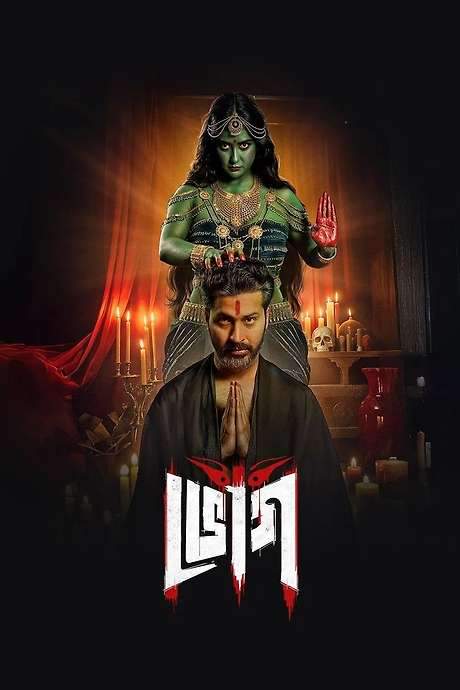
Atin Anirban Bhattacharya is a bachelor who lives with his elderly aunt Pushparani Das Sudipa Basu after his mother's death. A private employee, he is an extrovert who loves clubbing after office hours, until a mysterious brass idol from his friend Subesh Chhandak Chowdhury’s antique shop starts to alter the rhythm of his days. The statue’s goddess is unlike any he has seen before, holding a veena in her upper left hand, a kharga in the upper right, a human skull in the lower left, and a calm, inviting lower right hand in aashirvad mudra. When Atin asks Subesh about the idol’s name, the shopkeeper admits he doesn’t know either, having acquired it from an old house without a clear origin.
From the moment the idol enters his home, Atin begins to have haunted, sleepless nights. In his dreams, a greenish goddess appears, demanding offerings and claiming she is hungry. He responds by bringing her flowers and fruits as bhog, certain that he is simply appeasing a supernatural presence. Bhavesh Rajatabha Dutta kaku casts a wary eye on the statue, concluding that it depicts a tantric goddess. Alongside Pushparani Das, he warns Atin not to worship her without proper rituals, stressing that any misstep could invite a dangerous wrath. Yet Atin becomes more absorbed, his social life fading as his fixation grows into an all-consuming devotion.
Concerned, Bhavesh kaku arranges a priest to identify the idol, but the shock runs both ways: Atin performs a demented devotional dance for the goddess, and the priest cannot recognize the rite or its dangers. The priest advises against continuing the worship until the rituals are understood. But Atin is steadfast, insisting that the goddess speaks to him in his dreams and that their bond—his “ Maa - chele” relationship—must not be interfered with.
One day Atin encounters a mysterious homeless widow, Damri [Parno Mittra], who stops his car asking for food and shelter. Despite Pushparani Das’s objections, Atin welcomes her into their home, and Damri begins cooking bhog for the goddess. The next day, for the first time, the goddess eats Atin’s offerings, and he senses something magical in Damri’s cooking. Damri’s presence seems to unlock the ritual’s potential, but it also deepens the danger. When Pushparani Das vanishes, a police inquiry is opened and later closed after a tip is given to the police to stop the case.
As time passes, Atin grows increasingly isolated and despondent, struggling with a queasy, almost-life-suppressing malaise. He continues to eat Damri’s food despite his revulsion, leaving Bhavesh kaku to urge Subesh to trace the idol’s origins. They trace the idol to a local priest who confirms that the statue embodies the ninth of the ten Mahavidyas, the goddess Matangi. The aging kulguru, tied to the local zamindar lineage for generations, explains the ancient rule: Sahashraksh Chakraborty, the idol’s earliest worshipper, decreed that the idol must be handed over to someone if the family moves away from its ancestral home, or the holder will face deadly consequences when amavasya arrives. He hands over crucial context but insists that harm will come if the rituals are not properly followed, and the danger is very real.
On a bustling evening, Atin is approached by Krishnananda Maitra Subhasish Mukherjee at a dhaba. After sharing some food with Maitra, a kind gesture is rewarded with a sapphire pendant locket and a warning to never take it off, with Maitra promising that Maa Mahamaya will protect him. Wearing the pendant, Atin’s grip on reality begins to return, and he discovers that Pushparani Das is missing. Damri promises to prepare Mohabhog for that day’s offering, heightening the sense that something menacing lurks behind the goddess’s hunger.
On the roof, Atin finds ominous tantric yantras and the corpses of birds and cats—an evening of ritual danger that foreshadows a confrontation to come. Bhavesh kaku informs the others that Damri is a petni, a shape-shifting spirit associated with Matangi, and that the only way to stop her is a direct confrontation. If she defeats you, the consequences become fatal on amavasya night.
Returning home, the trio discovers Damri in the act of a horrific feat: she is cooking a hand in a pot, and the severed limb is clearly Pushparani Das’s. In the ensuing struggle, Bhavesh kaku is knocked unconscious by Damri’s maya, giving Atin little time to act. In a tense duel, Atin must remove the protective locket to survive, but he manages to seize the pendant and press it to Damri’s forehead, destroying the petni’s hold and killing her. A week later, Bhavesh kaku, now lucid again, advises Atin to immerse the idol in the Hooghly river to end its danger for good.
The film closes with a post-credits image: two friends by a river ghat, sharing a drink when one notices the goddess again, pleading for sustenance. The shot suggests that Matangi’s maya will continue to lure the unwary unless someone responsible can properly honor and manage the goddess’s hunger.