Eddie Thornton, a struggling animal trainer and widowed father, finds himself caught in a series of comedic misadventures that highlight both his dedication to his family and the chaos that ensues from unpredictable animals. He works as an assistant to Sal DeMarco, an egocentric and somewhat untalented animal show host, who is more interested in his own image than the success of their projects. The duo is hired to train animals for a new film called Frizzy, centered around a Bichon Frise dog. Sal is tasked with the dog's handling, while Eddie is responsible for training a lizard named Pete.
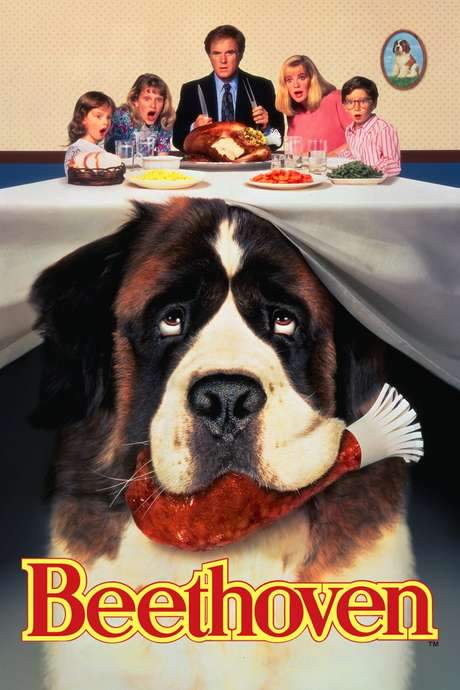
Their assignment takes a turn for the worse when Frizzy is unexpectedly kidnapped. Sal immediately blames Eddie, fueling tensions and leading to Eddie being fired by the stern producer Patricia. Instead of paying the ransom to get Frizzy back, the film's director Stanley and Patricia choose to hold auditions for a new dog to replace her, creating chaos on set. Meanwhile, Eddie’s son, Billy, is wandering around town when he stumbles upon a stray dog that begins to follow him. Curious and kind-hearted, Billy brings the dog home and names him Beethoven, inspired by the Ludwig van Beethoven’s 5th symphony, after an initial attempt to call him Wolfgang.
Back at home, Eddie discovers that not only has he lost his job, but his house has also been wrecked by Beethoven, who has become a large, enthusiastic dog. Eddie’s frustration grows when he realizes that the dog he just brought home is a big, energetic pup who seems to have a mind of his own. It turns out that Sal DeMarco and his cronies, Tick and Bones, are behind Frizzy's kidnapping — a scheme fueled by greed, as they wanted to keep her valuable by waiting for her to shoot some film scenes.
The next day, during auditions, finding a suitable replacement for Frizzy proves difficult for the studio. Eddie, meanwhile, has come to pick up Pete the lizard, when Beethoven unexpectedly races into the audition room. The dog performs an impressive chase scene, impressing the director Stanley, who instantly hired Beethoven. Surprisingly, Stanley finds Beethoven’s antics hilarious, and his untrained, clumsy behavior is appreciated for its comic charm. Sal is consequently fired by Stanley, and Eddie feels a renewed sense of hope.
Eddie celebrates by taking Billy and Beethoven out for hamburgers; however, Beethoven escapes with the food, leading to a humorous chase. The trail ends in an alley where Beethoven is caring for three puppies, the offspring of a mother dog who had apparently passed away. Moved by the little pups, Eddie decides to adopt them, adding even more chaos and joy to their household.
In the process of filming, Eddie is tasked with making Beethoven perform stunt scenes. However, Beethoven frequently crashes through shots and messes up scenes. Though each mishap seems like an opportunity for termination, director Stanley finds these scenes even funnier and decides to keep them in the final cut. Lisa, the film’s writer, notices the special talent of Beethoven and asks Eddie to spend more time with him so she can better tailor her script to his unique personality.
In an act of revenge, Sal orders his henchmen to kidnap Beethoven for a million-dollar ransom, planning to eliminate him after the ransom is paid. The kidnapping occurs during a park outing where Billy was flirting with his crush, Katie. Eddie, Billy, Lisa, and the puppies embark on a daring rescue mission to Sal’s secret lair — a former show stage turned hideout — where they manage to save Beethoven and apprehend Sal and his gang. Following the rescue, Sal and his cronies are arrested.
The story concludes with Eddie and Lisa beginning a budding relationship, sharing a quiet moment with Billy, Katie, and all their beloved animals, including Beethoven, the puppies, Frizzy, and Pete the lizard. They enjoy popcorn together while watching the world premiere of their film, celebrating their chaotic yet heartwarming journey.
The end credits feature playful parody titles like Dog-E, When Hairy Met Frizzy, and The Lizard of Oz. During the Gag Reel, Jonathan Silverman jokingly refers to Sal DeMarco as "Ned Ryerson", a nod to Stephen Tobolowsky’s character Ned Ryerson from Groundhog Day, adding a layer of hilarious meta-reference to the film’s comedy. Throughout it all, the story emphasizes themes of family, loyalty, and the unpredictable nature of animals, blending humor and heart in a narrative that celebrates joy, resilience, and the bond between humans and their furry, and sometimes scaly, friends.