










Plot Explained Spoilers guaranteed!
Plot Explained

Browse by genre

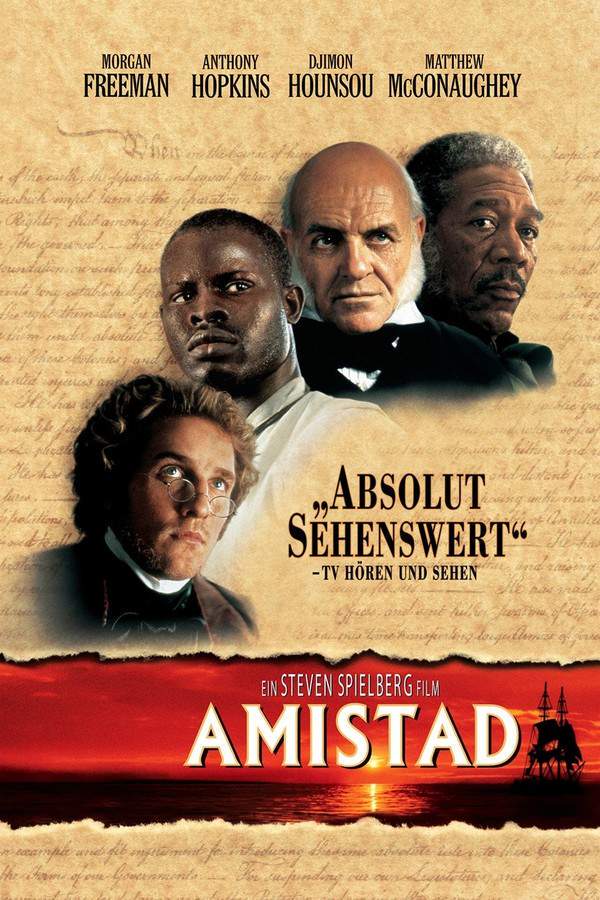
Amistad (1997) movie poster

Timeline

Amistad (1997) Timeline Explained – Every Event in Order

Release, runtime and language
1997 · 155 min · English
Directed by
Steven Spielberg
Starring
Anthony Hopkins, Matthew McConaughey, Morgan Freeman, Djimon Hounsou
Budget
$36M

In this powerful drama based on a true story, a group of African slaves being transported on the ship La Amistad mutiny and seize control. Their journey brings them to America, where their fight for freedom sparks a national debate about slavery, justice, and the core values of American society. The ensuing legal battles and moral complexities challenge the nation's understanding of human rights and the legacy of the slave trade.

On this page (6)
  1. 1 Where to watch
  2. 2 Events in order (14)
  3. 3 Timeline questions answered
  4. 4 Movie threads
  5. 5 Movies like Amistad
  6. 6 Every angle

Where to watch

Where to Watch Amistad (1997)

Where can you watch Amistad? Stream, rent or buy it in the US, including on Hoopla, Kanopy and YouTube Free: current JustWatch availability with up-to-date prices.

Streaming availability powered by JustWatch

14 events in order · contains spoilers

Amistad Timeline: Events in Chronological Order

Every key event of Amistad (1997) in order, scene by scene, with when and where it takes place. Use it to untangle flashbacks, time jumps and parallel storylines, to refresh your memory before the sequel or to find the exact scene you are thinking of.

  1. Capture of Africans

    In Sierra Leone, a group of Africans is captured and sold into slavery, marking the beginning of their harrowing journey. They are placed aboard the ship *La Amistad*, bound for Cuba, unaware of the cruel fate that awaits them.

    Where
    Sierra Leone
  2. Revolt Aboard *La Amistad*

    Sengbe Pieh, known as Cinque, leads a daring revolt against the crew of *La Amistad*. This rebellion results in the deaths of most crew members, signaling the captives' desperate fight for freedom.

    Where
    *La Amistad*
  3. Navigating Back to West Africa

    Following the revolt, the surviving crew is kept alive by the hopes of the Africans who believe they can navigate the ship back to West Africa. This moment encapsulates the captives' resolve and determination to return to their homeland.

    Where
    *La Amistad*
  4. Land in Sight

    After weeks at sea and dwindling supplies, the Africans spot land, bringing a glimmer of hope for fresh water and provisions. They send a group ashore, completely unaware of the lurking dangers.

    Where
    Near the coast
  5. Seizure of *La Amistad*

    The *La Amistad* is seized by a U.S. military vessel after the Spaniards deceitfully navigate the ship along the Atlantic coast. The Africans are imprisoned while legal debates ensue regarding their ownership and fate.

    Where
    U.S. waters
  6. Legal Turmoil

    Conflicting claims arise over the ownership of the Africans captured aboard *La Amistad*. The Spanish insist that the Africans were born as domestic slaves on a Cuban plantation, complicating their plight for freedom.

    Where
    Washington, D.C.
  7. Abolitionist Allies

    In Washington, former President John Quincy Adams teams up with abolitionists Theodore Joadson and Lewis Tappan to rally for the Africans’ freedom. They seek legal assistance, knowing the importance of compelling narratives in court.

    Where
    Washington, D.C.
  8. A New Interpreter

    Finding it difficult to communicate with the Africans due to language barriers, the legal team enlists a Royal Navy sailor named James Covey. His presence proves crucial as he bridges the gap, helping Baldwin understand Cinque's harrowing story.

    Where
    Washington, D.C.
  9. Discovery of Evidence

    Baldwin stumbles upon a notebook aboard *La Amistad* that documents illegal slave trading activities. This discovery bolsters the abolitionist case, as they prepare for legal battles against powerful interests.

    Where
    *La Amistad*
  10. Supreme Court Appeal

    The case reaches the U.S. Supreme Court after immense political pressure, with President Van Buren weighing the economic impacts of releasing the Africans. The predominantly Southern slave-holding justices will play a critical role in the outcome.

    Where
    U.S. Supreme Court
  11. Adams' Emotional Plea

    In a pivotal moment, John Quincy Adams delivers a heartfelt appeal in the Supreme Court on behalf of the Africans. His passionate defense contributes to their eventual release and the choice to return to Africa.

    Where
    U.S. Supreme Court
  12. British Marine Intervention

    In a parallel narrative, British Royal Marines attack the *Lomboko Slave Fortress*, freeing those unjustly imprisoned. This operation highlights the ongoing struggle against the slave trade in Africa.

    Where
    Lomboko Slave Fortress
  13. Return Home

    Cinque and the other Africans make the journey back to Sierra Leone, accompanied by James Covey. However, upon returning, they confront the grim reality of civil unrest and the likely loss of their families.

    Where
    Sierra Leone
  14. Political Fallout

    President Van Buren suffers a setback in his political aspirations as he loses his reelection bid following the upheavals surrounding the *Amistad* case. His loss signifies the changing tides of public opinion regarding slavery.

    Where
    Washington, D.C.

Last updated: November 03, 2024 at 22:03

Was this helpful?

Timeline questions answered

Amistad Timeline Explained: Your Questions Answered

When does it happen, and why in that order? The questions people ask about the chronology of Amistad (1997): time jumps, flashbacks, cause and effect between scenes and the correct order of events, each answered with spoilers.

Q1

Why did Cinque lead the revolt aboard La Amistad?

Cinque led the revolt because he and other Africans had been kidnapped from Sierra Leone and sold into slavery in Cuba against their will. After being captive for weeks under brutal conditions aboard La Amistad, he seized a moment when the ship's crew was asleep, used a file to free himself and others, and organized the uprising to reclaim their freedom and attempt to return home.

  • cinque
  • slave revolt
  • la amistad
  • freedom
  • captivity
Q2

How did the Africans end up in U.S. custody after the revolt?

After successfully seizing control of La Amistad, the Africans forced the surviving Spanish crew to navigate back toward Africa. However, when the ship ran low on supplies and a group went ashore to find water, the Spaniards secretly steered the ship northward along the American coast. A U.S. naval vessel intercepted La Amistad near Long Island and seized the ship, turning the Africans over to U.S. authorities.

  • la amistad
  • u.s. custody
  • seizure
  • spanish deception
  • capture
Q4

How did James Covey help the abolitionists?

James Covey was a Royal Navy sailor who spoke an African dialect, and he proved essential because the Africans had been unable to communicate their story to the legal team due to language barriers. As translator, Covey enabled Cinque to testify about his kidnapping in Sierra Leone, his enslavement, and his sale in Cuba, testimony that was crucial to building the abolitionists' case.

  • james covey
  • translator
  • interpreter
  • language barrier
  • testimony
Q5

What was the notebook found on La Amistad?

Roger Sherman Baldwin discovered a notebook aboard La Amistad that documented illegal slave trading activities, including the Africans' capture in Sierra Leone and their transport to Cuba. This record directly contradicted Spain's claim that the Africans were legally born Cuban slaves, providing critical evidence that the Africans had been illegally trafficked.

  • notebook
  • evidence
  • slave trading
  • baldwin
  • documentation
Q6

Why did President Van Buren appeal the case to the Supreme Court?

President Van Buren faced intense pressure from multiple directions. Spanish Queen Isabella II demanded payment for La Amistad and its cargo, while Senator John C. Calhoun warned that freeing the Africans would threaten the Southern economy reliant on slavery. Van Buren, seeking Southern support for his re-election, appealed the favorable lower court ruling to the predominantly Southern slave-holding Supreme Court.

  • van buren
  • supreme court
  • political pressure
  • calhoun
  • appeal
Q7

What was John Quincy Adams' role in the Amistad case?

Former President John Quincy Adams, now a Representative, joined the abolitionist team led by Theodore Joadson and Lewis Tappan. Though initially ambivalent about slavery itself, Adams provided legal expertise and ultimately delivered a passionate, emotionally powerful closing argument before the Supreme Court, which was pivotal in securing the Africans' freedom.

  • john quincy adams
  • abolitionists
  • supreme court
  • legal defense
  • argument
Q8

Why did the British attack Lomboko Slave Fortress?

British Royal Marines attacked Lomboko Slave Fortress as part of Britain's enforcement of anti-slavery policies in West Africa. Captain Fitzgerald, who had testified at the Amistad trial about the illegal slave trade, led the assault that freed prisoners held at the fortress and destroyed it, demonstrating Britain's commitment to suppressing the slave trade.

  • lomboko
  • british
  • slave fortress
  • captain fitzgerald
  • freed
Q9

What happened when Cinque returned to Sierra Leone?

When Cinque and the other Africans returned to Sierra Leone with James Covey, they discovered their homeland was in civil unrest. Cinque learned that his family had been lost, likely sold into slavery again during the chaos. This bittersweet ending acknowledged the legal victory while recognizing the ongoing tragedy of the slave trade.

  • cinque
  • sierra leone
  • return
  • family
  • civil unrest
Q10

Why was the "insurrection on the high seas" charge significant?

The Africans were charged with piracy and insurrection on the high seas, a capital offense that could result in execution. This charge framed the revolt as criminal rather than as an act of resistance against illegal enslavement. The abolitionists had to argue that the Africans had every right to fight for their freedom since they had been illegally kidnapped and enslaved.

  • insurrection
  • high seas
  • charge
  • piracy
  • capital offense
Q11

How did the Supreme Court ruling affect the Africans?

The Supreme Court ruled in favor of the Africans, declaring them free individuals who had been illegally enslaved and transported. The Court recognized they had been kidnapped and sold in violation of international law. The Africans were granted their freedom and given the choice to return to Africa, which most chose to do.

  • supreme court
  • ruling
  • freedom
  • justice
  • africa
Q12

Why did Van Buren lose his reelection bid?

President Van Buren lost his reelection bid partly due to his handling of the Amistad case. His attempt toappease Southern interests by appealing to the Supreme Court backfired when the Court ruled against him. Additionally, his moderate stance on slavery and the political upheaval from the case alienated both Northern abolitionists and Southern slave states.

  • van buren
  • election
  • loss
  • politics
  • slavery
Q13

What was the significance of the Africans being allowed to return to Africa?

The Supreme Court ruling granted the Africans not just their freedom but the explicit right to return to Africa if they chose. This was a remarkable legal victory because it recognized their status as free individuals with the right to make their own decisions, rather than being treated as property to be disposed of by the courts.

  • return to africa
  • choice
  • freedom
  • court ruling
  • liberty

Movie threads

More Movies Like Amistad, by Mood & Story

Curated lists built around what makes Amistad tick: the same mood, the same kind of story or the same emotional payoff. Each list explains why these movies belong together.

Courtroom Justice Dramas Like Amistad

True stories where a single court case challenges a nation's moral conscience. Movies like Amistad, featuring high-stakes legal dramas and true stories of justice. If you enjoyed the tense courtroom battles and political struggle in Amistad, you'll appreciate these similar films about landmark cases and the fight for human rights.

  • tense
  • urgent
  • somber
  • resilient
  • legal drama
  • high stakes
  • Tone: tense, somber, urgent
  • Pacing: steady, methodical
Why these movies?

The story pattern: The narrative follows a high-profile legal case, often based on real events, that progresses through the judicial system. The protagonists, usually lawyers or defendants, face not just legal opposition but also intense public and political pressure. The story methodically builds its case, focusing on strategy, evidence, and powerful moral arguments that have far-reaching consequences beyond the verdict.

Why they belong together: These films are grouped by their central focus on a transformative legal proceeding, their grounding in real-world injustice, and their tense, methodical pacing. They share a heavy emotional weight, driven by high-stakes outcomes and a sober examination of systemic failure and resilience.

Grim Historical Survival Stories Like Amistad

Stories of endurance against oppressive systems, where victory is hard-won and incomplete. If you liked the intense and somber mood of Amistad, explore these similar historical dramas. These movies share a focus on resilience against oppression, a heavy emotional weight, and a bittersweet tone, capturing the brutal fight for freedom in grim settings.

  • grim
  • somber
  • oppressive
  • resilient
  • historical
  • urgent
  • Tone: somber, grim, bittersweet
  • Pacing: steady, urgent
Why these movies?

The story pattern: The narrative thrust is a grueling fight for survival and dignity within an explicitly unjust historical context. Characters endure immense suffering and systemic brutality, their personal journeys mirroring a larger societal conflict. The plot is driven by a desperate urgency to overcome oppression, leading to an outcome that offers a measure of victory but is shadowed by profound loss and the enduring nature of the injustice faced.

Why they belong together: These movies are united by their oppressive, grim atmosphere, their focus on a resilient protagonist facing historical injustice, and their emotionally heavy, bittersweet conclusion. They deliver a potent mix of somber reflection on dark chapters of history and admiration for the human capacity to resist.

If you liked this

Movies Like Amistad

Similar movies to Amistad: the same genre, themes or kind of story. Each one comes with its own plot summary, timeline and ending explained.

Browse all movie summaries

Every angle

Amistad (1997) Explained: Plot, Timeline & Characters

Everything about Amistad in one place: what happens in the plot summary, the timeline in chronological order, the characters and meaning and a spoiler-free summary. What's After the Movie adds the cast, box office and post-credit scenes.

Coming soon on iOS and Android

The Plot Explained Movie Summary App

Plot summaries, endings explained and timelines on your phone. Catch up on any movie in minutes, save your favorites and never miss a twist again.

Be the first to know when we launch. Your email stays private, always.

Learn more about the app