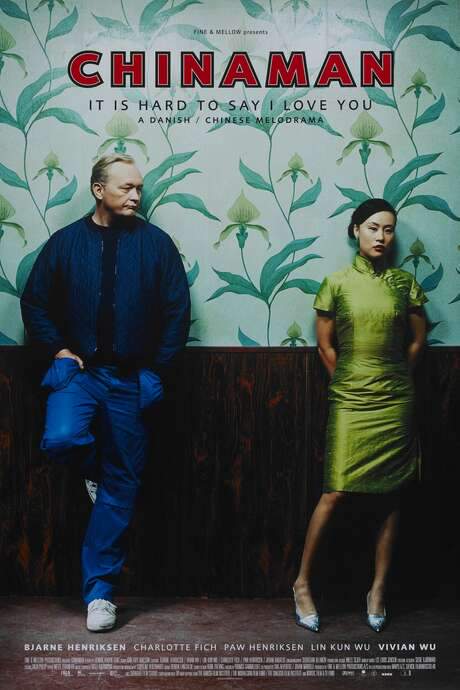
Yu Ming, Diyu Daniel Wu, a shopworker in China, grows tired of his quiet, repetitive life and begins to dream of a fresh start somewhere far away. To choose his destination, he spins a globe in a library and lands on Ireland, a decision that will push him into an unfamiliar culture and language. He learns early on that the official language of Ireland is Gaelic, a realization that sets him on a rigorous path to study Irish before he even boards a plane. For six months, he carves out time during meals and even while shaving to practice, turning every ordinary moment into a mini lesson. His dedication is underscored by small victories, like the ability to quote a line in Irish from a famous film: the memory of the scene, and the line, begin to feel like a talisman guiding him through a new land.
> An bhfuil tusa ag labhairt liomsa? (Are you talking to me?)
Arriving in Dublin, Yu Ming discovers that his growing command of Irish helps him navigate the city’s bilingual signs with surprising ease. His confidence continues to grow as he moves through the city, and he lands at a hostel where he tries to communicate his need for a bed in Irish: “Ba mhaith liom leaba anseo”. The moment is met with a mix of confusion and curiosity, as the receptionist—speaking with an Australian accent—looks to an Asian coworker for help. Here, the translator Enke—Enke Javkhlan—joins the scene, explaining that Yu Ming is probably looking for a room. The exchange is comic and revealing, underscoring how language and cultural expectations collide in everyday life.
> Ba mhaith liom leaba anseo (I would like a bed here)
The hostel episode continues to unfold with humor and humanity. In a nearby restaurant, Yu Ming’s Irish is put to a practical test: he tries to use a knife and fork the way he learned to use chopsticks, a reminder that techniques from home don’t always translate cleanly to local customs. The day’s wanderings bring him to a statue of Patrick Kavanagh, where he speaks again to the language’s quirks and possibilities, muttering another line in Irish as if practicing for a better future.
The search for work leads Yu Ming to a bar scene, where his Irish again presents a barrier. He tells the barman, “Tá mé ag lorg obair” (I am looking for work), and the moment highlights the stubborn reality: English remains the dominant language in much of Ireland, and Irish is spoken in only a small number of areas. The initial frustration is palpable, yet there’s a spark of possibility in the exchange—an echo of his long hours of study.
In the midst of this, an elderly Irish speaker named Paddy—Frank Kelly—sits at the end of the bar and watches Yu Ming with a mix of amusement and admiration. Paddy invites Yu Ming for a drink, recognizing a certain fluency in his speech even when others do not. The two begin a dialogue that feels almost uncanny to the other patrons, who suspect they are hearing Chinese rather than Irish. Yet Paddy’s warmth and practical wisdom begin to break down the barrier between language and understanding: he explains that Irish, while a minority language, holds a stubborn resilience, and Yu Ming’s ability to communicate—though imperfect—reaches beyond the surface.
As their conversation unfolds, Yu Ming confesses his doubts about his progress, worried that his efforts have been in vain. Paddy reassures him that he’s not failing; in fact, Yu Ming speaks Irish better than many locals, a surprising compliment that reframes his journey. Paddy clarifies the broader reality: Ireland is a country where English dominates, and Irish has a smaller footprint in daily life. The scene is a subtle meditation on language as identity, and it emphasizes that progress isn’t measured only by flawless pronunciation but by the courage to try, to inhabit a language, and to be understood by others.
From that moment, Yu Ming’s path begins to shift. He finds a job that suits his growing abilities not in the tourist districts but within the Gaeltacht—the Irish-speaking region of Connemara. There, the language life is more vibrant and immediate, and Yu Ming’s Irish serves him not just as a tool for communication but as a bridge to belonging. The transition is quiet but meaningful: he moves from the anonymity of a big city to the intimate rhythms of a community where Irish is truly spoken, where his daily work as a bartender becomes an extension of his language study and his desire to participate fully in Irish life.
This journey is a portrait of persistence, curiosity, and openness. It frames language learning not merely as academic exercise but as a living practice that can transform a person’s sense of place in the world. The film balances lighthearted moments with genre-typical realism: the misunderstandings at the hostel, the playful mishearings behind bar chatter, and the earnest conversations that reveal how language can connect strangers who once seemed worlds apart. It is also a gentle meditation on immigration—the mix of excitement and uncertainty, the humor found in awkward moments, and the slow accrual of comfort as a newcomer finds a foothold in a new country.
Throughout, the cast threads a loose, human tapestry. Yu Ming’s progress is measured not by flawless grammar but by the meaningful exchanges that gradually become routine. His growth culminates in a practical, grounded career in Connemara—a place where the language breathes in the air, where the locals’ daily routines affirm the value of every learner who dares to listen, imitate, and participate. The story leaves us with a quiet sense of possibility: language isn’t just a barrier to cross; it’s a doorway to a new life, one where patience, humor, and persistence can turn a determined student into a welcome presence in a community that has room for one more voice.
Note: This summary keeps the core characters and moments intact while rephrasing for a fresh, easy-to-read narrative. It maintains a neutral tone and highlights the linguistic and cultural themes at the heart of the story.