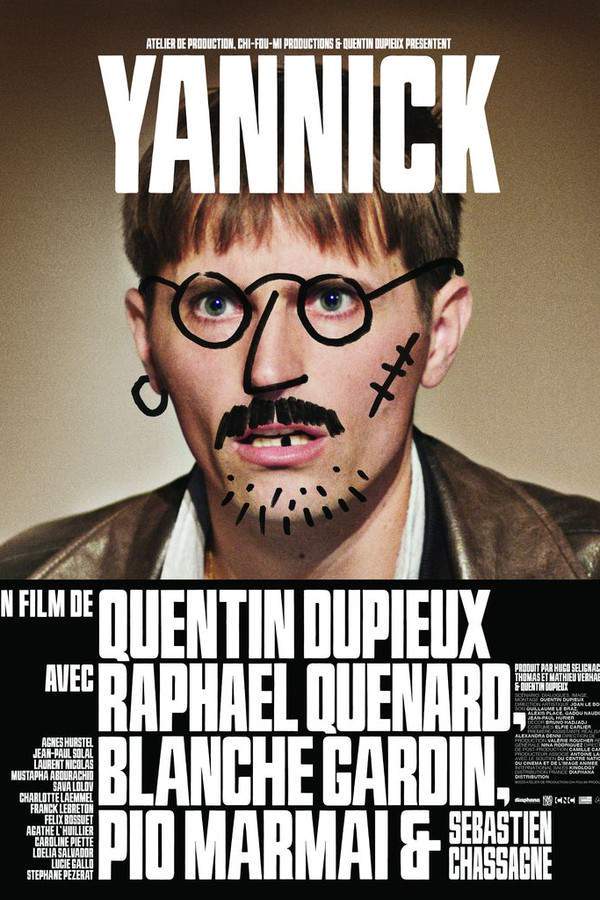
The film opens with a small, tense moment on a Paris stage: a boulevard comedy called Le Cocu is being performed at the Bouffes Parisiens, and the room is only half full. The three actors – Sophie Denis, Paul Rivière and William Keller – are doing their best to sell the laughs and the drama despite the rattling energy in the room. For the first time, the performers’ names are braided with the people behind them: Sophie Denis [Blanche Gardin], Paul Rivière [Pio Marmaï], and William Keller [Sébastien Chassagne] bring their characters to life as the audience claps and sighs in equal measure.
Into this fragile balance walks Yannick, a night parking attendant from Melun, who declares the show is terrible and won’t help him forget his daily troubles. He has driven forty five minutes to Paris, wandered the streets, and now stands in the theater with a revolver, interrupting the performance and demanding to be heard. The room’s tension spikes as some audience members and the actors urge him to leave; Paul even steps offstage in a heated moment, insisting Yannick must go. Yet Yannick stays, and when he returns, his anger has grown sharper and more personal.
What follows is an unsettling mix of coercion and improvisation. Yannick takes control of the space and begins to direct the play himself, insisting that a parking attendant can create real entertainment. He even asks a nearby spectator to lend him a laptop so he can write a new script. The crowd, half terrified and half curious, watches as Yannick wrestles with the computer, struggling with the keys yet somehow coaxing a strange, new energy from the room. The table is turned: the actors now navigate a script that is not theirs, while Yannick quietly sympathizes with the stunned spectators, their shock slowly giving way to a curious, shared curiosity.
Sophie, ever practical, hatches a plan. She signals to Paul, who seizes the moment when Yannick’s attention falters and nabs the gun. What unfolds is a tense, theatrical power-play: Paul confronts Yannick with a rough, almost brash bravado, humiliating him for the trouble he has caused and ordering him to the floor. Yannick needles Paul in return, the moment heavy with past grudges and a fragile sense of fame, until a technician hidden in the wings knocks Paul unconscious, allowing Yannick to reclaim the weapon. The tension dissipates into a curious, almost celebratory moment as the audience claps—an odd validation of the chaos they’ve witnessed.
With the weapon secured, Yannick’s rewritten play finally begins. In this new version, Paul steps into the role of a doctor, Sophie becomes the assistant, and William is recast as the dead man. The rehearsal takes on a ceremonial awkwardness: the assistant performs an autopsy on a corpse, only to be corrected by the doctor who explains that the “dead man” is not truly deceased—he is simply lacking love. The actors stumble through the new lines and clumsy blocking, yet the audience responds with sustained laughter, finding a surprising warmth in the improvised, imperfect performance. Behind the scenes, Yannick quietly guides the action, directing the performers with gentle, almost fatherly pride, and finally sheds tears of joy as the scenes come to life.
Meanwhile, the tension outside the theater escalates. A spectator quietly slips away and calls the police, signaling that the chaos inside has drawn real, cold consequences beyond the stage. The film closes on a note of impending intervention as the BR I arrives at the venue, signaling that the events inside may soon collide with outside authority.
This story unfolds with a careful balance of chaos and creativity, woven through a single night that reshapes the fates of its performers and scores the room with both fear and laughter. The film leans into the tension between art and disruption, showing how a failed show can become something unexpectedly alive when it is reframed by those who inhabit it.
- The cast anchors the world with pointed, human echoes: Blanche Gardin as Sophie Denis, Pio Marmaï as Paul Rivière, and Sébastien Chassagne as William Keller bring depth to characters who must improvise under pressure.
- The setting—an intimate Paris theater, a frustrated crowd, and a night where normal rules blur—becomes a character in its own right, inviting the viewer to consider what makes a performance true: the intention behind it, or the living moment when it happens.