Plot Explained Spoilers guaranteed!
Plot Explained

Browse by genre

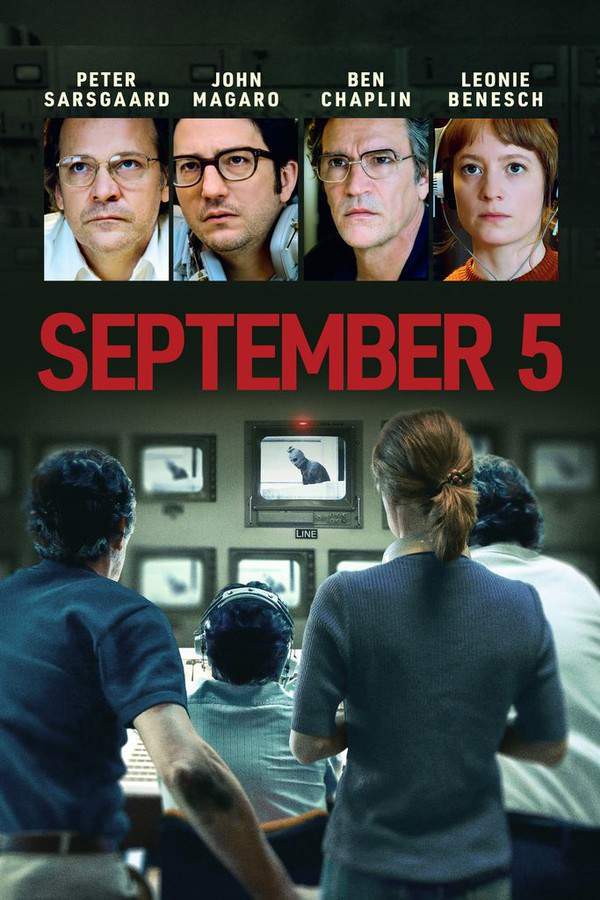
September 5 (2024) movie poster

Plot Summary

September 5 (2024) Plot Summary & Ending Explained

Release, runtime and language
2024 · 1 h 31 m · English
Echo score 84
JustWatch #3,136 84
Directed by
Tim Fehlbaum
Starring
Corey Johnson, John Magaro, Peter Sarsgaard, Leonie Benesch, Benjamin Walker, Ben Chaplin

During the 1972 Munich Summer Olympics, an American sports broadcasting team finds themselves unexpectedly covering a crisis when Israeli athletes are taken hostage. The film explores the events through their perspective, offering a unique look at the live broadcast that was watched by an estimated one billion people worldwide.

On this page (7)
  1. 1 Where to watch
  2. 2 What happens: full plot
  3. 3 Plot questions answered
  4. 4 How it ends
  5. 5 Movie threads
  6. 6 Movies like September 5
  7. 7 Every angle

Where to watch

Where to Watch September 5 (2024)

Where can you watch September 5? Stream, rent or buy it in the US, including on Amazon Prime Video, fuboTV and Paramount Plus Essential: current JustWatch availability with up-to-date prices.

Streaming availability powered by JustWatch

Full plot summary · contains spoilers

What Happens in September 5: Full Plot Summary

The whole story of September 5 (2024) explained, from the opening scene to the final frame: every key event, every twist and what it all adds up to. Read it as a quick recap before the sequel, to check a scene you missed, or to finally understand what really happened.

During the 1972 Summer Olympics in Munich, the ABC Sports crew presides over what appears to be a spirited and relatively uneventful Games coverage. When Mark Spitz wins gold in the swimming event over a West German competitor, ABC Sports president Roone Arledge, Peter Sarsgaard, dramatizes the moment by cutting to the rival's reaction and planning to introduce the subjects of the Holocaust and Nazi Germany during a live interview with the Jewish Spitz. When Marvin Bader, Ben Chaplin, head of operations, questions the decision, Arledge reminds him of the importance of emphasizing emotions over politics to make an effective broadcast.

During the night, gunshots are heard in the distance. The crew listens to police broadcasts, aided by Marianne Gebhardt, Leonie Benesch, the crew's local translator, and gradually learn that a terrorist attack is occurring: The terrorist group Black September has broken into the apartment housing the Israeli team and taken the athletes hostage, demanding the release of hundreds of Palestinian terrorist prisoners. Seeing an opportunity for a compelling story, Geoffrey Mason, John Magaro, the head of the control room, quickly organizes the crew to pivot to cover the hostage crisis instead. Along with Arledge, he takes pragmatic steps to turn the story into a gripping sensation, negotiating more advantageous time slots and even forging identification so that a crewmember can access the now-restricted Olympic village. Although most of the crew is enthusiastic and confident that the conflict will be resolved quickly and successfully, a dismayed Bader reminds Mason and Arledge that the lives of real people are at stake and warns them of the potential impact on the terrorists' narrative.

Throughout the day, the crisis worsens due to failed negotiations and mistakes from an unprepared local police force. Countless news stations jockey for the latest news and glimpses of the standoff, inciting Mason to become more competitive in covering the story. At one point, the crew realizes that the terrorists are watching their program, which ruins an attempted rescue. Law enforcement officers storm the control room and threaten the crew at gunpoint to turn off the broadcast, but Mason ultimately refuses. The terrorists are eventually transported with their hostages to the military airport of Fürstenfeldbruck, and Mason sends Marianne there for coverage, cynically including sound equipment in case a shootout takes place.

Marianne, at the airport with other news crews, reports to Mason that the hostages are rumored to be free, which is apparently confirmed by ZDF. Bader implores Mason to hold off on reporting until the information is confirmed, as the other stations will follow suit, but Mason is unwilling to lose the scoop and has the news announced, albeit with the caveat that the station qualifies its report by stating that the unconfirmed developments are what is currently being reported from its sources. Bader is furious but is pacified when Mason soon receives an official fax from German chancellor confirming the group's rescue. As the crew celebrates and Mason pivots to planning interviews with the survivors, Bader leaves to celebrate with Arledge. As he watches a live, televised ABC interview with Conrad Ahlers, acting as a spokesperson for the German government, Ahlers speaks of the resolution to the crisis in an optimistic future tense. Realizing that the reports the studio received were all incorrect, a horrified Bader contacts an inside source and learns that the rescue attempt failed and all the hostages were in fact murdered.

Sobered, Mason has Jim McKay correct the live broadcast. Arledge nevertheless commends him for an excellent job, while Marianne mourns that yet more innocent lives were lost on German soil, and she and countless other reporters had been at the airport, focused only on getting a scoop while lives were being lost. The crew heads home, and after closing up, Mason lingers to view the studio's bulletin board featuring photos of the victims.

A closing title card reveals that the event was the first time a terrorist attack had been broadcast on live television and was viewed by an audience of approximately 900 million, making it one of the most viewed broadcasts in history.
Last updated: October 09, 2025 at 16:11

Was this helpful?

Plot questions answered

September 5 Plot Explained: Your Questions Answered

The questions people ask most about September 5 (2024): what happens in the confusing scenes, why the characters do what they do, the twists, hidden details and what the ending means. Each answer contains spoilers.

Q1

Why did the terrorists watching the live broadcast ruin the rescue attempt?

The terrorists were monitoring all news networks to see what authorities knew about their demands. When they saw the live coverage revealing police positions and tactical movements, they realized the German police were planning a rescue operation. This forced them to act hastily and killed the hostages before authorities could execute their planned raid.

Foreshadowing: Earlier in the film, Bader warns that broadcasting details could give the terrorists valuable intelligence.

  • rescue attempt
  • live broadcast
  • terrorists
  • police raid
  • black september
Q2

Why did police threaten the ABC crew at gunpoint to stop broadcasting?

German authorities realized the live broadcast was providing real-time tactical information to the terrorists. When police stormed the building or moved in, the terrorists could see everything on their TV monitors. The police demanded the broadcast stop to prevent further leaks of their operation details.

Foreshadowing: The tension between news coverage and operational security builds as the crew becomes more competitive for footage.

  • police
  • gunpoint
  • broadcast
  • rescue operation
  • munich police
Q3

How did the false report about the hostages being freed spread across all networks?

Marianne at the airport heard rumors from other crews that the hostages might be free, which ZDF (German television) appeared to confirm. Despite Bader's warning to verify first, Mason rushed the unconfirmed report on air, and other stations followed ABC's lead. The studio then received an official-looking fax claiming success from the German chancellor, which turned out to be either forged or incorrect.

Foreshadowing: Bader specifically warns Mason that other stations will follow their lead, making accurate reporting critical.

  • false report
  • hostages free
  • zdf
  • rumors
  • chancellor fax
Q4

Why did Geoffrey Mason send Marianne to the airport with sound equipment for potential gunfire?

Mason was intensely competitive about getting the scoop and foresaw that a shootout might occur at the airport during the transport. He deliberately sent Marianne with audio equipment so ABC could capture the gunfire live, prioritizing dramatic content over the safety of being near an active tactical operation.

Foreshadowing: Earlier, Mason shows willingness to forge credentials to get footage, prioritizing the story over protocol.

  • marianne
  • airport
  • sound equipment
  • shootout
  • scoop
Q5

What caused the rescue attempt at Fürstenfeldbruck to fail and lead to all hostages being killed?

Multiple factors contributed to the failure: the police were poorly prepared and inexperienced with such an operation, the live broadcast had alerted terrorists to the approaching raid, and the tactical plan had significant flaws. When authorities moved in, the terrorists quickly killed all remaining hostages rather than risk capture.

Foreshadowing: Bader warns that the police are unprepared and the situation is escalating dangerously.

  • furstenfeldbruck
  • airport
  • rescue failed
  • hostages killed
  • munich massacre
Q6

Why did Roone Arledge want to discuss the Holocaust during Mark Spitz's interview?

Arledge wanted to create emotionally compelling television by connecting Spitz's Jewish heritage to the historical context of Germany hosting the Olympics. He planned to cut to the defeated German swimmer's reaction and pivot to topics about the Holocaust and Nazi Germany, treating the moment as dramatic storytelling rather than pure sports coverage.

Foreshadowing: Bader immediately pushes back, foreshadowing the ethical conflicts between ratings and sensitivity.

  • mark spitz
  • holocaust
  • roone arledge
  • jewish
  • olympics
Q7

Why was Marvin Bader concerned about the broadcast affecting the terrorists' narrative?

Bader understood that live coverage could inadvertently help Black September achieve their goal of international attention. Every hour the cameras rolled, the terrorists gained worldwide exposure for their political cause. He feared the crew was being used as a tool to amplify terrorism rather than simply reporting the news.

Foreshadowing: This concern is dismissed by Arledge and Mason, who see the crisis as an opportunity for major ratings.

  • bader
  • black september
  • narrative
  • terrorism
  • media
Q8

Why did Geoffrey Mason refuse to turn off the broadcast when police ordered him to?

Mason believed stopping the broadcast would surrender control of the story to authorities and lose ABC the ratings lead. He argued the public had a right to know what was happening and refused to bow to pressure, though this decision directly contributed to the rescue failure by allowing terrorists to monitor police movements.

Foreshadowing: This decision follows Mason's earlier choices to forge access and prioritize the scoop over ethics.

  • geoffrey mason
  • broadcast shutdown
  • police order
  • ratings
  • control room
Q9

What was the actual outcome of the 1972 Munich Olympics hostage crisis?

All eleven Israeli athletes held hostage by Black September were killed. The rescue attempt at Fürstenfeldbruck airbase failed catastrophically, with five terrorists also dying in the operation. One German police officer was also killed. The tragedy marked the first time a terrorist attack was broadcast live on television.

Foreshadowing: The film builds toward this moment with the crew celebrating prematurely over what they believed was a successful rescue.

  • israeli athletes
  • hostages killed
  • munich massacre
  • black september
  • 1972
Q10

Why does Mason stay behind at the end to look at the victims' photos?

After the tragedy is confirmed and the broadcast ends, Mason remains to view the studio's bulletin board featuring photographs of the victims. This moment represents his sobering realization of the human cost behind the story he pursued so aggressively. It underscores the film's moral message about the consequences of sensationalist journalism.

Foreshadowing: Throughout the film, Bader repeatedly reminds Mason that real lives are at stake, a warning that haunts the finale.

  • mason
  • victims photos
  • bulletin board
  • aftermath
  • reflection

Ending explained

What Happens at the End of September 5?

How September 5 (2024) ends, in short: the final scene, the last twist and what it means for the characters. The full ending explained, with every spoiler, lives on its own page.

Read the full ending explained

The ending of September 5 reveals that the media team's relentless pursuit of breaking the news during the Munich hostage crisis ultimately leads to tragic consequences. As the German police transfer the terrorists and hostages to a nearby airport, the ABC team, eager to be the first to report the latest developments, rushes to broadcast the events live. Geoffrey Mason, taking a significant risk, shares unverified information about the hostage situation’s resolution, believing it to be true after hearing reports from other channels. This decision seems to give the team a moment of triumph, but it quickly turns into a devastating mistake. In reality, the terrorists had murdered all the hostages before being killed themselves, and the police had lost a life in the process. The information Mason aired was false—based on rumors rather than confirmed facts—and this false report leads to a tragic misrepresentation of the true outcome. The film ends on a poignant note, showing Mason mournfully reflecting on the consequences of his choices and the toll that obsession with breaking news can take. It highlights how the drive for immediate reporting can sometimes overshadow ethics and compassion, ultimately resulting in the loss of innocent lives and a distorted version of reality. The ending serves as a stark commentary on the dangerous power of media and the responsibilities journalists face in moments of crisis. It’s a sobering reminder that in journalism, haste and sensationalism can have heartbreaking consequences, and that true professionalism requires restraint and verification in even the most urgent situations.

September 5 ending explained in full

Movie threads

More Movies Like September 5, by Mood & Story

Curated lists built around what makes September 5 tick: the same mood, the same kind of story or the same emotional payoff. Each list explains why these movies belong together.

Real-time journalism thrillers like September 5

Thrillers that unfold in real-time from the nerve-wracking perspective of media professionals. Movies like September 5 that capture the frantic, high-pressure world of broadcast journalism during a crisis. If you liked the intense, real-time perspective of media professionals in a tense thriller, you'll find similar gripping stories here.

  • urgent
  • tense
  • suspenseful
  • sobering
  • gripping
  • anxious
  • Tone: tense, urgent, sobering
  • Pacing: fast, chaotic, real-time
Why these movies?

The story pattern: These narratives typically follow a linear, chronological structure that mirrors the live unfolding of a catastrophic or politically charged event. The protagonists are often reporters, producers, or anchors whose personal and professional ethics are tested under extreme duress, creating a narrative built on urgency, difficult choices, and the weight of bearing witness.

Why they belong together: Movies in this thread are grouped by their shared immersive perspective, placing the viewer directly in the shoes of media figures during a crisis. They share a specific blend of relentless pacing, high moral stakes, and a tense, anxious tone that comes from depicting events as they are broadcast to the world.

Bleak historical tragedies like September 5

Sobering films that recount dark, real-world events with unflinching emotional weight. Films similar to September 5 that explore dark, tragic chapters from real history. If you were moved by the heavy emotional weight and devastating, historically accurate ending of this movie, you will find other powerful and sobering true stories here.

  • grim
  • sobering
  • tragic
  • heavy
  • dramatic
  • historical
  • Tone: grim, sobering, sad
  • Pacing: steady, building dread
Why these movies?

The story pattern: The narrative journey in these films is often linear and straightforward, prioritizing factual accuracy and emotional immersion over complex plotting. They build towards a known, tragic outcome, creating a sense of inevitable dread. The focus is on the human cost and the moral or political implications of the event, resulting in an ending that is profoundly sad and thought-provoking.

Why they belong together: These films are connected by their commitment to portraying real-life tragedies with heavy emotional weight and a bleak, sobering tone. They share a similar emotional arc—building tension and dread that culminates in a devastating, historically grounded conclusion—creating a powerful and unsettling viewing experience.

If you liked this

Movies Like September 5

Similar movies to September 5: the same genre, themes or kind of story. Each one comes with its own plot summary, timeline and ending explained.

Browse all movie summaries

Every angle

September 5 (2024) Explained: Plot, Ending, Timeline & Characters

Everything about September 5 in one place: what happens in the plot summary, the timeline in chronological order, the characters and meaning, the ending explained and a spoiler-free summary. What's After the Movie adds the cast, box office and post-credit scenes.

Coming soon on iOS and Android

The Plot Explained Movie Summary App

Plot summaries, endings explained and timelines on your phone. Catch up on any movie in minutes, save your favorites and never miss a twist again.

Be the first to know when we launch. Your email stays private, always.

Learn more about the app