Plot Explained Spoilers guaranteed!
Plot Explained

Browse by genre

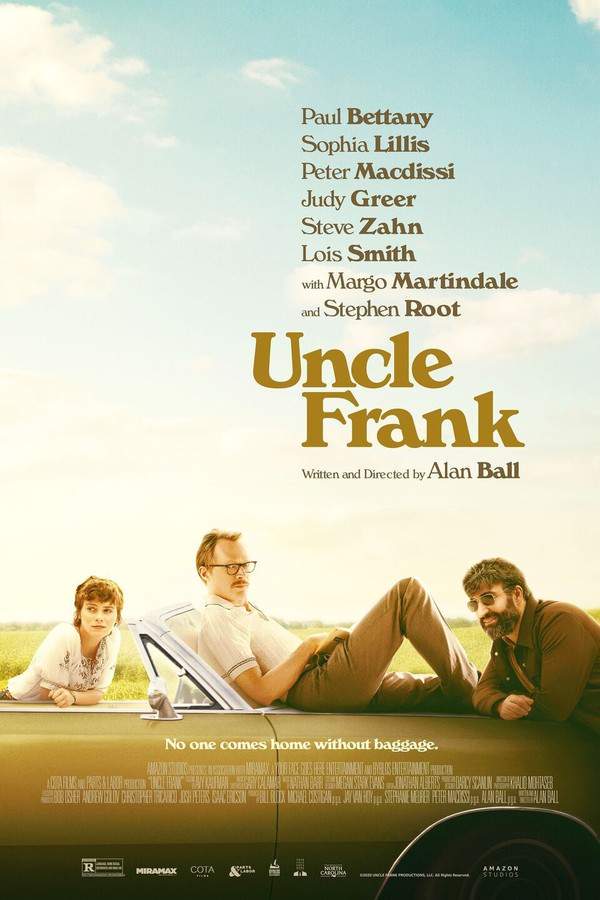
Uncle Frank (2020) movie poster

Plot Summary

Uncle Frank (2020) Plot Summary Explained

Release, runtime and language
2020 · 95 min · English
Echo score 80
JustWatch #24,252 1
Directed by
Alan Ball
Starring
Paul Bettany, Steve Zahn, Judy Greer, Lois Smith, Stephen Root, Jane McNeill

In 1973, a young woman travels north from her Southern home to study at New York University. There, she discovers that her beloved Uncle Frank has been living a secret life, including a long-term, hidden same-sex relationship. When a figure from Frank's past unexpectedly reappears, he and his niece must confront the painful events that have shaped his life. They are forced to examine themes of identity, family history, and the possibility of redemption.

On this page (6)
  1. 1 Where to watch
  2. 2 What happens: full plot
  3. 3 Plot questions answered
  4. 4 Movie threads
  5. 5 Movies like Uncle Frank
  6. 6 Every angle

Where to watch

Where to Watch Uncle Frank (2020)

Where can you watch Uncle Frank? Stream, rent or buy it in the US, including on Amazon Prime Video, Amazon MX Player and Amazon Prime Video Free: current JustWatch availability with up-to-date prices.

Streaming availability powered by JustWatch

Full plot summary · contains spoilers

What Happens in Uncle Frank: Full Plot Summary

The whole story of Uncle Frank (2020) explained, from the opening scene to the final frame: every key event, every twist and what it all adds up to. Read it as a quick recap before the sequel, to check a scene you missed, or to finally understand what really happened.

In the sweltering summer of 1969, fourteen-year-old Betty Bledsoe finds a ray of hope in the occasional visits from her uncle Frank, a brilliant professor whose erudition brightens the otherwise mundane atmosphere of Creekville, South Carolina. Unlike the rest of her sprawling family, who view her youth as a liability, Uncle Frank treats Betty with an equal's respect, engaging her in witty banter and spinning tales of the bustling streets of New York City. In stark contrast, her grandfather Daddy Mac exerts a cold, calculating influence over the household, often hurling venomous disdain towards Frank, a perplexing behavior for Betty, given her uncle's kind-heartedness.

Betty uses this unique bond to share her dreams of escaping Creekville and discovering the vast world waiting beyond. Frank encourages her pursuits, sharing his wisdom and assuring her that achieving academic success will unlock numerous opportunities. He even grants her the cherished gift of a new identity by renaming her Beth, a name that resonates with her ambitions. Just before they part, he imparts vital advice, urging her to reach out if she ever finds herself in a challenging situation or a predicament like an unexpected pregnancy.

Fast forward to 1973, and Beth is on the cusp of her dreams, heading to New York City for college with her parents, Kitty and Mike, Uncle Frank's conservative brother. However, their dinner visit to Frank’s home becomes an awkward affair when Charlotte, his girlfriend, is unveiled as a Jewish woman whose existence had been artfully concealed from the family due to Frank's fears of their disapproval.

As Beth embarks on her new collegiate adventure, she crosses paths with Bruce, a fellow student enamored with Uncle Frank's course. Their attempt to visit Frank is thwarted as they find him engrossed in preparations for an impending party. There, they are greeted by Wally, a friendly figure who becomes intrigued by Beth's stories. Yet, as Frank's relationship with Wally becomes clearer, a complex tapestry of deception unfolds, exposing the tension between Frank’s hidden life and his family's entrenched conservative values.

When Bruce's insincerity unravels, Frank remains unimpressed, refusing to engage with any romantic intentions. Instead, he takes care of a tipsy Beth, alongside Wally, and candidly discusses Bruce's deceit. This revelation sparks domino effects, urging Frank to confide in Beth about his longstanding relationship with Wally, one that has been shrouded in secrecy, particularly because Wally fears backlash for his identity.

The sad news of Daddy Mac’s passing draws Frank and Beth back towards Creekville, with the matriarch Mammaw reaching out with funeral details. After some hesitation, Wally decides to accompany them, sensing the distance that Frank has put between them. As they travel, Beth’s inquiries lead to deep discussions related to Frank's past and the secrets he’s carried.

During a stop on their journey, Frank grows suspicious of a car tailing them, yet he feels reassured when Wally unexpectedly arrives at their hotel. The following morning, as they continue their expedition, the trio faces a car breakdown and opts for Wally's rental instead.

Upon their arrival in Creekville, Frank is met with the town’s unwelcoming stares, highlighting his family's intolerance. In a private moment, he warns Wally to wait before checking in, illustrating Frank's reluctance to expose their relationship to the judgmental town. As they prepare for the impending funeral, Frank resorts to self-medication, desperate for courage while entrusting Beth with the secret of his drinking.

At the funeral, Mike’s emotional apology for their lost connection propels Frank into a spiral of self-destructive behavior, retreating to the solace of the nearest restroom. Amidst all this, Beth inadvertently mentions Wally, prompting Frank and his sister to fabricate a hasty cover story about his identity. The dynamics shift sharply during the will reading when shocking family sentiments about his lifestyle surface, compelling Frank to escape into a state of grief.

Haunted by painful memories of loss, Frank drives recklessly through the woods, repeatedly reliving the words of his father that echo through his mind: “You'll never be normal.” Upon discovering a note from his deceased friend Sam, who too suffered immense pain, Frank is thrust back to the lake where tragedy once struck.

As Beth and Wally anxiously search for him, they find Frank's items by the dock, leading to fears of his demise. When he suddenly appears, claiming he merely took a dip, tensions explode; a confrontation leads to a fierce physical brawl between Frank and Wally, symbolizing the lifelong torment Frank has battled.

Following this eruption of violence, Frank seeks refuge at Sam's grave, lamenting the unresolved hurt in his life. Wally’s arrival offers a moment of stability as Frank crumbles, yet his confession of having no family amplifies the gravity of his desolation.

When Beth arrives, she mirrors Frank's earlier advice to her about being true to herself, yet this moment showcases Frank's inability to shed his self-doubt. In a testament to their bond, Wally reassures Frank of his commitment to family. Frank's return to familiarity is met with warmth from Mike, yet judgment from others, leaving Frank balancing between acceptance and isolation.

Despite the emotional upheaval, guidance from Mammaw and the affection from Wally pave a path toward healing for Frank, as family ties reinforce the notion that, amidst life's chaos, love and forgiveness can shine through the darkness. In this poignant conclusion, Beth's narration encapsulates the sentiment that sometimes, "despite the turmoil that surrounds us, we find ourselves exactly where we are meant to be," revealing the enduring beauty of human connection.
Last updated: November 17, 2024 at 13:44

Was this helpful?

Plot questions answered

Uncle Frank Plot Explained: Your Questions Answered

The questions people ask most about Uncle Frank (2020): what happens in the confusing scenes, why the characters do what they do, the twists, hidden details and what the ending means. Each answer contains spoilers.

Q1

Why does Daddy Mac treat Frank with such coldness and disdain?

Daddy Mac's hostility stems from his discovery that Frank is gay. Throughout Frank's life, his father repeatedly told him "You'll never be normal," using his position of authority to shame and reject his son. This deep-seated homophobia created the traumatic family environment that forced Frank to hide his true self, ultimately leading him to leave South Carolina and build a secret life in New York City.

Foreshadowing: The cold dynamic between Daddy Mac and Frank is established early when the young Betty observes her grandfather's perplexing cruelty toward her kind-hearted uncle.

  • daddy mac
  • frank's father
  • homophobia
  • family rejection
  • creekville
Q2

Why does Frank hide his relationship with Wally from his family?

Frank conceals his relationship with Wally because he fears the same rejection and judgment he experienced from his father and community in conservative Creekville. Throughout his life, Frank learned that being openly gay would cost him family acceptance. Even in New York, he initially presents Wally only as a roommate, demonstrating how deeply the fear of rejection is ingrained in him.

Foreshadowing: Frank's secrecy is first hinted at when he hides Charlotte (his previous girlfriend) from the family, showing his pattern of concealing personal relationships.

  • wally
  • frank's secret
  • hidden relationship
  • new york
  • family acceptance
Q3

What causes Frank's emotional breakdown at the funeral?

Frank's breakdown is triggered by multiple converging factors at the funeral. First, Mike's heartfelt apology about their lost connection as brothers opens old wounds. Second, the will reading reveals the family's continued contempt for Frank's lifestyle, with relatives making shocking derogatory comments. These painful revelations about his father's enduring hatred, even in death, overwhelm Frank's ability to cope, causing him to retreat to the bathroom in distress.

Foreshadowing: Frank's fragile emotional state is foreshadowed by his self-medicating with alcohol before the funeral, showing he's already struggling to maintain composure.

  • funeral
  • breakdown
  • emotional collapse
  • will reading
  • family judgment
Q4

Who was Sam and what is the note Frank finds?

Sam was Frank's close friend who died, likely by suicide, as suggested by the note he left Frank and the lake being described as a site of previous tragedy. The note from Sam, discovered during Frank's darkest moment at the funeral, serves as a painful reminder of another victim of the same societal rejection and self-loathing that Frank himself has endured. This connection deepens Frank's crisis, as he sees in Sam's fate a possible preview of his own.

Foreshadowing: The story hints at past trauma when Frank is described as haunted by memories of loss, and the lake is revealed as the site of a previous tragedy involving someone close to him.

  • sam
  • note
  • death
  • lake
  • suicide
  • tragedy
Q5

Why does Frank drive dangerously through the woods after the funeral?

Frank's reckless driving is a manifestation of his psychological crisis. Haunted by his father's voice repeating "You'll never be normal" and the note from Sam, Frank is overwhelmed by a desperate need to escape his pain. He drives blindly through the woods in a dissociative state, essentially trying to outrun his traumatic memories and the crushing weight of family rejection. This leads him back to the lake where Sam's tragedy occurred.

Foreshadowing: Frank's self-destructive tendencies are foreshadowed by his earlier self-medication with alcohol and his warning to Beth about his drinking problem.

  • reckless driving
  • woods
  • escape
  • trauma
  • emotional breakdown
Q6

Why do Frank and Wally have a physical confrontation at the dock?

The fight at the dock represents the culmination of years of unspoken tension in their relationship. Wally has patiently supported Frank through his hidden life and secrecy, but Frank's emotional shutdown and self-destructive behavior finally push Wally to his limit. When Beth and Wally find Frank's belongings by the dock, fearing the worst, and Frank appears seemingly unharmed, Wally's fear and frustration explode into anger. The fight symbolizes both Wally's desperation to reach Frank and Frank's internalized self-hatred being directed at the person closest to him.

Foreshadowing: The tension between Frank's need for secrecy and Wally's frustration with it builds throughout their journey to Creekville.

  • wally fight
  • dock confrontation
  • emotional outburst
  • relationship strain
Q7

Why does Uncle Frank rename Betty to Beth?

Frank renames Betty to Beth because she dreams of escaping her small-town life and creating a new identity for herself in the wider world. By gifting her the name Beth, Frank gives her the symbolic tools to become someone beyond the limitations of Creekville. This act of renaming represents Frank's understanding of the power of self-definition, something he was never able to fully achieve for himself due to his own traumatic relationship with identity and family acceptance.

Foreshadowing: Frank's advice to Beth about reaching out if she ever faces a difficult situation foreshadows his own inability to seek help when he needs it most.

  • beth name
  • renamed
  • identity
  • new life
  • encouragement
Q8

Why does Frank think a car is following them on the way to Creekville?

Frank's paranoia about being followed stems from his deep-seated anxiety about his hidden life being exposed. Having lived in fear of discovery for years, Frank is hypervigilant about any potential threat to his carefully constructed secrecy. When he notices a car trailing them during their journey to Creekville, his immediate assumption is that his relationship with Wally has been discovered or that his past is catching up with him, a reflection of how constantly on edge he is about maintaining his false public persona.

Foreshadowing: This moment reflects Frank's overall pattern of anxiety about exposure, established earlier when he warns Wally to wait before checking into the hotel in Creekville.

  • car following
  • paranoia
  • secrecy
  • anxiety
  • exposure
Q9

How does Mammaw help Frank find acceptance despite his family's judgment?

Mammaw represents unconditional love that transcends the family's prejudice. Despite knowing about Frank's relationship with Wally, she offers warmth and acceptance when the rest of the family judges him. Her guidance helps Frank understand that love and forgiveness can exist even within a flawed family structure. This matriarchal support becomes the foundation for Frank's gradual healing, showing him that he doesn't have to choose between his family and his authentic self.

Foreshadowing: Mammaw's reaching out to Frank and Beth about the funeral, despite the family's dynamics, hints at her more progressive and compassionate nature.

  • mammaw
  • acceptance
  • forgiveness
  • family healing
  • support
Q10

What does the ending imply about Frank's future with his family?

The ending suggests a cautiously optimistic path forward for Frank. While some family members (like Kitty) continue to judge him, others like Mike offer warmth and acceptance. Most importantly, Frank now has Mammaw's blessing and Wally's unwavering commitment to their relationship. Beth's narration about finding oneself "exactly where we are meant to be" implies Frank can finally live authentically while maintaining family connections, achieving the balance between self-acceptance and family that has eluded him throughout his life.

Foreshadowing: Wally's reassurance that he wants a family with Frank, combined with Beth's echoing of Frank's own wisdom about authenticity, sets the stage for this hopeful conclusion.

  • ending
  • future
  • family acceptance
  • redemption
  • healing

Movie threads

More Movies Like Uncle Frank, by Mood & Story

Curated lists built around what makes Uncle Frank tick: the same mood, the same kind of story or the same emotional payoff. Each list explains why these movies belong together.

Bittersweet Journeys of Self-Acceptance like in Uncle Frank

Characters confront deep-seated secrets and trauma to find a path toward healing. If you were moved by the emotional journey in Uncle Frank, explore more movies like it. These stories feature characters confronting deep-seated secrets and internal conflict, leading to heavy but ultimately hopeful conclusions about identity and acceptance.

  • introspective
  • grieving
  • hopeful
  • tender
  • melancholic
  • oppressive
  • Tone: melancholic, bittersweet
  • Pacing: steady, character driven
Why these movies?

The story pattern: The narrative pattern follows a protagonist forced to confront a long-suppressed truth about their identity or past. This confrontation, often triggered by an external event or a supportive relationship, involves revisiting trauma and facing difficult truths. The arc is defined by a move from self-denial or shame toward a hard-won, imperfect self-acceptance.

Why they belong together: These movies are grouped together because they share a specific emotional trajectory: a heavy, melancholic tone rooted in personal struggle, a steady, character-focused pacing that allows for deep introspection, and a defining bittersweet ending that acknowledges pain while offering a glimmer of hope.

Movies about Family Secrets and Intergenerational Trauma like Uncle Frank

A painful return home or a sudden revelation forces a family to face its buried past. Discover similar movies to Uncle Frank that delve into the theme of hidden family histories. These dramatic stories focus on the emotional impact of uncovering secrets, dealing with grief, and the difficult process of healing from intergenerational pain.

  • oppressive
  • grieving
  • melancholic
  • revelatory
  • tense family dynamics
  • introspective
  • Tone: melancholic, oppressive
  • Pacing: steady, revelatory
Why these movies?

The story pattern: The plot is typically set in motion by an event that forces characters to re-engage with their family history. The story structure involves peeling back layers of denial and silence to reveal a traumatic core, often involving shame, loss, or a forbidden relationship. The narrative explores the ripple effects of this trauma across generations.

Why they belong together: This thread connects movies through their central focus on a hidden family history and its destructive legacy. They share a melancholic, often oppressive mood, a steady pacing that builds toward emotional reveals, and a thematic weight centered on grief, shame, and the difficult path toward truth.

If you liked this

Movies Like Uncle Frank

Similar movies to Uncle Frank: the same genre, themes or kind of story. Each one comes with its own plot summary, timeline and ending explained.

Browse all movie summaries

Every angle

Uncle Frank (2020) Explained: Plot, Timeline & Characters

Everything about Uncle Frank in one place: what happens in the plot summary, the timeline in chronological order, the characters and meaning and a spoiler-free summary. What's After the Movie adds the cast, box office and post-credit scenes.

Coming soon on iOS and Android

The Plot Explained Movie Summary App

Plot summaries, endings explained and timelines on your phone. Catch up on any movie in minutes, save your favorites and never miss a twist again.

Be the first to know when we launch. Your email stays private, always.

Learn more about the app