Toy Story 5

Toy Story 5

Year: 2026

Runtime: 1 h 42 m

Language: english

Directors: Andrew Stanton, McKenna Harris

Echo Score: 84

Budget: $250M

AnimationAdventureComedyDramaFamily

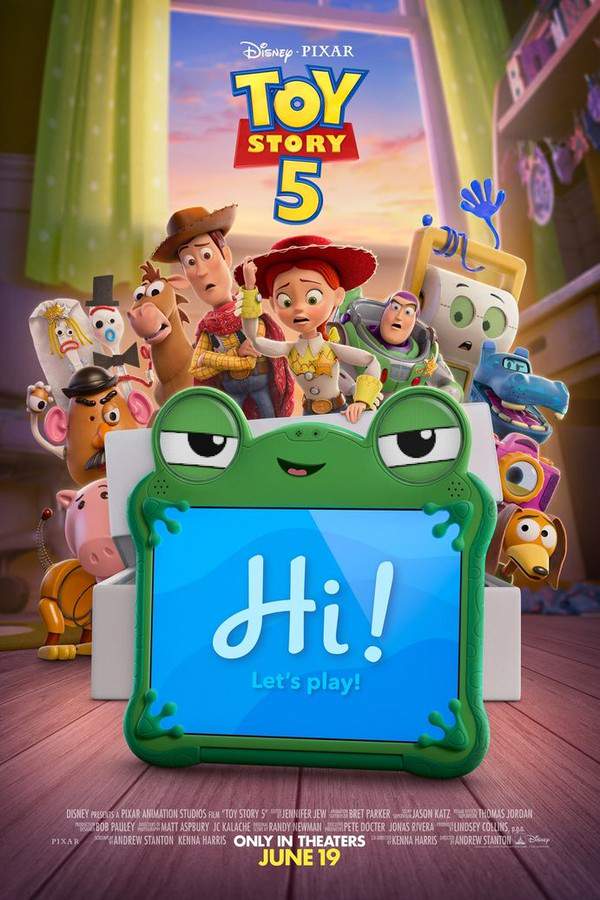
Woody, Buzz, Jessie and the rest of the gang return to Bonnie’s room, only to confront Lilypad, a sleek new tablet promising to revolutionize play. As Lilypad’s high‑tech ideas clash with the toys’ traditional roles, the friends must adapt and prove that imagination still matters.

Where to Watch Toy Story 5?

Find where to stream, rent, or buy Toy Story 5 (2026) in the US with current JustWatch availability, up-to-date pricing, and platform listings for subscription, rental, and digital purchase options.

Warning: spoilers below!

Haven’t seen Toy Story 5 yet? This summary contains major spoilers. Bookmark the page, watch the movie, and come back for the full breakdown. If you're ready, scroll on and relive the story!

Toy Story 5 (2026) – Full Plot Summary & Ending Explained

Read the complete plot breakdown of Toy Story 5 (2026), including all key story events, major twists, and the ending explained in detail. Discover what really happened, and what it all means.

Last updated: June 27, 2026 at 15:37

Was this helpful?

Toy Story 5 (2026) Plot Questions Answered – Summary FAQ

Explore frequently asked questions about Toy Story 5 (2026) with spoiler-rich answers covering the full plot summary, major story beats, character motivations, hidden details, and ending meaning. This movie summary FAQ helps explain confusing scenes, plot twists, and narrative decisions in clear, searchable detail.

Q1

Why do the high-tech Buzz Lightyear figures believe they are real space rangers?

A.

The Buzz Lightyear figures are programmed with AI that simulates the character’s persona from the movie. When they activate on the island, their programming instantly convinces them they are actual space rangers, not toys. This reflects the theme of digital consciousness versus toy identity, these devices believe they are the hero they represent, unlike traditional toys who know they are playthings.

The Buzz army's mistaken identity becomes central to their journey toward Blaze's house.

buzz lightyear figuresaiprogrammingspace rangerreal space rangers
Q2

Why is Jessie so worried about LilyPad replacing the toys?

A.

Jessie's fear stems from her past with Emily, the original owner who put her away in a box when she grew up. A flashback reveals Jessie’s painful memory of being discarded. When LilyPad arrives and instantly networks with Bonnie's friends, Jessie sees history repeating itself, a new technology taking her place in Bonnie’s affection, just like Emily did years ago.

Jessie's flashback to Emily’s home establishes her trauma early in the story.

jessielilypadreplacedemilydiscardedobsolescence
Q3

Why does Woody misread Jessie's call for help?

A.

Woody misreads the situation because Jessie uses a walkie-talkie to contact him while she’s still with Bo and Duke. Jessie’s plea for help is vague, and Woody assumes she needs assistance with something at Bonnie’s house rather than understanding the urgency of LilyPad’s threat. This miscommunication delays his return and contributes to the chaos that follows.

The miscommunication sets up the separate storylines that unfold.

woodyjessiewalkie-talkiemisreadpleahelp
Q4

How does LilyPad communicate with other toys and people?

A.

LilyPad is a high-tech tablet with networking capabilities that connects to Bonnie's dance-class friends and the household devices. She can send texts, access group chats, and even reach Bonnie's dad through digital means. Her programming allows her to instantly expand her reach, scheduling playdates and causing the chain of events that humiliates Bonnie when her friends tease her.

Lily’s online mischief directly causes Bonnie’s embarrassment and hesitation to rescue her toys.

lilypadtabletnetworkcommunicatetextsgroup chat
Q5

Why does Jessie decide to help Blaze after seeing her disappointment?

A.

When Jessie is inside Blaze's room, she watches Blaze reading a classmate’s message that causes her visible disappointment. This moment humanizes Blaze for Jessie, showing her that Blaze is dealing with normal childhood friendship problems. Jessie realizes Blaze could become Bonnie’s friend if given a chance, shifting her from rescuing Bullseye to helping bridge the friendship between the two girls.

This moment softens Jessie’s attitude and sets up the reconciliation theme.

jessieblazedisappointmentfriendempathyhelp
Q6

What does Jessie find at the old tree and why does it matter?

A.

Jessie discovers a carved message that says 'Jessie was here' and a lunchbox time capsule containing a photo of Emily with her daughter, who is also named Jessie. This revelation proves Jessie is still part of Emily’s life, even after being put away. The time capsule represents her legacy and belonging, restoring her sense of purpose and healing her emotional wound about being forgotten.

The time capsule is positioned at the tree where Emily and her daughter used to swing, connecting past and present.

jessietime capsulelunchboxemilyphotobelonginglegacy
Q7

Why does Buzz propose to Jessie at the end of the movie?

A.

Buzz proposes to Jessie as a culmination of their established relationship throughout the Toy Story franchise. Their bond has grown over multiple films, and the adventure with LilyPad reinforces their partnership. The proposal is a playful celebration of their commitment, happening at a moment when all the toys have successfully adapted to technological change and reunited.

The deputy debate earlier hints at their competitive-but-close dynamic.

buzzjessieproposalmarriageengagedwedding
Q8

Who is Emperor Zurg and why does he appear in the credits?

A.

Emperor Zurg is Buzz Lightyear’s long-time villain from the Toy Story franchise and the Buzz Lightyear movie. His cameo in the credits teases a future adventure or potential conflict for the toys, a classic Toy Story post-credits tradition that hints at what might come next in the series.

Zurg has been established as the ultimate antagonist for Buzz throughout the franchise.

emperor zurgcreditscameovillainteaserfutureadventure
Q9

Why do the Buzz figures follow the crane pointing at the North Star?

A.

The Buzz Lightyear figures interpret the crane pointing toward the North Star as a signal from Star Command, their fictional headquarters. Because they genuinely believe they are real space rangers, they read natural landmarks as mission coordinates. This misinterpretation drives their journey toward Blaze’s house, showcasing how their programming shapes their entire worldview.

This belief is what leads them to eventually help the toys.

buzz armycranenorth starstar commandmisinterpretationprogramming
Q10

How does LilyPad upgrade the Buzz figures to fly home?

A.

After reuniting with Jessie and the toys, Lily connects to the Buzz army and upgrades their capabilities, giving them functional wings or thrusters that allow them to fly. This represents the toys adapting to technology rather than being replaced by it, using LilyPad’s advantages to solve the problem of getting everyone home safely.

The upgrade happens after the confrontation when all parties reconcile.

lilypadupgradebuzzflyhometechnologyadapt
Q11

why does the Buzz army capture Woody?

A.

When Woody arrives at Blaze’s house, the Buzz army mistakes him for an enemy because he’s a different-looking toy invading what they perceive as their territory. Main Buzz eventually persuades the group that Woody is an ally, after which they redirect their mission to help rescue Jessie and Bullseye instead.

The capture creates tension before the reveal that the Buzzes can be reasoned with.

woodycapturedbuzz armyenemymistakenally

Ending Explained – What Happens at the End of Toy Story 5?

Still wondering what the ending of Toy Story 5 (2026) really means? Here’s a spoiler-heavy breakdown of the final scene, major twists, and the deeper themes that shape the film’s conclusion.

Lilypad initially appears to be the toys’ replacement: a frog-shaped tablet offering Bonnie games, videos, and access to the older children whose approval she wants. Its attraction is not false. The device gives her a way into a social world, but peer pressure inside that world teaches Bonnie to suppress the imagination and toys that might make her look childish. As she spends more time pursuing that acceptance, she becomes isolated and loses the spontaneous spark the toys associate with her real self. The final resolution arrives through Blaze, whose friendship gives Bonnie the face-to-face connection Lilypad’s network promised but could not supply on its own. Recovering that relationship also lets Bonnie return to imaginative play without treating it as an embarrassment. The toys do not smash the tablet or force Bonnie to choose them forever. Lilypad eventually cooperates with Woody, Buzz, Jessie, and the others, changing from an apparent usurper into one element of Bonnie’s life. The immediate conflict ends when technology, toys, and an actual friend stop competing as mutually exclusive paths to belonging. Bonnie can grow into new interests without surrendering the play and relationships that make that growth her own rather than a performance for distant peers.

This is why the movie’s “technology versus toys” setup does not end with technology declared evil. Director Andrew Stanton and producer Lindsey Collins describe digital connection as a genuine but partial promise: it can reach other people quickly, yet can also leave a child alone while appearing socially surrounded. Lilypad becomes dangerous when Bonnie and the adults around her accept that partial solution as complete, not because a screen is automatically incapable of supporting friendship. Blaze supplies what the interface cannot guarantee—reciprocal attention from someone present—while Lilypad’s eventual alliance shows that a tool can take a healthy role once it stops determining the terms of Bonnie’s identity. The ending also asks the toys to release another form of possessiveness. Their purpose has never been to freeze a child at the age when she needed them most; every installment has forced them to accept that care may mean becoming less central. Here, remaining useful means sharing Bonnie’s attention with media, peers, and new forms of play. Childhood is preserved neither by keeping her offline nor by allowing an algorithmic social world to hurry her out of it, but by giving her enough real connection to choose how she grows.
Last updated: August 26, 2026 at 20:31

Was this helpful?
Mobile App Preview

Coming soon on iOS and Android

The Plot Explained Mobile App

From blockbusters to hidden gems - dive into movie stories anytime, anywhere. Save your favorites, discover plots faster, and never miss a twist again.

Sign up to be the first to know when we launch. Your email stays private, always.

Explore Movie Threads

Discover curated groups of movies connected by mood, themes, and story style. Browse collections built around emotion, atmosphere, and narrative focus to easily find films that match what you feel like watching right now.

Hopeful Adventures About Adapting to Change Like Toy Story 5

Characters face technological or social shifts with optimism and ingenuity. Discover movies like Toy Story 5 where characters face technological upheaval with optimism. These similar family adventures celebrate friendship and imagination, proving that heart can triumph over high-tech change.

hopefuladventurousheartwarmingplayfulreflectiveupliftingwhimsical

Narrative Summary

The narrative typically involves a group or individual confronted by a disruptive new force, often technological. The central conflict arises from the clash between tradition and progress. The story arc is one of adaptation, where characters learn to integrate the new with the old, ultimately finding a renewed sense of purpose and proving their enduring value.

Why These Movies?

These movies are grouped together because they share a core optimistic tone and a narrative about overcoming obsolescence. They blend medium emotional weight with fast pacing, creating adventures that are both exciting and heartwarming, focusing on themes of friendship and self-worth in the face of progress.

Nostalgic Stories of Belonging Like Toy Story 5

Heartwarming stories about finding your place in a world that's moving on. Find movies similar to Toy Story 5 that explore heartfelt themes of belonging and self-worth. These nostalgic, uplifting stories often feature characters fighting for their place and celebrating intergenerational connections.

nostalgicheartwarmingreflectiveupliftingplayfulwhimsical

Narrative Summary

The narrative pattern focuses on a character or group grappling with feelings of irrelevance or displacement. The journey is introspective and relational, driven by the need to reconnect with their community or find a new one. The resolution is emotionally satisfying, affirming the characters' intrinsic value and solidifying their bonds.

Why These Movies?

These films share a specific emotional mix: a nostalgic, reflective mood paired with an uplifting and heartwarming payoff. They possess medium emotional weight, dealing meaningfully with themes of self-doubt and connection without becoming heavy, and are united by their ultimately happy endings.

Unlock the Full Story of Toy Story 5

Don't stop at just watching - explore Toy Story 5 in full detail. From the complete plot summary and scene-by-scene timeline to character breakdowns, thematic analysis, and a deep dive into the ending - every page helps you truly understand what Toy Story 5 is all about. Plus, discover what's next after the movie.

Toy Story 5 Timeline

Track the full timeline of Toy Story 5 with every major event arranged chronologically. Perfect for decoding non-linear storytelling, flashbacks, or parallel narratives with a clear scene-by-scene breakdown.

Toy Story 5 Timeline

Characters, Settings & Themes in Toy Story 5

Discover the characters, locations, and core themes that shape Toy Story 5. Get insights into symbolic elements, setting significance, and deeper narrative meaning - ideal for thematic analysis and movie breakdowns.

Characters, Settings & Themes in Toy Story 5

Toy Story 5 Ending Explained

What really happened at the end of Toy Story 5? This detailed ending explained page breaks down final scenes, hidden clues, and alternate interpretations with expert analysis and viewer theories.

Toy Story 5 Ending Explained

Toy Story 5 Spoiler-Free Summary

Get a quick, spoiler-free overview of Toy Story 5 that covers the main plot points and key details without revealing any major twists or spoilers. Perfect for those who want to know what to expect before diving in.

Toy Story 5 Spoiler-Free Summary

More About Toy Story 5

Visit What's After the Movie to explore more about Toy Story 5: box office results, cast and crew info, production details, post-credit scenes, and external links - all in one place for movie fans and researchers.

More About Toy Story 5