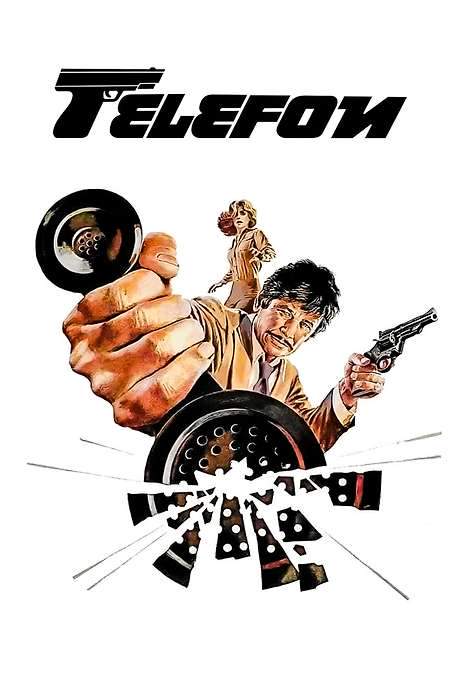
CIA director Maxwell Danforth [Burt Lancaster] watches a recording of agent Laurence Fassett [John Hurt] and his wife in an intimate moment, a disturbing prelude to a violence that shocks Fassett to the core. When Fassett heads toward the shower, two KGB assassins slip into the bedroom and murder his wife, an act that shocks Fassett not because of its brutality alone, but because the CIA had sanctioned the hit. Grief and rage consume him as he searches for answers, and his pursuit leads him to a dangerous discovery: a Soviet spy network known as Omega.
Fassett’s grief becomes a strategic problem for the agency, because he links the killings to a covert operation that could threaten American interests if exposed. He identifies three men as the top Omega operatives: television producer Bernard Osterman [Craig T. Nelson], plastic surgeon Richard Tremayne [Dennis Hopper], and stock trader Joseph Cardone [Chris Sarandon]. Rather than publicly arresting them—an action that could provoke a KGB backlash—Fassett proposes an intricate workaround: recruit one of these three to the West’s side and use that insider to unravel the entire network with greater efficiency. His eye falls on John Tanner [Rutger Hauer], a controversial television journalist known for his sharp critiques of government power. Tanner has been close friends with Osterman, Tremayne, and Cardone since their Berkeley days, and Fassett believes he can steer one of them toward betraying Omega.
The CIA discreetly approaches Tanner, presenting him with a stark ultimatum: his closest allies are Omega agents, and the agency will not reveal this to the public. At first, Tanner’s skepticism is high, but Fassett can show him taped conversations with a shadowy Russian contact—clips in which Cardone discusses the possibility of targeting Tanner, Tremayne hints at leaving the country if “it” goes down, and Osterman speaks of radical change with the caveat that he wants it all to be paid for in a Swiss bank account. With this damning evidence, Tanner slowly comes to believe that the threat is real. He agrees to the risky plan, but only if the weekend reunion—a gathering of Osterman, Tremayne, Cardone, and their spouses—can be staged at his own home, and only if Danforth agrees to appear as a guest on Tanner’s show.
Tanner’s personal life is already strained. He asks his wife Ali [Meg Foster] to take their son away for the weekend to avoid dragging them into an operation they don’t understand. Fassett assures him that keeping the family safe at home is the CIA’s best defense, but Tanner remains unsettled. Fassett continues setting the stage: he sets up a large van on the grounds with a contingent of CIA agents nearby, and the home is wired with closed-circuit video to feed him evidence for the investigation. Ali’s patience wears thin as she senses the danger and the secret-carrying nature of her husband’s work.
The weekend arrives with a tense mood. Osterman, Tremayne, and Cardone—each harbored their own troubles engineered by the CIA to undermine them—move into Tanner’s house, their couples bringing a palpable strain to the atmosphere. On the second night, Fassett shares a video feed to Tanner’s dining room TV about Swiss bank accounts and illegal financial manipulation, a move that inflames Virginia Tremayne [Helen Shaver] and enrages Ali. Osterman reveals his discomfort with the whole enterprise, while the guests settle in for what promises to be a fragile, high-stakes convergence. The atmosphere is thick with suspicion, and the tension escalates when Tanner’s son discovers the head of their family dog in the fridge—a decoy that underscores Fassett’s intent to push boundaries—and Tanner, exasperated, demands that the CIA arrest the suspects.
The plot accelerates as Cardone and Tremayne, along with their wives, flee in Tanner’s RV after a standoff with Osterman. Tanner confronts Osterman, and a brutal confrontation follows, where Osterman asserts that he is not a traitor but merely engaged in illicit financial activity meant to shield funds from taxation. Osterman maintains that his actions are not aimed at harming the United States, even as the family becomes increasingly endangered. Fassett interrupts the confrontation with a calculated move: he detonates an explosive device remotely attached to the RV, killing Tremayne and Cardone, and unleashing a deadly assault on the house with his soldiers.
As chaos erupts, Fassett taunts Tanner, revealing that Danforth authorized his wife’s murder. He offers to release Tanner’s family if Tanner will expose Danforth on television, turning the trap into a televised spectacle that would shift the balance of power. The standoff culminates in a dramatic broadcast: Danforth prepares for a remote interview, while Tanner—assisted by Osterman—executes a carefully pre-planned sequence. Tanner introduces Fassett on the air, and Fassett, who is simultaneously beamed from a remote location, exposes Danforth as a murderer. Danforth’s public fury erupts in a paranoid tirade, and he vows to annihilate Fassett. Yet the crucial twist arrives when Tanner, having set a pre-recorded set of questions with Osterman’s help, uses the live feed to locate Fassett and shoot him. The angle of Fassett’s death preserves Tanner’s anonymity, making Fassett’s demise appear to be the result of Danforth’s threats turning real. In the end, Tanner’s wife, son, and dog are rescued, and the truth about Omega, Fassett’s actions, and the CIA’s heavy-handed tactics is laid bare in a way that leaves the audience to weigh the costs of such power.
This film threads a taut line between personal loyalty and political manipulation, exploring how a man driven by personal loss can be drawn into a high-stakes game of espionage and deception. It questions the ethics of covert operations carried out in the name of national security, and it probes the limits of trust when the very people who are meant to protect a nation become the architects of its darkest secrets. The conclusion leaves viewers with a striking final image: a family saved at the last moment, and a public exposure that exposes the risks—and the price—of fighting shadows in the name of safety.