Year: 1942
Runtime: 100 min
Language: English
Director: Billy Wilder
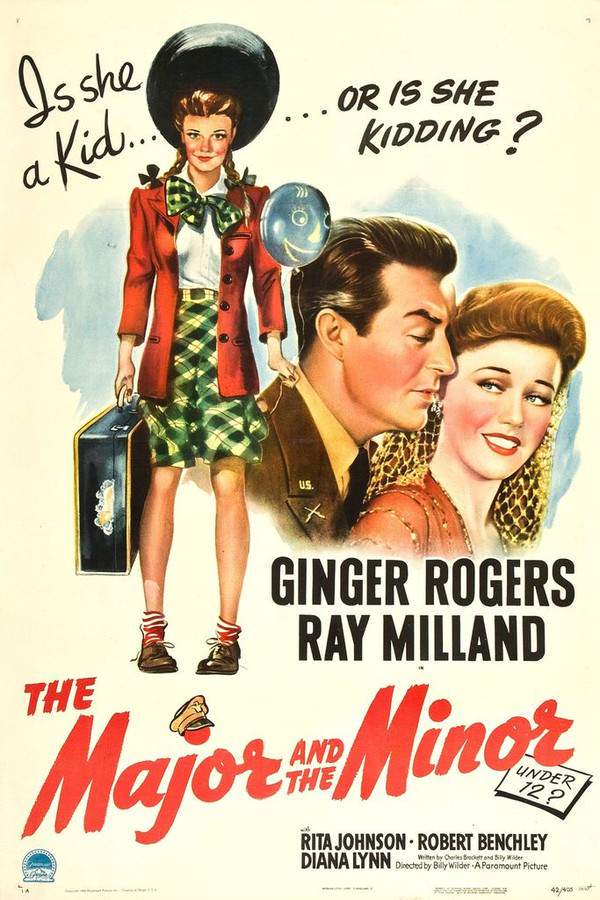
A spirited New Yorker, Susan Applegate, pretends to be a young girl to obtain a train ticket to Iowa. The train conductor discovers her deception, and she cleverly hides in the quarters of Major Kirby, who is captivated by her seemingly innocent demeanor. As his fiancée and others become suspicious of her true identity, Susan uses her quick wit and charm to maintain the elaborate ruse and avoid exposure.
Find where to stream, rent, or buy The Major and the Minor (1942) in the US with current JustWatch availability, up-to-date pricing, and platform listings for subscription, rental, and digital purchase options.
Warning: spoilers below!
Haven’t seen The Major and the Minor yet? This summary contains major spoilers. Bookmark the page, watch the movie, and come back for the full breakdown. If you're ready, scroll on and relive the story!
Trace every key event in The Major and the Minor (1942) with our detailed, chronological timeline. Perfect for unpacking nonlinear stories, spotting hidden connections, and understanding how each scene builds toward the film’s climax. Whether you're revisiting or decoding for the first time, this timeline gives you the full picture.
Last updated: November 17, 2024 at 21:05
Find frequently asked questions about the The Major and the Minor (1942) timeline, including chronological order, nonlinear jumps, cause-and-effect links, and scene sequence clarifications. This timeline FAQ helps explain when key events happen, how moments connect, and why the story unfolds in that specific order.
Susan pretends to be a child because she cannot afford the full adult fare to return to Iowa. As a scalp massager in New York City earning modest wages, she discovers that a child ticket costs significantly less, prompting her to adopt the persona of 'Su-Su,' a 12-year-old girl, to save money and escape her difficult situation.
Her financial desperation is established early when she decides to leave New York after unwanted advances from Albert Osborne.
Major Philip Kirby believes Susan is a frightened child who was caught smoking by conductors and hid in his compartment out of fear. His paternal instincts and military background make him want to protect this 'lost' girl, so he agrees to keep her with him until they reach their destination.
His protective nature toward what he perceives as innocence sets up his eventual attraction to Susan as an adult.
Lucy, Pamela's sister and a budding biologist, recognizes Susan's disguise immediately but sees an opportunity. She persuades Susan to help thwart Pamela's plans to keep Philip at the military academy by pointing out they share a common goal, ensuring Philip won't be reassigned to active duty. Lucy's scientific mind and status as an outsider make her willing to collaborate with Susan.
Lucy identifies Susan as a fellow 'specimen' who doesn't fit in with the Academy's social hierarchy.
The cadets invent a playful kissing method based on the fall of the Maginot Line, the famous French defensive fortification that was circumvented by German forces in World War II. They humorously compare their kissing technique to the historical military tactic, creating a lighthearted game that becomes popular during Susan's stay at the academy.
This comedic reference to France's defeat foreshadows Susan's later comment about believing in the Fall of France and destiny.
Pamela refuses to marry Philip on short notice because she has already decided to marry someone else. While Philip expresses gratitude for her support and prepares to report for active duty, Pamela withholds this information and declines the marriage, later spinning a deceitful tale to Susan about why she cannot marry him.
Her refusal sets up the final romantic resolution between Susan and Philip at the train station.
At the film's conclusion, Philip's gaze is described as 'one impaired, one perfect' as he looks at Susan on the train platform. This references his earlier convoluted metaphor about lightbulbs and moths, and suggests his vision is imperfect, he must choose which 'eye' to trust. When he looks at Susan with his 'perfect' eye and smiles, it signifies clear recognition and acceptance of who she truly is.
Philip's earlier lightbulb and moth metaphor about being drawn to the light foreshadows this moment of clarity.
The frog that Lucy sends to Philip as a gift symbolizes innocence and her biological expertise. As a budding biologist, Lucy chooses a creature that represents simplicity and purity, a sharp contrast to the complex deception surrounding Susan's identity. The frog also serves as a subtle message to Philip about remaining true to honest, uncomplicated emotions.
Lucy, having helped Susan maintain her disguise, uses the frog to communicate her own genuine intentions.
Mrs. Applegate, wise and perceptive, advises Philip that men heading into battle shouldn't wed because marriage would give them something to lose, a family waiting at home that could distract them or cause emotional vulnerability during wartime. This wisdom reflects the historical reality of wartime marriages and provides Philip with perspective on his impending departure for active duty.
This conversation occurs just before Philip visits the train station to reunite with Susan, adding weight to his decision.
When Cadet Clifford Osborne introduces Susan to his parents and accidentally reveals her true identity to Pamela, it creates a dangerous situation. Albert Senior recognizes Susan from his earlier unwanted advances in New York, exposing both her dual identities as Su-Su and Susan Applegate. This threatens Philip's reputation and career because he had been harboring a woman masquerading as a child in his compartment, which could be interpreted as improper conduct.
The elaborate ruse that begins as a simple ticket scheme spirals into a situation that could end Philip's military service.
When Susan meets Philip at the train station, she boldly declares herself as 'Susan Kathleen Applegate,' abandoning her child disguise completely. This moment represents her choosing authenticity and a future with Philip over her old life and her former fiancé Will Duffy. Her firm belief in destiny, which she expresses through her musings about the Fall of France, empowers her to claim her true identity and offer herself to Philip as a woman ready to marry a soldier.
Susan's earlier claim that she believes in the Fall of France and destiny foreshadows her confident declaration at the platform.
Discover curated groups of movies connected by mood, themes, and story style. Browse collections built around emotion, atmosphere, and narrative focus to easily find films that match what you feel like watching right now.
Movies where charming characters maintain a complex lie through quick thinking.If you enjoyed the witty ruse in The Major and the Minor, you'll love these movies about charming characters maintaining elaborate lies. Discover similar comedy stories where quick thinking and clever deception drive a playful and romantic plot, creating a fun, fast-paced viewing experience.
Stories in this thread typically feature a protagonist who adopts a false identity or concocts a complex scheme for a specific goal. The plot is propelled by a series of close calls and comic misunderstandings as they try to maintain their deception, often leading to romantic entanglements and a final, satisfying revelation.
These movies are grouped together because they share a core narrative device of a clever, high-stakes deception. They create a consistent vibe of playful tension through witty dialogue, charismatic leads, and a plot that balances the thrill of the con with lighthearted romantic or comedic elements.

Energetic comedies driven by witty banter, romantic chaos, and social satire.Fans of the rapid-fire wit and romantic chaos of The Major and the Minor will enjoy these classic screwball comedies. Find movies like this with fast pacing, clever social commentary, and charming leads whose verbal sparring leads to love in the most unexpected and hilarious ways.
The narrative pattern involves a central romantic couple, often from different social strata, who engage in a 'battle of the sexes' through sharp, witty dialogue. The plot is a chaotic sequence of schemes, misunderstandings, and social satire that accelerates towards a unifying and happy conclusion.
These films are united by their specific blend of tone and pacing. They share a light, charming feel, a focus on verbal wit over slapstick, and a narrative engine that is fast, farcical, and ultimately optimistic, providing a very particular and beloved comedic experience.
Don't stop at just watching - explore The Major and the Minor in full detail. From the complete plot summary and scene-by-scene timeline to character breakdowns, thematic analysis, and a deep dive into the ending - every page helps you truly understand what The Major and the Minor is all about. Plus, discover what's next after the movie.
Read a complete plot summary of The Major and the Minor, including all key story points, character arcs, and turning points. This in-depth recap is ideal for understanding the narrative structure or reviewing what happened in the movie.
Discover the characters, locations, and core themes that shape The Major and the Minor. Get insights into symbolic elements, setting significance, and deeper narrative meaning - ideal for thematic analysis and movie breakdowns.
Discover movies like The Major and the Minor that share similar genres, themes, and storytelling elements. Whether you’re drawn to the atmosphere, character arcs, or plot structure, these curated recommendations will help you explore more films you’ll love.
The Major and the Minor (1942) Plot Summary & Movie Recap
The Major and the Minor (1942) Scene-by-Scene Movie Timeline
The Major and the Minor (1942) Spoiler-Free Summary & Key Flow
Movies Like The Major and the Minor – Similar Titles You’ll Enjoy
The Very Thought of You (1999) Detailed Story Recap
Sunday in New York (1964) Plot Summary & Ending Explained
No Man of Her Own (1932) Ending Explained & Film Insights
Her Minor Thing (2005) Ending Explained & Film Insights
All Aboard (1917) Story Summary & Characters
Thoroughly Modern Millie (1967) Full Movie Breakdown
The Matinee Idol (1928) Spoiler-Packed Plot Recap
Slightly Dangerous (1943) Detailed Story Recap
The Girl from Missouri (1934) Complete Plot Breakdown
The Flapper (1920) Movie Recap & Themes
General Nuisance (1941) Full Movie Breakdown
Unfinished Business (1941) Movie Recap & Themes
The Affairs of Susan (1945) Film Overview & Timeline
Who Was That Lady? (1960) Film Overview & Timeline
She Wouldn’t Say Yes (1945) Ending Explained & Film Insights