Plot Explained Spoilers guaranteed!
Plot Explained

Browse by genre

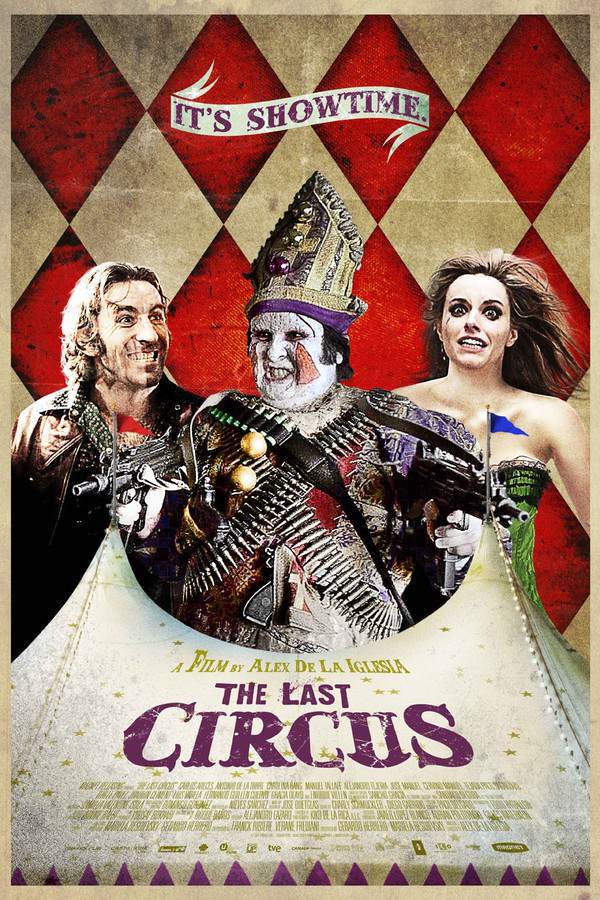
The Last Circus (2011) movie poster

Timeline

The Last Circus (2011) Timeline Explained – Every Event in Order

Release, runtime and language
2011 · 107 min · Spanish
Loading streaming availability…
Directed by
Álex de la Iglesia

In 1973 Spain, Javier, the troubled son of a famed clown, struggles to find joy while enduring constant torment from his father's cruel counterpart, Sergio, the "Happy" clown. He finds comfort in Natalia, a captivating acrobat caught in a difficult marriage. As their connection deepens, a complex and passionate love triangle emerges, setting the stage for a fierce rivalry between the Sad Clown and Happy Clown. Their conflict escalates into a bizarre and unforgettable battle, blurring loyalties and pushing boundaries.

On this page (5)
  1. 1 Where to watch
  2. 2 Events in order (15)
  3. 3 Timeline questions answered
  4. 4 Movie threads
  5. 5 Every angle
Loading streaming availability…

15 events in order · contains spoilers

The Last Circus Timeline: Events in Chronological Order

Every key event of The Last Circus (2011) in order, scene by scene, with when and where it takes place. Use it to untangle flashbacks, time jumps and parallel storylines, to refresh your memory before the sequel or to find the exact scene you are thinking of.

  1. The Arrival of War

    In the tumultuous year of 1937, a troupe of performers face the devastating grip of war. Their lives are shattered as they navigate the horrors unfolding around them, setting the stage for tragedy.

    When
    1937
  2. The Funny Clown's Fury

    The enigmatic Funny Clown begins his rampage against the Nationalist forces. Armed with a machete, he unleashes a ferocious frenzy, taking down enemy troops with skill and determination.

  3. The Clown's Final Stand

    Despite being wounded and disarmed, the Funny Clown continues his fight until he meets a grim end at the hands of Colonel Salcedo's merciless horse. This marks a tragic loss for his fellow performers and sets a dark tone for the events to come.

  4. Condemnation to Forced Labor

    After the chaos, the Funny Clown is condemned to a life of forced labor at the Valle de los Caídos monument. This punishment encapsulates the tragedy that befalls both him and his troupe.

    Where
    Valle de los Caídos
  5. Javier's Ambitious Reunion

    Fast forward to 1973, Javier, a melancholic sad clown, seeks to honor his father's legacy by joining the same circus. His journey back to this world is laced with nostalgia and burgeoning hopes.

    When
    1973
  6. Complicated Relationships

    Javier becomes involved with Sergio, the provocative Funny Clown, who struggles with his violent tendencies. Their relationship is marked by tension and emotional depth as they both navigate the complexities of clowning and their own personas.

  7. The Incident with Natalia

    In a shocking act fueled by rage, Sergio savagely beats Natalia unconscious after a night of heavy drinking. This incident sets off a chain reaction that deeply impacts Javier's and Natalia's budding romance.

  8. Secret Romance Blossoms

    Despite the chaos, Javier and Natalia cultivate a forbidden romance filled with tender moments and stolen glances. Their connection deepens when Natalia confesses her love for Javier under the enchanting lights of an amusement park.

    Where
    Amusement Park
  9. The Wrath of Sergio

    Sergio's sense of jealousy and danger culminates in a sudden, violent encounter that leaves both Natalia and Javier severely injured. This pivotal moment reshapes their fates as Javier is confined to a hospital bed.

    Where
    Hospital
  10. Javier's Descent into Madness

    While recovering, Javier experiences nightmares where he is powerless to save Natalia from Sergio's threats. Driven nearly to madness, he ultimately escapes the hospital, fueled by a fiery quest for revenge.

  11. Confrontation at the Circus

    Returning to the circus, Javier confronts former troupe members and is devastated to find Natalia and Sergio entangled in a passionate affair. His rage boils over, leading to a brutal beating of Sergio.

    Where
    Circus
  12. The Circus Crumbles

    In the aftermath of the confrontation, the circus starts to collapse, its members scattering away. Natalia and others seek refuge in a nightclub, attempting to navigate the fallout of the violence.

    Where
    Nightclub
  13. Javier's Transformation

    In a dark turn, Javier becomes a feral creature in the wilderness after being captured by hunters. His transformation accelerates as he bites a hand of Generalísimo Francisco Franco, landing him in prison.

    Where
    Wilderness
  14. A Vision in Prison

    In prison, Javier has a haunting vision of Natalia appearing like the Virgin Mary. This vision urges him to take on the role of her Angel of Death, driving him to disfigure his face and plot revenge.

    Where
    Prison
  15. Tragic Climax at the Monumental Cross

    The pursuit escalates to the Monumental Cross where Natalia sacrifices herself in a struggle between Javier and Sergio. Her tragic fall marks the ultimate sorrow in their love triangle, leading to their impending doom.

    Where
    Monumental Cross

Last updated: November 22, 2024 at 18:36

Was this helpful?

Timeline questions answered

The Last Circus Timeline Explained: Your Questions Answered

When does it happen, and why in that order? The questions people ask about the chronology of The Last Circus (2011): time jumps, flashbacks, cause and effect between scenes and the correct order of events, each answered with spoilers.

Q1

Why is Natalia attracted to both Sergio and Javier?

Natalia is drawn to two opposing forces: Sergio's dangerous violence and Javier's emotional sensitivity. She admits to feeling an inexplicable attraction to Sergio's raw ferocity despite his brutal behavior, while she falls in love with Javier's honesty and refusal to laugh at cruel jokes. This duality reflects her own conflicted nature - she craves both the excitement of danger and the comfort of genuine connection.

  • Natalia love triangle
  • Sergio violence attraction
  • Javier emotional depth
Q2

Why does Sergio beat Natalia?

Sergio beats Natalia after a night of heavy drinking and rage, driven by jealousy and his inherent violent nature. He openly admits that without the circus to contain him, he would unleash his malevolence upon the world. The circus serves as his only restraint; when alcohol removes that inhibition, his violent impulses surface against those closest to him.

Foreshadowing: Sergio earlier admits he would be dangerous without the circus constraints.

  • Sergio violence
  • Natalia abuse
  • clown rage
Q3

Why does Javier see Natalia as the Virgin Mary in prison?

While imprisoned for biting Generalísimo Franco, Javier experiences a psychological break where Natalia appears to him as the Virgin Mary. This vision represents his distorted perception - he transforms her into a religious figure who commands him to become her "Angel of Death." This delusional mission gives him purpose and justification for the violent revenge he will later enact.

  • Javier vision
  • Virgin Mary
  • Angel of Death
  • prison madness
Q4

Why does Javier disfigure his face with sodium hydroxide and an iron?

Javier disfigures his face to become what he perceives as Natalia's "Angel of Death" - a grotesque clown version of a religious executioner. Using sodium hydroxide (lye) and a clothes iron, he deliberately burns his face into a monstrous visage. This act is driven by his prison vision and his distorted belief that he must transform into something horrifying to carry out his divine mission of revenge against Salcedo and those who wronged him.

  • Javier disfigurement
  • Angel of Death
  • clown transformation
Q5

Why does Natalia flee with Sergio instead of Javier at the nightclub?

When both Sergio and Javier arrive at the nightclub simultaneously, Natalia chooses to flee with Sergio instead of joining Javier. This decision appears to stem from her complicated attraction to Sergio's dangerous nature and possibly her fear of Javier's increasingly unstable behavior. However, later at Valle de los Caídos, she tells Javier that her feelings for Sergio have faded, suggesting her initial choice was more about escaping immediate chaos than genuine preference.

  • Natalia choice
  • Sergio Javier rivalry
  • love triangle ending
Q6

Why does Sergio inform the police about Javier's location?

Sergio betrays Javier by informing the military police about his hideout at Valle de los Caídos, claiming Javier has terrorist ties. This act stems from Sergio's jealousy and desire to eliminate his rival rather than face him directly. Rather than fighting Javier himself, Sergio uses the authorities as a weapon, demonstrating his willingness to resort to treachery rather than honorably confronting his competitor for Natalia's affection.

  • Sergio betrayal
  • police informant
  • Javier capture
Q7

How does Natalia die at the Monumental Cross?

Natalia dies when she grabs Sergio's leg and jumps off the Monumental Cross in an attempt to help Javier escape. As she falls, the tension snaps her spine, killing her. Her sacrifice was meant to enable Javier's escape using lengths of drapery, but Sergio's intervention triggers the struggle that leads to her fatal leap. Both men are left devastated as she becomes the tragic victim of their rivalry.

  • Natalia death
  • Monumental Cross
  • sacrifice fall
Q8

Why does Javier bite Generalísimo Franco's hand?

While captured by hunters led by the older Salcedo, Javier bites the hand of Generalísimo Francisco Franco himself. This act lands him in prison and appears to be a defiant gesture of resistance against the Franco regime that imprisoned his father. The bite represents his transformation from victim to aggressor, channeling his madness into a symbolic attack on the dictatorship that destroyed his family.

  • Javier bites Franco
  • resistance
  • dictator attack
Q9

Why is the ETA attack on Admiral Carrero Blanco included in the film?

The ETA assassination of Admiral Carrero Blanco on December 20, 1973, serves as a real historical backdrop that enables Javier's kidnapping of Natalia. The bombing creates a distraction in the city, allowing Javier to seize the opportunity to take Natalia while chaos erupts. This real event anchors the fictional narrative in Spain's turbulent political history and provides a crucial turning point in the plot.

  • ETA
  • Carrero Blanco
  • 1973 Spain
  • historical event
Q10

Why does Javier become a feral creature in the wilderness?

After being severely beaten by Sergio and hospitalized, Javier escapes and retreats into the wilderness where he descends into madness, surviving like a feral animal. His mental breakdown is triggered by trauma, jealousy, and nightmares about being unable to protect Natalia. The wilderness represents his complete separation from society and his transformation into something less than human - a precursor to his later disfigurement and violent vendetta.

  • Javier madness
  • wilderness survival
  • mental breakdown
Q11

Why does Sergio dress as a clown to chase Javier and Natalia?

When Sergio leads the military police to capture Javier at Valle de los Caídos, he puts on his clown costume and chases both Javier and Natalia through the monumental landscape. This bizarre moment represents Sergio's inability to separate his identity from his circus persona - even in a deadly serious operation, he reverts to his clown identity. The clown costume in this context becomes both comedic and deeply unsettling, blurring performance and reality.

Foreshadowing: Sergio has always defined himself by his clown persona.

  • Sergio clown
  • Valle de los Caidos chase
  • surreal scene
Q12

Why is Javier's father condemned to forced labor at Valle de los Caídos?

In 1937, Javier's father (the original Funny Clown) attacks Nationalist forces with a machete, killing many soldiers before being killed himself. However, he survives the horse attack and is instead condemned to forced labor at the Valle de los Caídos monument - the very same location where his son will later take Natalia. This punishment represents the Franco regime's cruel retribution against those who opposed the Nationalists during the Spanish Civil War.

  • Javier father
  • forced labor
  • Valle de los Caidos
  • Spanish Civil War
Q13

Why does Natalia admit being attracted to Sergio's violence?

After Sergio beats her unconscious, Natalia shockingly admits to Javier her inexplicable attraction to Sergio's raw ferocity. This admission reveals the film's dark exploration of battered woman syndrome and the psychological hold abusive partners can have. Natalia is drawn to the same dangerous quality that makes Sergio violent - his unbridled intensity - even though it causes her harm.

  • Natalia abuse
  • attraction to violence
  • toxic relationship
Q14

Why does Javier kidnap Natalia at the end?

Taking advantage of the ETA bombing chaos, Javier kidnaps Natalia from Sergio and transports her to Valle de los Caídos. He desperately wants her to accept him as he is - just as she once loved Sergio. His kidnapping stems from his inability to accept that she might choose another man, combined with his delusional belief that their love can survive his transformation into a violent, disfigured avenger.

  • Javier kidnapping
  • Natalia capture
  • desperation love

Movie threads

More Movies Like The Last Circus, by Mood & Story

Curated lists built around what makes The Last Circus tick: the same mood, the same kind of story or the same emotional payoff. Each list explains why these movies belong together.

Descent into madness thrillers like The Last Circus

Stories where fragile psyches unravel under pressure, leading to violence. If you liked The Last Circus for its intense portrayal of a mental collapse, you'll find similar stories here. This list features movies about characters spiraling into chaos, blending psychological horror with dramatic tension. These films share a dark tone, heavy emotional weight, and often feature unhinged protagonists.

  • unhinged
  • psychological
  • tragic
  • violent
  • surreal
  • nightmarish
  • Tone: dark, tragic, unhinged
  • Pacing: variable, building to chaotic
Why these movies?

The story pattern: The narrative typically centers on a vulnerable individual pushed to their breaking point. What begins as a steady character study accelerates into a chaotic and often violent unraveling. The story uses the protagonist's distorted perception to blur the lines between reality and nightmare, leading to a climax that is both psychologically and physically destructive.

Why they belong together: Movies are grouped here based on their shared focus on psychological deterioration. They possess a consistently dark and oppressive tone, high emotional intensity, and a pacing that builds from steady to frantic. The central theme is the tragic, and often violent, consequence of a fractured mind.

Surreal and violent love triangles like in The Last Circus

Passionate obsessions that spiral into bizarre and destructive conflicts. For viewers who enjoyed the brutal and bizarre love triangle in The Last Circus, this collection highlights similar films. These movies feature passionate, toxic relationships that escalate into surreal and highly violent confrontations. Expect dark tones, complex character dynamics, and narratives where romance and brutality are intertwined.

  • violent
  • toxic relationship
  • surreal
  • tragic
  • passionate
  • unhinged
  • Tone: dark, tragic, violent
  • Pacing: variable, escalating
Why these movies?

The story pattern: The plot revolves around a toxic love triangle where passion is inextricably linked to destruction. The rivalry between the characters escalates beyond typical drama into a symbolic and often physically brutal war. The narrative structure uses this conflict to explore themes of obsession, identity, and the grotesque, resulting in a climax that is both emotionally and visually overwhelming.

Why they belong together: These films are connected by their unique blend of a central love triangle with extreme violence and surrealistic storytelling. They share a dark, tragic tone and a high level of intensity. The pacing is often variable, building tension steadily before exploding into a chaotic and stylized finale.

Every angle

The Last Circus (2011) Explained: Plot, Timeline & Characters

Everything about The Last Circus in one place: what happens in the plot summary, the timeline in chronological order, the characters and meaning and a spoiler-free summary. What's After the Movie adds the cast, box office and post-credit scenes.

Coming soon on iOS and Android

The Plot Explained Movie Summary App

Plot summaries, endings explained and timelines on your phone. Catch up on any movie in minutes, save your favorites and never miss a twist again.

Be the first to know when we launch. Your email stays private, always.

Learn more about the app