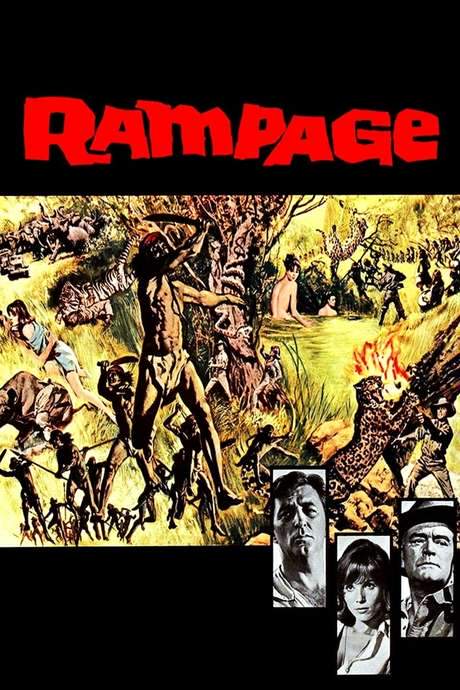
In a remote Malaya jungle, the rugged explorer Christopher Powell arrives at a sprawling game-hunting camp with two companions: his fiancée, Ava, and her stern father, Colonel Lane. The mission, as much about daring as about survival, is interrupted by a sudden attack from a tiger named Limau. Powell is gravely wounded, and the wild cat’s ferocity seems to seal his fate until help arrives in the form of Ulah, a resourceful young woman who has where she camped alone in the jungle since childhood. Ulah, whose loyalty to Limau is matched only by her deep knowledge of the forest, carries Powell back to her cave, where she tends to his injuries with a quiet care that hints at a profound, if uneasy, bond forming between predator and patient.
As Powell fights his way back to strength, Ulah’s presence fills the camp with new tensions. When Powell eventually makes it back to the safety of the camp, Ulah follows, drawn by an undeniable connection that Ava does not understand and cannot accept. Ava’s jealousy is sharpened by the camp’s superstitious locals, who view Ulah—and even Limau—as demons from ancient fears. The fragile peace of the expedition shatters as cultural misunderstandings, personal possessiveness, and a looming sense of doom collide.
The situation escalates when the natives seize the camp and move to execute Ulah by lowering her into a pit. The betrayal comes from within the group: Melan, a native ally who has turned traitor, digs the trap. In a tragic sequence, Limau dies while trying to shield Ulah, the creature’s loyalty and Ulah’s grief echoing through the jungle as spears arc toward the couple. The camp erupts into chaos as chaos becomes a brutal reckoning for everyone involved.
In the midst of the storm, Karen Neg—a brave man who confronts the locals with a broadsword—battles valiantly but falls to treachery when Melan strikes from behind. The moment is mirrored by the camp’s animal helper, Bogo the chimpanzee, whose unexpected rally of a horde of monkeys shifts the balance of power. Powell seizes Ava’s pistol, fights his way free, and shoots Melan just as Melan prepares to deliver a fatal blow to Ulah. The sudden arrival of the primate army creates a chaotic stampede, tearing through the village and destroying homes with a force that seems to echo the film’s earlier imagery.
This cascade of violence also contains a reflective echo: the flashback to an earlier catastrophe, where a herd of Indian elephants wrecked Ulah’s childhood village, now mirrored by the stampede that devastates the natives’ settlement. In the heat of the moment, Powell fires at another aggressor who moves to threaten Bogo, underscoring a recurring theme: survival often hinges on decisive, selfless acts.
Eventually, the tension gives way to a fragile reconciliation. Powell and Ava find common ground, their renewed bond tempered by the harrowing trials they’ve endured, while Ava and the Colonel share a quiet, relieved embrace. In a final, intimate reversal, Powell and Ulah share a tender kiss, hinting at possibilities beyond the immediate dangers of the jungle. The curtain falls with Bogo the chimpanzee sheltering his face, a small, humorous counterpoint to the film’s intense emotional and physical clashes.
- This story blends romance, danger, and moral conflict against a lush, perilous backdrop, exploring how love can cross cultural boundaries and survive even in the most volatile environments.
- The narrative threads through trust and betrayal, testing loyalties among humans and the jungle’s creatures alike, while never losing sight of the core idea that resilience and courage can emerge from the most unlikely partnerships.
- The film balances spectacle—savannah storms, animal allies, and perilous chases—with moments of quiet, intimate connection, inviting the audience to consider what it means to belong in a world where civilization and wilderness collide.