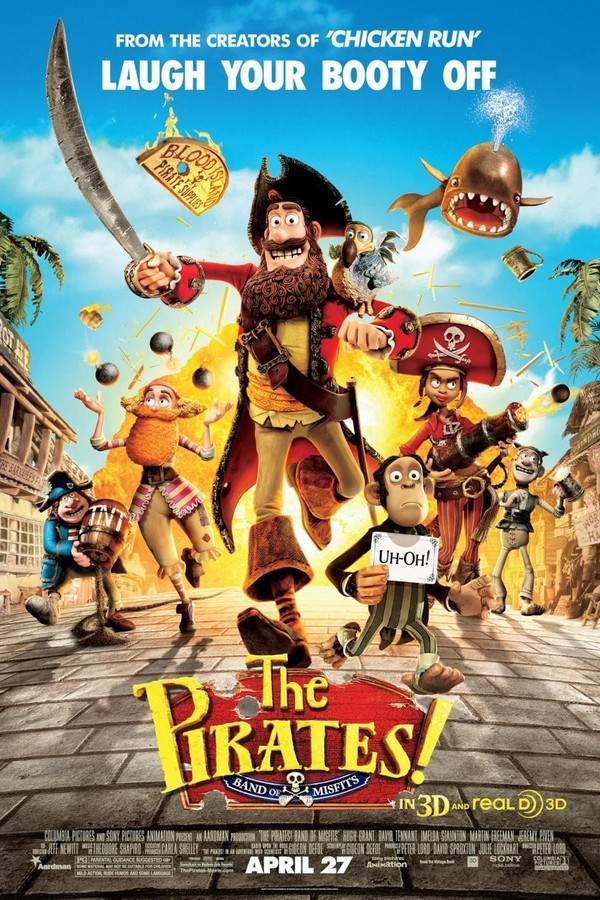
The Crimson Permanent Assurance weds corporate satire to swashbuckling fantasy in a tale that follows a retiree-era squad of clerks from a stodgy London insurance firm who refuse to bow to a slick takeover by the Very Big Corporation of America (VBCA). When one of their own is unjustly dismissed, the seasoned workers mobilize, locking up the surviving supervisors and forcing their boss to tread a makeshift plank out a window. Their resistance sparks a radical transformation: the quiet Edwardian office building they occupy literally becomes a vessel. The fortress-like structure loosens its anchor, hoists its scaffolding and tarpaulins as sails, and lurches into motion, turning into a pirate ship afloat on the urban sea of finance.
From there, the building-turned-ship leaves the City of London and charted harbors, heading toward another financial stronghold. The crew arms themselves with the most unlikely weaponry—wooden filing cabinets become carronades, and blades ripped from ceiling fans are repurposed as swords—before launching an audacious raid on VBCA’s glittering skyscraper. In a bold, almost whimsical revolution, they swing into the boardroom on ropes, trading blows with VBCA’s executives in a long, relentless clash that blends comedy with triumph. The clash resolves in the clerks’ favor, and the victory is celebrated not with a quiet office party but with a rousing sea shanty that lifts the crew above the office walls as they pursue further adventures on the “wide accountan-sea.”
Yet the gales of Python-esque whimsy are not done. The jubilant crew discovers that their voyage has a perilous, philosophical twist: the world itself appears to be curved in a way that would spell disaster if taken literally, and they slip—quite comedically—off the edge of the world. The tale then eases into a self-referential pivot that is characteristic of the troupe’s style: the Crimson Permanent Assurance resurfaces in the middle of another film, The Meaning of Life. In a brisk montage, the ship’s legend slides into a donor scene before the action shifts to a modern VBCA boardroom, where executives debate existence, purpose, and even whether people are wearing enough hats.
>Has anyone noticed that building there before?
What follows is a meta-narrative reversal: the boardroom scene abruptly recognizes the suspiciously familiar office-building-pirate-ship looming over the proceedings, and the chase resumes as the donor sequence echoes back into the action. The raid is cut short not by a decisive victory but by an ironic catastrophe: a falling skyscraper crashes into the Permanent Assurance building, and a narrator apologizes for the “unwarranted attack by the supporting feature.” The joke lands with the same sly wit that marks Monty Python’s broader repertoire, reminding viewers that this tale of corporate rebellion is as much a playful critique of blockbuster spectacle as it is a caper of plucky misfits.
In this hybrid of corporate satire, nautical fantasy, and self-aware humor, the staff’s resourcefulness, camaraderie, and grit become a buoyant celebration of stubborn independence in the face of soulless conglomerates. The narrative bounces between peril and parody, labor and loot, seriousness and whimsy, all while maintaining a brisk, engaging tempo and a spirit of irreverent invention that fans of the troupe will recognize and relish.