Plot Explained Spoilers guaranteed!
Plot Explained

Browse by genre

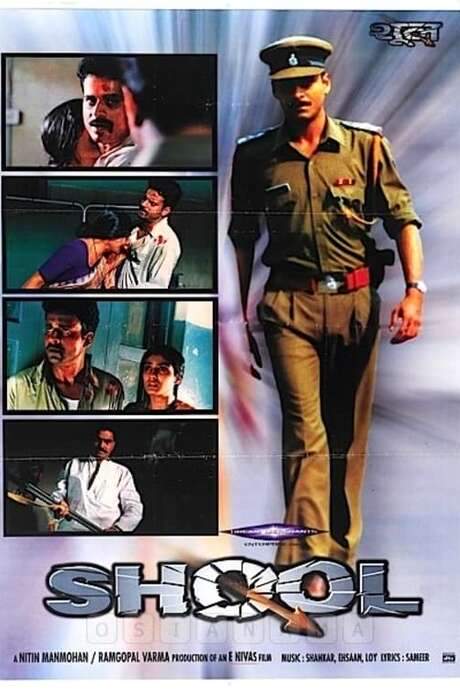
Shool (1999) movie poster

Plot Summary

Shool (1999) Plot Summary Explained

Release, runtime and language
1999 · 142 mins · Hindi
JustWatch #23,950
Directed by
Eeshwar Nivas
Starring
Veerendra Saxena, Rajpal Yadav, Yashpal Sharma, Sayaji Shinde, Vineet Kumar, Manoj Bajpayee

Police Inspector Samar Pratap Singh is posted to Motihari, Bihar with his wife Manjari and their daughter. His honesty and diligence put him at odds with the District Superintendent of Police, his subordinates and fellow officers, creating a tense struggle within a force resistant to reform.

On this page (6)
  1. 1 Where to watch
  2. 2 What happens: full plot
  3. 3 Plot questions answered
  4. 4 Movie threads
  5. 5 Movies like Shool
  6. 6 Every angle

Where to watch

Where to Watch Shool (1999)

Where can you watch Shool? Stream, rent or buy it in the US, including on Brew, Fawesome and Tubi TV: current JustWatch availability with up-to-date prices.

Streaming availability powered by JustWatch

Full plot summary · contains spoilers

What Happens in Shool: Full Plot Summary

The whole story of Shool (1999) explained, from the opening scene to the final frame: every key event, every twist and what it all adds up to. Read it as a quick recap before the sequel, to check a scene you missed, or to finally understand what really happened.

The film opens with a late-night phone call to Bacchu 'Bhaiyyaji' Yadav, Sayaji Shinde — an influential MLA aligned with the ruling party in Bihar. His men track him to a prostitute’s dwelling, where he learns that his party has chosen another MLA for the ticket this time. He doesn’t waste a second and heads straight to the newly selected candidate’s home, pressing him to withdraw his nomination for a fat pay-off. When intimidation fails, his thugs—led by the notorious Violent Coolie Rajpal Yadav—stab the candidate under Yadav’s supervision.

Across Motihari, Inspector Samar Pratap Singh, Manoj Bajpayee is posted with his wife Manjari Singh, Raveena Tandon, and their daughter. At the railway station, a heated dispute with a coolie over a ₹30 fare escalates until a local hawaldaar tries to muscle in. Samar insists on fair payment, and the confrontation spills into the station area. A sub-inspector, Hussain Ganesh Yadav, steps in, but Samar refuses to back down. He soon learns that Motihari’s police operate under Yadav’s influence, collecting hafta to do his bidding, and that the law here scarcely serves the people.

The central conflict intensifies when the D.S.P. Shri Vallabh Vyas assigns Samar to quell a clash between rival gangs and to arrest the attackers who targeted Yadav’s men. Samar digs into the case, uncovering that Yadav’s own crew, including Lallan Singh Yashpal Sharma and others, are the true perpetrators. When the D.S.P. orders the released men back, Samar refuses, insisting the case is already on file. This becomes the first clear signal of Samar’s stubborn integrity, and it alarms those who profit from the system’s rot.

Yadav, irritated by Samar’s insistence on law over convenience, stages his own grand anniversary party to flout the rules. Samar arrives to enforce the lack of proper permissions for late-night loudspeakers; with no papers shown, he confiscates the music system and halts the spectacle. Yadav attempts a patronizing, almost benevolent lecture, while the inebriated D.S.P. tries to sweep the issue under the rug. Samar remains unmoved and demands written orders, a stance that triggers renewed pressure from above. The clash culminates in a public confrontation where the corrupt apparatus manipulates events to frame Samar for a physical assault on his superior. Tiwari, Vineet Kumar, tries to help, but the chain of power seems unbreakable, and Samar is suspended.

Yadav and his men decide to deliver a final blow, and in one cruel turn the gang’s indecency toward Samar’s daughter shatters his restraint. Samar’s temper erupts, and one attacker clubs him, yet the blow backfires when the henchman strikes Samar’s daughter, killing her. Laljee Yadav Nandu Madhav, badly beaten, goes to Yadav to report Samar’s assault, only to be killed by a shotgun blast from Yadav himself, who then manipulates the scene to have Samar arrested on the charge of the crime. Samar’s parents arrive, and his father pleads for his release, but Yadav uses the moment to secure it, while Samar publicly insults him in return.

Days pass, and Manjari, the wife who stood by him, sinks into despair. She attempts suicide with sleeping pills, and a panicked Tiwari informs Samar of her condition. The hospital scene offers a brief, uncertain solace as Manjari, before dying, urges Samar to avenge their daughter and their family’s suffering.

With his world shattered, Samar discards everything but his oath. He retrieves his service weapon, overpowers the warnings of Hussain, and sets out for Patna. He breaches the legislature’s security and seeks out Babu Bhaiyyaji in the well of the House. In a final act of defiance and heartbreak, he drags Yadav to the Speaker’s dais, makes an emotional appeal about leadership and the criminalization of politics, and then, in a vow to restore justice, shoots Yadav in the head and proclaims his patriotism, crying out twice the words that echo through the halls: > Jai Hind
Last updated: October 09, 2025 at 11:05

Was this helpful?

Plot questions answered

Shool Plot Explained: Your Questions Answered

The questions people ask most about Shool (1999): what happens in the confusing scenes, why the characters do what they do, the twists, hidden details and what the ending means. Each answer contains spoilers.

Q1

Why did Inspector Samar refuse to release Yadav's men when ordered by the D.S.P.?

Samar refused because he had already filed the case and recorded the arrests of Lallan Singh and Sudhir Vinod as the attackers. He understood that releasing them would let the real perpetrators go unpunished and perpetuate the cycle of corruption in Motihari's police force. This was the first major display of his integrity, which directly conflicted with the D.S.P.'s orders and set him on a collision course with the entire corrupt system.

  • samar pratap singh
  • lallan singh
  • arrest
  • corruption
  • motihari police
Q2

Why was Inspector Samar suspended from his job?

Samar was suspended because he refused to back down during the loudspeaker confrontation at Yadav's anniversary party. He demanded proper written orders and insisted the rules applied to everyone, embarrassing the D.S.P. and Yadav. The corrupt system then framed him for a physical assault on his superior, using the D.S.P. and Hussain's testimony to have him suspended from service.

  • samar suspension
  • loudspeakers
  • dsp
  • corruption
  • motihari
Q3

How did Samar's daughter die in the market?

During a confrontation in the Motihari market, one of Yadav's henchmen attacked Samar with a heavy wooden club. However, the blow accidentally struck Samar's daughter instead, killing her. The tragic accident was a turning point that shattered whatever restraint Samar still held, transforming his grief into uncontrollable rage.

  • daughter death
  • market attack
  • yadav henchmen
  • tragic turning point
Q4

Why did Bacchu Yadav kill Laljee after the market incident?

Yadav killed Laljee because he came to report that Samar had beaten Yadav's men badly. Rather than showing concern, Yadav vieweds Laljee as a loose end who could potentially testify against him. Using his callous exercise of power, Yadav shot Laljee with a shotgun and then manipulated the scene to frame Samar for the murder, having his men file a false complaint.

  • laljee murder
  • frame job
  • yadav shot
  • false complaint
Q5

Why did Manjari attempt suicide in the film?

Manjari attempted suicide because the relentless pressure of corruption, her husband's suspension, their daughter's death, and the overall destruction of their family had broken her spirit. Blaming Samar's idealism for their ruined life, she took sleeping pills in despair. She died at the hospital after urging Samar to avenge their daughter and their suffering.

  • manjari suicide
  • sleeping pills
  • idealism
  • revenge
  • hospital death
Q6

Why did Samar kill Yadav inside the state legislature?

After losing his daughter and wife to the corrupt system orchestrated by Yadav, Samar felt he had nothing left to lose. He entered the Bihar State Legislature, dragged Yadav to the Speaker's dais, and delivered an emotional appeal about criminalization of politics. Then, in an act of personal vengeance disguised as patriotism, he shot Yadav in the head and shouted "Jai Hind" twice to proclaim his actions as a patriot's duty.

  • legislature killing
  • patna
  • jai hind
  • vengeance
  • political corruption
Q7

Why did Yadav have the new MLA candidate stabbed?

Yadav attacked the candidate because his political party had chosen someone else for the electoral ticket instead of him. When his pressure campaign for a fat pay-off failed and the candidate refused to withdraw his nomination, Yadav ordered his thugs to stab the candidate under his direct supervision, eliminating his political rival through violence.

  • mla candidate
  • stabbing
  • political ticket
  • bihar
  • bacchu yadav
Q8

Why did Samar confront the coolie over Rs 30 at the railway station?

Samar refused to overpay the coolie the Rs 30 excess fare because he believed in fair payment and could not tolerate harassment. This confrontation revealed his character, unwilling to be bullied or cheated. When a hawaldaar tried to muscle in and Hussain suggested he forgive the harassment, Samar's insistence on standing up for himself exposed the corruption that permeated every level of Motihari's police.

  • railway station
  • coolie
  • rs 30
  • hawaldaar
  • hussain
Q9

Why did Samar confiscate the loudspeakers at Yadav's party?

Samar confiscated the loudspeakers because Yadav was using them without proper permission for a late-night celebration, violating noise regulations. Rather than accepting the D.S.P.'s pressure to overlook it, Samar demanded to see the written permits. When none were produced, he shut down the music system, directly challenging Yadav's sense of entitlement and exposing the D.S.P.'s complicity.

  • loudspeakers
  • party
  • permissions
  • dsp
  • motihari
Q10

Why was Samar framed for Laljee's murder?

After Yadav killed Laljee with his own shotgun, he ordered his henchmen to file a false complaint claiming Laljee died due to Samar's actions. The corrupt police quickly moved to arrest Samar, who was already grieving his daughter's death. This framing was Yadav's final move to completely destroy Samar and silence anyone who opposed his criminal empire.

  • false complaint
  • police arrest
  • framed
  • laljee
  • criminal empire
Q11

Why did Samar travel to Patna instead of seeking legal justice?

Samar chose to take the law into his own hands because the legal system had completely failed him. After his suspension, his daughter's death, the false murder charge, and his wife's suicide, he concluded that no court would deliver justice against the powerful Yadav. Discarding his badge and service weapon, he decided personal vengeance was the only remaining option.

  • patna
  • legal system failure
  • personal vengeance
  • final confrontation
Q12

What did Samar mean when he shouted "Jai Hind" after killing Yadav?

By shouting "Jai Hind" twice after executing Yadav, Samar framed his act of personal revenge as a patriotic duty. He positioned himself as a patriot who eliminated a criminal politician corrupting the system. This tragic irony, using nationalist slogans to justify murder, underscored how deeply corrupted the political and legal system had become, leaving no legitimate avenue for justice.

  • jai hind
  • patriotism
  • revenge
  • political corruption
  • irony

Movie threads

More Movies Like Shool, by Mood & Story

Curated lists built around what makes Shool tick: the same mood, the same kind of story or the same emotional payoff. Each list explains why these movies belong together.

Movies about fighting corruption like Shool

Stories of righteous individuals pushed to the brink by systemic decay. Explore films similar to Shool, where an honest individual confronts a deeply corrupt system. If you liked the tense, righteous struggle in Shool, you'll find more movies here about principled heroes facing off against institutional decay, often at great personal cost. These are gritty, high-stakes dramas about fighting a rigged game.

  • righteous
  • tense
  • frustrating
  • grim
  • angry
  • oppressive
  • Tone: dark, righteous, grim
  • Pacing: steady, escalating
Why these movies?

The story pattern: The narrative follows a linear, escalating path of opposition. The protagonist's initial attempts at reform are met with resistance, which quickly turns into targeted hostility. The conflict moves from professional obstruction to violent personal attacks, culminating in a final, often tragic, confrontation that tests the very limits of their morality.

Why they belong together: These films are grouped by their core conflict: the lone righteous figure versus the corrupt institution. They share a high emotional intensity, a dark and unforgiving tone, and a steady pacing that methodically builds frustration and rage towards a cathartic but costly climax.

Bleak vigilante justice movies like Shool

Tragic stories where personal loss leads to a dark path of revenge. Discover films with a similar tragic arc to Shool, where a devastating personal loss pushes a protagonist towards vigilante justice. If you were moved by the grim transformation and heavy emotional weight in Shool, this collection features other stories of moral decay and desperate, violent retribution born from grief.

  • tragic
  • vengeful
  • despairing
  • grim
  • angry
  • frustrating
  • Tone: dark, tragic, despairing
  • Pacing: steady, methodical
Why these movies?

The story pattern: The narrative pattern is a fall from grace. It begins with establishing a normal, often principled life. A catalytic, brutal event—such as the murder of a family member—destroys this normality. The second act explores grief and the failure of official justice, leading the protagonist to abandon the system and embrace violence in the third act, resulting in a sad or bleak resolution that offers no true victory.

Why they belong together: These movies are united by a specific emotional journey: from grief and powerlessness to righteous rage and violent action. They share a dark tone, heavy emotional weight, and a straightforward narrative that makes the protagonist's tragic transformation feel inevitable and deeply affecting.

If you liked this

Movies Like Shool

Similar movies to Shool: the same genre, themes or kind of story. Each one comes with its own plot summary, timeline and ending explained.

Browse all movie summaries

Every angle

Shool (1999) Explained: Plot, Timeline & Characters

Everything about Shool in one place: what happens in the plot summary, the timeline in chronological order, the characters and meaning and a spoiler-free summary. What's After the Movie adds the cast, box office and post-credit scenes.

Coming soon on iOS and Android

The Plot Explained Movie Summary App

Plot summaries, endings explained and timelines on your phone. Catch up on any movie in minutes, save your favorites and never miss a twist again.

Be the first to know when we launch. Your email stays private, always.

Learn more about the app