Plot Explained Spoilers guaranteed!
Plot Explained

Browse by genre

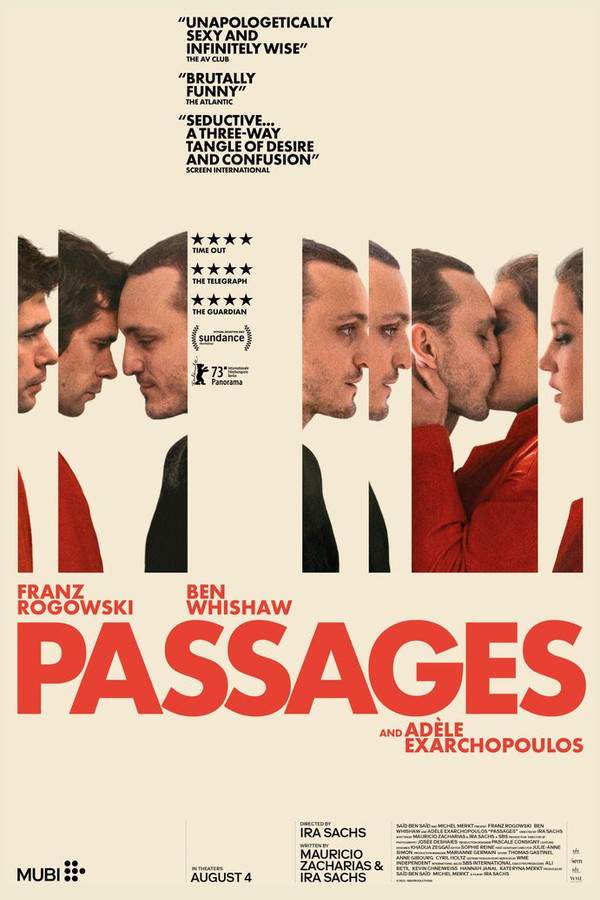
Passages (2023) movie poster

Ending Explained

Passages (2023) Ending Explained – Final Scene & Meaning

Release, runtime and language
2023 · 91 min · English
Echo score 71
Directed by
Ira Sachs
Starring
Ad, Ben Whishaw, Franz Rogowski, William Nadylam, Théo Cholbi, Caroline Chaniolleau

A filmmaker named Tomas begins an intense affair with a schoolteacher, Agathe, disrupting his marriage to Martin. Driven by a desire for excitement, Tomas finds himself increasingly consumed by the relationship, diverting his attention from his work. This passionate entanglement forces him to examine the challenges of love, the instability of commitment, and the depths of his own desires.

On this page (6)
  1. 1 What happens at the end
  2. 2 Final events in order
  3. 3 Ending questions answered
  4. 4 Movie threads
  5. 5 Movies like Passages
  6. 6 Every angle

Ending explained · contains spoilers

What Happens at the End of Passages?

How Passages (2023) ends, what the final scene means, which earlier moments set it up and how to read the ending if the film leaves it open. The full ending explained, with every spoiler.

At the end of Passages, the complex web of relationships reaches a breaking point. Tomas, a vulnerable and self-absorbed director, has been manipulating those around him, craving attention and control. His affair with Agathe, a woman who entered his life after her breakup, initially seemed to be casual, but Tomas’s need for dominance turned it into something more obsessive. As the story unfolds, Tomas’s desire to be the center of attention becomes painfully evident. His interference in Martin's relationship with Agathe and his constant intrusion into Martin’s life reveal his inability to accept losing control.

Martin, Tomas’s husband, is portrayed as more mature, trying to hold steady and analyze the situation. Yet, beneath his calm exterior, he is deeply hurt by Tomas’s betrayal. When Tomas announces that Agathe is pregnant, the underlying tensions explode. Tomas’s manipulation intensifies when he involves Martin in the chaos, even pretending that the three of them might make a family work, despite the clear imbalance. This culminates in Agathe’s decision to have an abortion after a night of emotional chaos at the cottage, as she recognizes the toxicity of the relationship and her own need to escape from Tomas’s destructive cycle.

In the final moments, the characters’ choices culminate in heartbreak. Martin, overwhelmed by betrayal, finally chooses to leave Tomas, refusing to go to Venice with him and seeking emotional reconciliation with Agathe. Tomas, on the other hand, is left lost in the streets, desperately searching for someone to listen to him or be there for him, too self-absorbed to see the pain he causes others. The ending leaves us with a stark reflection on self-destructive behavior, the need for genuine connection, and the pain of manipulative love. It shows how Tomas’s relentless pursuit of attention and control ultimately isolates him, leaving him alone, still searching for the validation he craves but unable to recognize that true fulfillment can’t be found in control or manipulation.

Last updated: June 25, 2025 at 08:59

Was this helpful?

The last 4 events

How Passages Ends: The Final Events in Order

The last events of Passages (2023) in chronological order, the run-up to the ending explained above. The complete timeline has all 15 events, scene by scene.

Open the full timeline
  1. Agathe's Abortion

    Agathe meets with Martin to confide that she has undergone an abortion. She expresses her desire for a family but realizes she would feel lost among the three of them.

    Where
    Restaurant
  2. Final Breakup with Martin

    Martin confronts Tomas, breaking up with him and refusing to join him on a trip to Venice. This finality marks a significant end to their relationship.

    Where
    Tomas and Martin's Apartment
  3. Desperate Plea to Agathe

    Tomas visits Agathe at her classroom, pleading for forgiveness and inviting her to join him on a trip. His desperation is met with rejection, intensifying his feelings of isolation.

    Where
    Agathe's Classroom
  4. Aimless Through the City

    In a moment of despair, Tomas rides his bicycle aimlessly through the city after the rejections from both Martin and Agathe. This act symbolizes his search for meaning and belonging.

    Where
    Paris

Ending questions answered

Passages Ending: Your Questions Answered

The questions people ask most about the ending of Passages (2023): what the final scene means, how the twist works, what happens to each character and how to read the ending. Each answer contains spoilers.

Q1

Why does Agathe decide to have an abortion in Passages?

Agathe chooses to have an abortion after a night of emotional chaos at the cottage because she recognizes the toxicity of her relationship with Tomas and her own need to escape from his destructive cycle. The pregnancy would have tied her further to a manipulative and unstable dynamic, and she realizes that leaving is the only way to break free from Tomas's control.

Foreshadowing: Tomas's manipulation intensifies earlier when he involves Martin in the chaos, even suggesting the three of them might make a family work despite the clear imbalance.

  • agathe
  • abortion
  • pregnancy
  • escape
  • toxicity
Q2

Why does Martin leave Tomas at the end?

Martin finally leaves Tomas because he is overwhelmed by betrayal and years of emotional manipulation. After Tomas announces Agathe's pregnancy and continues his manipulative behavior, Martin refuses to go to Venice with Tomas and instead seeks emotional reconciliation with Agathe. This represents Martin's breaking point after trying to hold steady throughout the relationship.

Foreshadowing: Martin's calm exterior masks deep hurt from Tomas's betrayal, which builds throughout the film until it finally explodes.

  • martin
  • leave
  • betrayal
  • venice
  • divorce
Q3

What happens to Tomas at the end of Passages?

Tomas is left alone, lost in the streets, desperately searching for someone to listen to him or be there for him. He is too self-absorbed to recognize the pain he has caused others. The ending shows him isolated and disoriented, still searching for the validation he craves but unable to find true fulfillment through control or manipulation.

Foreshadowing: Tomas's relentless pursuit of attention and need to be the center of everything has been building throughout the film, culminating in his complete isolation.

  • tomas
  • alone
  • isolated
  • lost
  • validation
Q4

Why does Tomas pretend they could be a family?

Tomas suggests the three of them could make a family work as a manipulation tactic. His need for dominance and control drives him to interfere in Martin's relationship with Agathe and maintain involvement in both their lives. He cannot accept losing control, so he creates a false narrative of possibility to keep everyone entangled rather than face abandonment.

Foreshadowing: Tomas's desire to be the center of attention becomes painfully evident early in the film, and his interference in others' relationships reveals his inability to let go.

  • tomas
  • manipulation
  • control
  • family
  • dominance
Q5

What does Tomas really want from Agathe and Martin?

Tomas wants constant attention, validation, and control rather than genuine connection. His affair with Agathe was initially casual but became obsessive because he craves being the center of someone's world. He manipulates those around him to maintain this feeling of importance, unable to find true fulfillment because he seeks control instead of authentic love.

Foreshadowing: Tomas is described as vulnerable yet self-absorbed from the beginning, driven by a desire for excitement that consumes his attention.

  • tomas
  • attention
  • validation
  • control
  • manipulation
Q6

Why does Martin choose Agathe over Tomas?

Martin chooses to seek emotional reconciliation with Agathe because he sees her as the genuine connection he was missing. After years of Tomas's betrayal and manipulation, Martin recognizes that Agathe also suffered under Tomas's control and that they share mutual understanding. His choice represents his need for authentic emotional connection rather than continued manipulation.

Foreshadowing: Martin is portrayed as more mature, trying to analyze the situation throughout, suggesting he ultimately seeks something real and stable.

  • martin
  • agathe
  • choice
  • connection
  • authentic
Q7

What is the message or meaning of the ending?

The ending delivers a stark reflection on self-destructive behavior and manipulative love. Tomas's relentless pursuit of attention and control ultimately isolates him, leaving him alone still craving validation he cannot recognize as unattainable through manipulation. The film shows that true fulfillment cannot be found in control or using others for personal validation.

Foreshadowing: The film consistently portrays romance as a destructive force, with tension and sadness building as Tomas's true nature emerges.

  • theme
  • message
  • self-destruction
  • manipulation
  • isolation
Q8

Why does the film reveal Agathe's pregnancy and then the abortion?

The pregnancy reveal serves as the catalyst that exposes the underlying tensions between all three characters. Tomas uses it as another manipulation tool, while Agathe's decision to have an abortion represents her act of reclaiming agency from Tomas's control. The sequence forces everyone to confront the reality of their toxic dynamic.

Foreshadowing: Tomas's manipulation intensifies when he involves Martin in the chaos after the pregnancy announcement.

  • pregnancy
  • abortion
  • catalyst
  • reveal
  • agency
Q9

Why can't Tomas function without someone to validate him?

Tomas cannot function alone because his self-worth depends entirely on external validation. He is described as vulnerable and self-absorbed, constantly seeking attention to fill an internal void. His final desperate search for someone to listen to him demonstrates his inability to be alone with himself or recognize his own destructive patterns.

Foreshadowing: Tomas's need for attention and inability to accept losing control has been evident throughout the entire film.

  • tomas
  • validation
  • alone
  • attention
  • dependent

Movie threads

More Movies Like Passages, by Mood & Story

Curated lists built around what makes Passages tick: the same mood, the same kind of story or the same emotional payoff. Each list explains why these movies belong together.

Movies about destructive affairs and love triangles like Passages

Intense stories of passionate love triangles that unravel lives and leave devastation. If you liked the intense emotional turmoil of Passages, explore other movies about destructive affairs and volatile love triangles. These films delve into the painful fallout of infidelity, featuring characters whose passionate entanglements lead to commitment issues, self-destruction, and heavy emotional consequences.

  • volatile
  • passionate
  • unsettling
  • melancholic
  • anxious
  • claustrophobic
  • Tone: tense, melancholic
  • Pacing: variable, driven by confrontation
Why these movies?

The story pattern: These narratives often follow a character who enters an intense, disruptive affair, destabilizing their existing life. The story charts the escalating chaos, confrontations, and emotional fallout within a love triangle. The journey typically culminates in a sad or bleak resolution, with characters facing profound loneliness and the irreversible damage caused by their actions.

Why they belong together: They are grouped by their shared focus on the destructive power of passion. They deliver a consistently tense and heavy viewing experience, marked by high emotional intensity, volatile character dynamics, and a deep exploration of relationship turmoil and its melancholic aftermath.


Claustrophobic character studies of self-destruction like Passages

Intimate portraits of characters whose own impulses lead them into emotional isolation. For viewers who appreciated the intimate, anxiety-inducing character focus of Passages, this collection features other films about psychological unraveling. These movies offer a similar tense, claustrophobic vibe, following protagonists on a path of self-destruction that leads to a profound sense of melancholic loss and isolation.

  • claustrophobic
  • unsettling
  • anxious
  • melancholic
  • psychological
  • intense
  • Tone: tense, unsettling
  • Pacing: variable, intimate
Why these movies?

The story pattern: The narrative pattern centers on a protagonist, often an artist or creative type, whose narcissistic or impulsive tendencies drive the plot. The story unfolds in a tight, often linear fashion, focusing on their increasingly poor choices and the shrinking circle of their relationships. The arc is one of inevitable decline, ending with the character facing the stark consequences of their behavior alone.

Why they belong together: These films share a specific, immersive vibe: a tense, claustrophobic atmosphere driven by a volatile protagonist. They are united by a similar pacing that shifts with the character's emotional states, a high level of intensity, and a heavy, melancholic tone that explores themes of creative turmoil and relationship dissolution.

If you liked this

Movies Like Passages

Similar movies to Passages: the same genre, themes or kind of story. Each one comes with its own plot summary, timeline and ending explained.

Browse all movie summaries

Every angle

Passages (2023) Explained: Plot, Ending, Timeline & Characters

Everything about Passages in one place: what happens in the plot summary, the timeline in chronological order, the characters and meaning, the ending explained and a spoiler-free summary. What's After the Movie adds the cast, box office and post-credit scenes.

Coming soon on iOS and Android

The Plot Explained Movie Summary App

Plot summaries, endings explained and timelines on your phone. Catch up on any movie in minutes, save your favorites and never miss a twist again.

Be the first to know when we launch. Your email stays private, always.

Learn more about the app