Plot Explained Spoilers guaranteed!
Plot Explained

Browse by genre

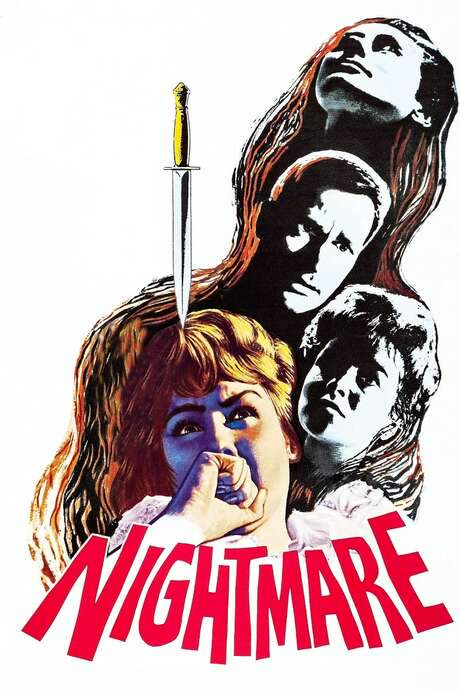
Nightmare (1965) movie poster

Timeline

Nightmare (1965) Timeline Explained – Every Event in Order

Release, runtime and language
1965 · 101 mins · Swedish
Directed by
Arne Mattsson
Starring
Sven Lindberg, Christina Carlwind, Mona Malm, Ulla Jacobsson, Tord Peterson, Mimi Pollak

A woman driving alone at night nearly runs over a man on the road. She stops to investigate, and the stranger suddenly attacks her. Later, a farmer discovers the dead body of Eva Jansson and alerts the police. Soon after, fashion designer Maj Berg travels the same route, is halted by officers, and once the road reopens she suffers a flat tire. While changing the spare, she finds a mysterious black notebook lodged in the ditch. Back in Stockholm, Maj opens it and is shocked to see a cryptic note that seems to involve her directly.

On this page (5)
  1. 1 Events in order (12)
  2. 2 Timeline questions answered
  3. 3 Movie threads
  4. 4 Movies like Nightmare
  5. 5 Every angle

12 events in order · contains spoilers

Nightmare Timeline: Events in Chronological Order

Every key event of Nightmare (1965) in order, scene by scene, with when and where it takes place. Use it to untangle flashbacks, time jumps and parallel storylines, to refresh your memory before the sequel or to find the exact scene you are thinking of.

  1. Six years ago: tragedy and asylum

    Janet's mother killed her father, an act that shatters the family and leads to her mother's confinement in an asylum. The tragedy casts a long shadow over Janet's childhood and memories of the family home. These events set the emotional stakes for the rest of the story.

    When
    Six years ago
    Where
    Family home / asylum
  2. Janet returns from finishing school; Grace takes charge

    Miss Mary Lewis brings Janet home in Henry Baxter's absence. They are greeted by John, the chauffeur, Mrs. Gibbs the housekeeper, and Grace Maddox, the nurse-companion hired by Henry. Miss Lewis leaves Janet in Grace's care, initiating her uneasy guardianship. The household watches over Janet as she adjusts to being back home.

    When
    Start of story
    Where
    Baxter residence
  3. Nightmares begin: a ghostly visitor

    Janet is plagued by recurring nightmares, beginning with a white-shrouded woman roaming the corridors. In the dream she is urged to burst into her parents' room, where the same figure lies with a knife on the bed. The unsettling visions blur dream and reality and unsettle Janet.

    When
    Early in the story
    Where
    Baxter residence corridors
  4. Henry returns; doctors urge treatment

    Henry returns to a distressed Janet who is under sedation. Doctors recommend psychiatric care to address her condition, but Henry refuses to institutionalize her. The refusal deepens the sense that Janet is trapped between care options and her fragile state.

    When
    Soon after the nightmares
    Where
    Baxter residence
  5. Janet's suicide attempt

    Following the medical impasse, Janet makes a desperate attempt to take her own life. The incident underscores her severe distress and prompts a crisis in how her care is handled. Staff and family consider new steps to prevent further harm.

    When
    After refusal of care
    Where
    Baxter residence / hospital
  6. Tea visit leads to murder; Janet's commitment

    Henry's wife visits for tea, and Janet, convinced she is the nightmare figure, stabs her to death. The shocking act leads to Janet's immediate commitment to an asylum. The event marks a turning point, driving the family deeper into tragedy.

    When
    Shortly after the suicide attempt
    Where
    Henry's home
  7. Grace revealed as the white figure; conspiracy with Henry

    The white figure is revealed to be Grace Maddox, disguised with a wig and mask as part of Henry's scheme. Grace's disguise and partnership with Henry become clear, reframing Janet's experiences as staged manipulation. The revelation exposes the depth of the plot against Janet.

    When
    After Janet's commitment
    Where
    Henry's home
  8. Grace and Henry marry; growing fear

    Grace and Henry marry, signaling their continued alliance. Grace begins to fear that Henry is driving her mad, adding a layer of personal instability to the plan. The couple's uneasy bond hints at further danger to Janet.

    When
    Soon after marriage
    Where
    Henry's home
  9. Grace suspects Janet's escape; Henry killed

    Under the impression that Janet has escaped from the asylum, Grace stabs Henry to death, hoping the blame would fall on Janet. The murder removes a key conspirator and heightens the danger surrounding Janet. The others involved in the ruse become more determined to protect Janet's recovering status.

    When
    After the marriage
    Where
    Henry's home
  10. Conspiracy exposed; Janet's recovery noted

    Mrs. Lewis, Mrs. Gibbs, and John reveal that they suspected Grace and Henry's manipulation and have decided to retaliate. They explain that Janet is actually making progress and is recovering well. The revelation shifts the power dynamics and sets the stage for the final confrontation.

    When
    After Henry's death
    Where
    Baxter residence / nearby location
  11. Grace's breakdown and arrest

    Grace experiences a breakdown under mounting pressure and is brought to justice. Janet's stability is reaffirmed, and her guardians and companions confront the emotional aftermath of the plot. The film moves toward a resolution as Grace's schemes crumble.

    When
    Final act
    Where
    Police custody / court
  12. Janet's ongoing recovery

    With the danger resolved, Janet's recovery continues and hope returns for her future. The end implies she may reclaim a normal life despite the trauma she endured. The surrounding characters face the consequences of their actions as the story closes.

    When
    Ending
    Where
    Asylum / home

Last updated: March 05, 2026 at 18:40

Was this helpful?

Timeline questions answered

Nightmare Timeline Explained: Your Questions Answered

When does it happen, and why in that order? The questions people ask about the chronology of Nightmare (1965): time jumps, flashbacks, cause and effect between scenes and the correct order of events, each answered with spoilers.

Q1

Why does Henry refuse to send Janet for psychiatric treatment?

Henry refuses psychiatric care because he fears that institutionalizing or restraining Janet would worsen her distress. He believes keeping her at home under his supervision is the safer option, though this decision also allows him to continue his manipulation without professional intervention in her treatment.

Foreshadowing: Earlier, Miss Mary Lewis specifically asked Henry to arrange proper psychiatric care for Janet, hinting at Henry's unwillingness to seek outside help.

  • henry baxter
  • psychiatric care
  • refusal
  • janet treatment
Q2

What is the white figure haunting Janet's nightmares?

The white-robed figure is Grace Maddox disguised in a white gown and wig, deliberately planted by Henry as part of a coordinated scheme to torment Janet. The revelation comes later when it's exposed that Henry orchestrated the entire plot.

Foreshadowing: The nightmares begin almost immediately after Grace arrives at the household, establishing her as the likely source of Janet's visions.

  • white figure
  • nightmare
  • grace maddox
  • disguise
Q3

Why does Grace disguise herself as the white figure?

Grace disguises herself as the spectral woman as part of Henry's conspiracy to drive Janet further into madness. The pair orchestrate these terrifying visions to manipulate Janet and ultimately frame her as mentally unstable, allowing Henry to maintain control over her inheritance and circumstances.

Foreshadowing: Henry's scheme becomes clearer when he dismisses doctors' recommendations for psychiatric care, suggesting he benefits from Janet remaining dependent and emotionally fragile.

  • grace maddox
  • disguise
  • henry plot
  • conspiracy
Q4

What is Henry's motivation for the conspiracy against Janet?

Henry's motivation stems from his desire to control Janet and presumably benefit from her circumstances. By keeping Janet emotionally unstable and isolated, he maintains power over her and can orchestrate events to his advantage, including eventually marrying Grace.

Foreshadowing: Henry's refusal to seek proper help for Janet, combined with his hiring of Grace specifically to 'care' for her, establishes his manipulative intent from the start.

  • henry baxter
  • motivation
  • conspiracy
  • control
Q5

Why does Janet attack and kill Henry's wife during tea?

Janet mistakes Henry's wife for the white figure from her nightmares, the same figure she has been seeing repeatedly in her dreams. When the woman visits for tea, Janet experiences a terrifying vision where reality blurs with her nightmares, causing her to fatally stab what she believes is the figure haunting her.

Foreshadowing: The nightmares repeatedly show the white figure lying on a bed with a knife, building to this tragic confrontation where Janet enacts the violent imagery she's been seeing.

  • janet
  • henry wife
  • murder
  • nightmare
  • mistaken identity
Q6

Why does Grace kill Henry after they marry?

Grace becomes paranoid that Henry is plotting to drive her mad as well, just as he did with Janet. Believing Janet has escaped from the asylum, Grace stabs Henry to death and attempts to frame Janet for the murder, thinking this will cover her own tracks and eliminate the person she now fears.

Foreshadowing: Earlier, Grace expresses unease about Henry, wondering if he intends to turn her into another victim of his psychological manipulation.

  • grace maddox
  • henry baxter
  • murder
  • paranoia
Q7

How is the conspiracy between Grace and Henry exposed?

Mrs. Lewis, Mrs. Gibbs, and John, the household staff, have been quietly observing the suspicious events and growing uneasy about Grace and Henry's behavior. They decide to take action and reveal what they've witnessed, exposing the manipulation plot and helping to clear Janet's name.

Foreshadowing: Throughout the story, these household members are shown watching and questioning the events around Janet, suggesting their growing suspicion would eventually lead to revelation.

  • conspiracy exposed
  • revelation
  • household staff
  • mrs lewis
Q8

What triggers Janet's suicide attempt?

Janet's suicide attempt stems from the relentless torment of the nightmares combined with the feeling that no one believes her or takes her fears seriously. Under sedation and with doctors recommending institutionalization that Henry rejects, Janet reaches a breaking point and attempts to end her life.

Foreshadowing: The nightmares intensify progressively, with Janet growing increasingly desperate and isolated before this crisis point.

  • janet
  • suicide attempt
  • desperation
  • nightmares
Q9

Why does Grace fear she is going mad?

Grace begins to realize Henry's manipulative nature extends beyond Janet, she fears he is deliberately working to destabilize her mental state as well. Her paranoia grows as she recognizes the same patterns of psychological manipulation that were used on Janet, and she starts to question her own grip on reality.

Foreshadowing: The dramatic irony suggests Grace is experiencing the same manufactured reality that Henry engineered for Janet, turning his tactics back onto his own accomplice.

  • grace maddox
  • madness
  • paranoia
  • psychological manipulation
Q10

What happens to Janet after she is committed to the asylum?

After being wrongly committed to the asylum for killing Henry's wife, Janet's recovery becomes a central focus. Once the conspiracy is exposed and the truth comes to light, Janet is shown to be gradually recovering. The resolution implies she may eventually reclaim a normal life, though the psychological damage from the manipulation will take time to heal.

Foreshadowing: The staff and guardians who reveal the conspiracy specifically note that Janet is making progress and recovering well, offering hope for her future.

  • janet
  • asylum
  • recovery
  • commitment

Movie threads

More Movies Like Nightmare, by Mood & Story

Curated lists built around what makes Nightmare tick: the same mood, the same kind of story or the same emotional payoff. Each list explains why these movies belong together.

Paranoid Gaslighting Thrillers like Nightmare

Stories where the protagonist's reality is systematically undermined by conspirators. If you liked the systematic psychological torment in 'Nightmare', you'll find more movies here where a fragile protagonist is gaslit into doubting their sanity. These films create a similar claustrophobic atmosphere of escalating paranoia and manipulation.

  • gaslighting
  • paranoid
  • suspenseful
  • sinister
  • claustrophobic
  • psychological manipulation
  • Tone: tense, paranoid
  • Pacing: steady, deliberate
Why these movies?

The story pattern: Narratives in this thread typically follow a vulnerable character—often isolated or recovering from trauma—who becomes the target of a deliberate campaign to make them question their sanity. The plot unfolds through a series of suspicious events, false evidence, and manipulative interactions, leading to a climax where the conspiracy is either exposed or collapses under its own weight.

Why they belong together: Movies share this grouping because they focus intensely on the experience of psychological abuse and gaslighting. They create a specific, unsettling mood where the protagonist's perception of reality is the central conflict, resulting in a tense, emotionally heavy viewing experience.
Movies with Fragile Protagonists under Psychological Siege like Nightmare

Emotionally fragile characters besieged by external psychological forces. Find more films like 'Nightmare' where an emotionally vulnerable character endures a sustained psychological attack. If you were captivated by the portrayal of a fragile woman targeted by conspirators, this thread groups similar stories of mental resilience under pressure.

  • psychological torment
  • fragile protagonist
  • unsettling
  • anxious
  • suspenseful
  • trauma
  • Tone: tense, heavy, unsettling
  • Pacing: steady
Why these movies?

The story pattern: These narratives often begin by establishing the protagonist's emotional fragility or past trauma. An external force—be it individuals, an institution, or a circumstance—then begins a systematic campaign to break them down. The story arc follows the protagonist's gradual descent into despair, a crucial turning point, and a fight for recovery, often leaving them scarred but alive.

Why they belong together: These films are grouped by their central focus on a character's psychological vulnerability and the intense, often cruel, external pressure applied to them. They share a heavy emotional weight and a tone that is deeply suspenseful and unsettling, focusing on the internal battle for sanity.

If you liked this

Movies Like Nightmare

Similar movies to Nightmare: the same genre, themes or kind of story. Each one comes with its own plot summary, timeline and ending explained.

Browse all movie summaries

Every angle

Nightmare (1965) Explained: Plot, Timeline & Characters

Everything about Nightmare in one place: what happens in the plot summary, the timeline in chronological order, the characters and meaning and a spoiler-free summary. What's After the Movie adds the cast, box office and post-credit scenes.

Coming soon on iOS and Android

The Plot Explained Movie Summary App

Plot summaries, endings explained and timelines on your phone. Catch up on any movie in minutes, save your favorites and never miss a twist again.

Be the first to know when we launch. Your email stays private, always.

Learn more about the app