







Plot Explained Spoilers guaranteed!
Plot Explained

Browse by genre

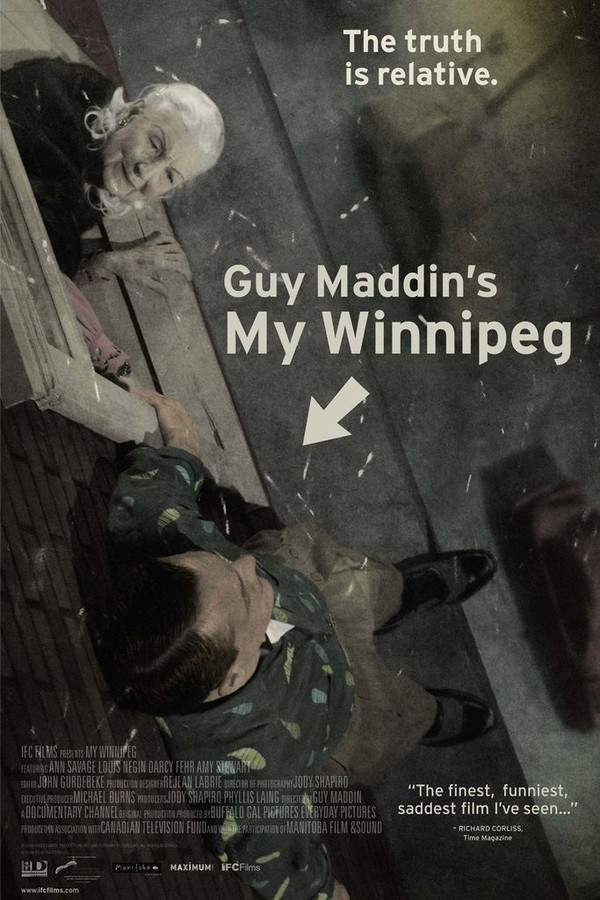
My Winnipeg (2008) movie poster

Timeline

My Winnipeg (2008) Timeline Explained – Every Event in Order

Release, runtime and language
2008 · 80 min · English
JustWatch #31,573 1
Directed by
Guy Maddin
Starring
Ann Savage, Darcy Fehr

This whimsical documentary offers a poignant tribute to Winnipeg, Guy Maddin’s childhood home. He blends factual accounts with fantastical narratives to explore the city’s history, mythology, and his own personal experiences. Featuring Ann Savage portraying his mother, the film delves into themes of nostalgia, identity, and longing through surreal visuals and metaphorical storytelling, revealing a candid and emotionally honest perspective.

On this page (6)
  1. 1 Where to watch
  2. 2 Events in order (15)
  3. 3 Timeline questions answered
  4. 4 Movie threads
  5. 5 Movies like My Winnipeg
  6. 6 Every angle

Where to watch

Where to Watch My Winnipeg (2008)

Where can you watch My Winnipeg? Stream, rent or buy it in the US, including on AMC+, Philo and Sundance Now: current JustWatch availability with up-to-date prices.

Streaming availability powered by JustWatch

15 events in order · contains spoilers

My Winnipeg Timeline: Events in Chronological Order

Every key event of My Winnipeg (2008) in order, scene by scene, with when and where it takes place. Use it to untangle flashbacks, time jumps and parallel storylines, to refresh your memory before the sequel or to find the exact scene you are thinking of.

  1. Awakening on the Train

    The story begins with Guy Maddin waking up on a bumpy train, lost in a groggy contemplation of his life in Winnipeg. This moment serves as the catalyst for his desire to escape the confines of his hometown through filmmaking.

    Where
    Train
  2. Contemplating Escape

    As Maddin travels, he ponders the question, 'What if?' This significant moment reflects his yearning to break free from the languid existence he has built around himself in Winnipeg, solidifying his resolve to create a film that enables his escape.

    Where
    Train
  3. Exploring Winnipeg's Geography

    Maddin dives into Winnipeg's strategic location at the confluence of the Red and Assiniboine rivers, famously known as 'the Forks.' Through his narrative, he draws an evocative comparison, hinting at a deeper, almost mystical connection between the city's geography and his maternal roots.

    Where
    Winnipeg
  4. The Myth of the Hidden Rivers

    He introduces viewers to the concept of a hidden 'Forks beneath the Forks,' a mysterious underground river system that lies below the well-known waterways of Winnipeg. This notion emphasizes the enchanting, dual nature of the city that underpins much of Maddin's reflections.

    Where
    Winnipeg
  5. Unique Local Lore

    Maddin shares humorous anecdotes about Winnipeg's quirks, including a sponsored annual treasure hunt by the Canadian Pacific Railway. He amusingly highlights how no resident has ever utilized a one-way ticket out of town, showcasing the deep-seated connection Winnipeggers have with their city.

    Where
    Winnipeg
  6. The Sleepwalking Capital

    In exploring local by-laws, Maddin discusses the bizarre situation where new tenants must allow sleepwalkers to return to their previous homes. He playfully suggests that Winnipeg's high rate of sleepwalkers is a factor in residents' reluctance to leave, adding to the city's unique charm.

    Where
    Winnipeg
  7. Reenacting Family Life

    Maddin rents his childhood home at 800 Ellice Avenue, engaging actors to portray his family members, including his mother. This creative choice allows him to revisit cherished memories while artfully omitting roles that are too painful to confront directly.

    Where
    800 Ellice Avenue
  8. Watching 'LedgeMan'

    In a surreal family gathering, Maddin's fictional family watches a television show titled 'LedgeMan,' which centers on a sensitive man contemplating jumping from a ledge. The parallels between the show and his own life reflect his ongoing struggles with trying to navigate relationships.

  9. The General Strike of 1919

    The narrative shifts into a historical reflection on the 1919 Winnipeg General Strike, a significant event with both local and global significance. By recounting this pivotal moment, Maddin layers his exploration of personal and collective histories.

    When
    1919
    Where
    Winnipeg
  10. Family Intrigue and Suspicion

    Amidst family reenactments, a tale of betrayal unfolds, revealing a mother's suspicion that Janet Maddin is involved in an illicit affair after a deer accident. This subplot illustrates the intricate dynamics of family relationships and secrets that permeate Winnipeg.

    Where
    Winnipeg
  11. Architectural Reflections

    Maddin highlights Winnipeg's rich architectural legacy, focusing on significant sites like the now-demolished Eaton's and Winnipeg Arena. His poignant memory of being the last person to use the arena's restroom before its destruction underscores a sense of loss in both personal and communal histories.

    Where
    Winnipeg Arena
  12. The Haunting Racetrack Fire

    A disturbing recounting of a racetrack fire that claimed numerous horses introduces an eerie tone to the film. Maddin evokes haunting imagery of ghostly horse heads supposedly re-emerging from the Red River each winter, leaving lasting impressions of tragedy.

    Where
    Red River
  13. The Fake Nazi Invasion of If Day

    The narrative takes an odd turn as Maddin describes 'If Day', a staged Nazi invasion during World War II intended to promote war bond sales. This bizarre historical footnote exemplifies the surreal events that have shaped Winnipeg's quirky identity.

    Where
    Winnipeg
  14. The Symbol of 'Citizen Girl'

    As Maddin's journey progresses, he conjures the image of the 'Citizen Girl', inspired by the 1919 strike's newsletter, symbolizing his longing for freedom from his hometown. This character becomes pivotal in representing his desires and struggles throughout the film.

  15. Facing Family Tragedy

    The film culminates in a gut-wrenching reenactment involving Maddin's brother Cameron, whose tragic suicide forces Maddin to confront complex emotional realities. This moment encapsulates the bittersweet nature of memory, loss, and the inescapable ties to his hometown.

Last updated: November 16, 2024 at 17:27

Was this helpful?

Timeline questions answered

My Winnipeg Timeline Explained: Your Questions Answered

When does it happen, and why in that order? The questions people ask about the chronology of My Winnipeg (2008): time jumps, flashbacks, cause and effect between scenes and the correct order of events, each answered with spoilers.

Q1

Why does Guy Maddin want to escape Winnipeg?

Maddin feels trapped in a languid existence in Winnipeg and believes he can only escape by filming his way out. The film operates on the premise that he can use cinema as a vehicle to break free from his hometown, making this quest the central driving force of the documentary. His desire represents a deeper longing to escape the weight of memory, nostalgia, and the emotional ties that bind him to both the city and his family.

  • escape Winnipeg
  • filmmaking
  • Guy Maddin
  • hometown
  • longing
Q2

What is the 'Forks beneath the Forks' in the film?

Maddin introduces the concept of a hidden underground river system lying beneath the visible confluence of the Red and Assiniboine rivers at Winnipeg's Forks. He draws a provocative metaphorical connection between this geological feature and female anatomy, linking it to his mother. This dual nature of aboveground and belowground waterways represents the enchanting, mystical quality of Winnipeg that he describes as having magnetic and sexual energy.

  • Forks
  • underground rivers
  • Winnipeg geography
  • metaphor
  • confluence
Q3

Why does Maddin cast Ann Savage as his mother?

Maddin rents his childhood home at 800 Ellice Avenue and hires actors to portray his family members, specifically casting Ann Savage as his mother. This creative decision allows him to recreate cherished memories while deliberately omitting the painful roles of his father and himself. The choice of Ann Savage, a classic film noir actress, adds a surreal, cinematic quality to the family reenactments, blending personal memory with theatrical performance.

  • Ann Savage
  • mother
  • family reenactment
  • 800 Ellice Avenue
  • casting
Q4

What is the 'LedgeMan' television show about?

LedgeMan is a fictional television show within the film featuring a sensitive man who misinterprets situations, climbs out on a window ledge, and threatens to jump. His mother appears in a parallel window encouraging him not to give in. The show mirrors Maddin's own psychological state and his ongoing struggle to navigate relationships and escape his circumstances. Maddin's mother is noted as the star of this fictional program.

  • LedgeMan
  • television show
  • metaphor
  • window ledge
  • family dynamics
Q5

Why does the film cover the 1919 Winnipeg General Strike?

The 1919 Winnipeg General Strike was a pivotal historical event with global ramifications, and Maddin incorporates it to layer personal history with collective history. This historical segment represents his broader exploration of Winnipeg's identity and past. The strike also connects to his creation of the 'Citizen Girl' character, inspired by the 1919 strike's newsletter, which becomes a symbol of his desire for freedom.

  • 1919 Winnipeg General Strike
  • history
  • labor movement
  • Citizen Girl
Q6

What is the 'Citizen Girl' and what does it represent?

The Citizen Girl is a pinup figure that Maddin conjures as a symbol of his desire to break free from Winnipeg. Inspired by the newsletter from the 1919 Winnipeg General Strike, she represents liberation, hope, and the possibility of escape. This character becomes pivotal in expressing Maddin's yearning for freedom from his circumstances and the emotional ties that bind him to his hometown.

  • Citizen Girl
  • freedom
  • escape
  • 1919 strike
  • symbol
Q7

What is the story about Janet Maddin hitting a deer?

During the family reenactments, Maddin recounts a tale of suspicion involving his mother believing that Janet Maddin was involved in an illicit affair after hitting a deer. This subplot illustrates the intricate dynamics of family relationships and secrets that permeate the narrative. Maddin's assertion that 'everything that happens in Winnipeg is a euphemism' underscores how this seemingly simple story carries deeper metaphorical weight.

  • Janet Maddin
  • deer
  • affair
  • family secret
  • suspicion
Q8

What was 'If Day' in Winnipeg history?

If Day was a staged Nazi invasion that occurred during World War II in Winnipeg, designed to boost war bond sales. Maddin presents this bizarre historical footnote as an example of the surreal events that have shaped Winnipeg's quirky identity. This odd piece of local history exemplifies the film's blend of factual accounts and fantastical narratives that create Winnipeg's unique mythology.

  • If Day
  • Nazi invasion
  • World War II
  • war bonds
  • Winnipeg history
Q9

What happens with Maddin's brother Cameron at the end?

The film culminates in a gut-wrenching reenactment involving Maddin's brother Cameron, whose real-life suicide forces Maddin to confront the complexities of familial relationships and emotions. This devastating moment represents the emotional climax of the film, forcing Maddin to face the pain he has been avoiding throughout his elaborate escape attempt. It brings bittersweet resolution to his exploration of memory, loss, and the inescapable ties to his hometown.

  • Cameron Maddin
  • suicide
  • brother
  • family tragedy
  • emotional climax
Q10

What is the story about ghost horses in the Red River?

Maddin recounts a disturbing racetrack fire that led to horses perishing in the Red River. Each winter, ghostly horse heads are said to emerge from the ice, creating haunting imagery that lends an eerie atmosphere to the narrative. This spectral element exemplifies the film's surreal, fantastical approach to storytelling, blending tragedy with supernatural imagery.

  • ghost horses
  • Red River
  • racetrack fire
  • haunting
  • supernatural
Q11

What is Winnipeg's sleepwalking capital lore?

Maddin shares the curious local claim that Winnipeg is the world's sleepwalking capital, with an astonishingly high rate of sleepwalkers. According to local bylaws, new tenants must allow sleepwalkers to return to their old homes during their nighttime wanderings, carrying keys to their past lives. This quirky piece of lore represents the unique charm and eccentricity that defines Winnipeggers' relationship with their city.

  • sleepwalking
  • bylaws
  • Winnipeg quirks
  • sleepwalkers
  • local lore
Q12

Why does Maddin end the film with his brother's suicide?

Maddin ends the film with the Cameron reenactment because it represents the unavoidable confrontation with family trauma that his entire escape attempt has been avoiding. The elaborate family reenactments were a futile effort to leave Winnipeg, but facing his brother's suicide forces him to acknowledge the pain that truly binds him to his hometown. This bittersweet conclusion provides emotional resolution while acknowledging both the grief of memory and the inescapable pull of home.

  • ending
  • brother Cameron
  • reenactment
  • resolution
  • bittersweet conclusion

Movie threads

More Movies Like My Winnipeg, by Mood & Story

Curated lists built around what makes My Winnipeg tick: the same mood, the same kind of story or the same emotional payoff. Each list explains why these movies belong together.

Dreamlike City Portraits like My Winnipeg

Films that use fantasy and memory to paint a lyrical portrait of a place. Discover movies like My Winnipeg that poetically explore the identity of a city. These films often blend documentary with fantasy, using personal memory and local mythology to create a dreamlike and nostalgic portrait of a place, perfect for viewers who enjoy lyrical urban stories.

  • dreamlike
  • nostalgic
  • contemplative
  • lyrical
  • surreal
  • melancholic
  • Tone: whimsical, melancholic, nostalgic
  • Pacing: variable, contemplative
Why these movies?

The story pattern: These narratives are often non-linear, weaving together personal anecdotes, historical events, and fantastical legends. The journey is less about a traditional plot and more about an immersive exploration, where the protagonist's personal memories and the city's collective history become inextricably linked.

Why they belong together: These films are grouped by their unique approach to setting, transforming a real location into a dreamscape. They share a wistful, contemplative mood, a blend of fact and fiction, and a central theme of how places shape our identity and hold our memories.

Surreal Memory Journeys like My Winnipeg

Non-linear stories where personal history is reconstructed through surreal fragments. If you liked how My Winnipeg reconstructs the past, you'll enjoy these films about memory. They use surreal imagery, fictionalized reenactments, and non-linear storytelling to explore how we process personal and family history, creating a dreamy and emotionally honest narrative.

  • surreal
  • nostalgic
  • introspective
  • non-linear
  • metaphorical
  • melancholic
  • Tone: melancholic, whimsical, contemplative
  • Pacing: variable, introspective
Why these movies?

The story pattern: The narrative pattern involves a protagonist (often a filmmaker or artist) attempting to make sense of their past. The story unfolds through associative leaps rather than chronological order, using metaphor and surrealism to convey the feeling of remembering, often culminating in a bittersweet acceptance of what can and cannot be recovered.

Why they belong together: These movies share a complex, non-linear structure and a focus on the slippery nature of recollection. They are united by a dreamlike tone, a medium emotional weight that balances personal pain with artistic detachment, and a visual style that prioritizes poetic truth over realism.

If you liked this

Movies Like My Winnipeg

Similar movies to My Winnipeg: the same genre, themes or kind of story. Each one comes with its own plot summary, timeline and ending explained.

Browse all movie summaries

Every angle

My Winnipeg (2008) Explained: Plot, Timeline & Characters

Everything about My Winnipeg in one place: what happens in the plot summary, the timeline in chronological order, the characters and meaning and a spoiler-free summary. What's After the Movie adds the cast, box office and post-credit scenes.

Coming soon on iOS and Android

The Plot Explained Movie Summary App

Plot summaries, endings explained and timelines on your phone. Catch up on any movie in minutes, save your favorites and never miss a twist again.

Be the first to know when we launch. Your email stays private, always.

Learn more about the app