Plot Explained Spoilers guaranteed!
Plot Explained

Browse by genre

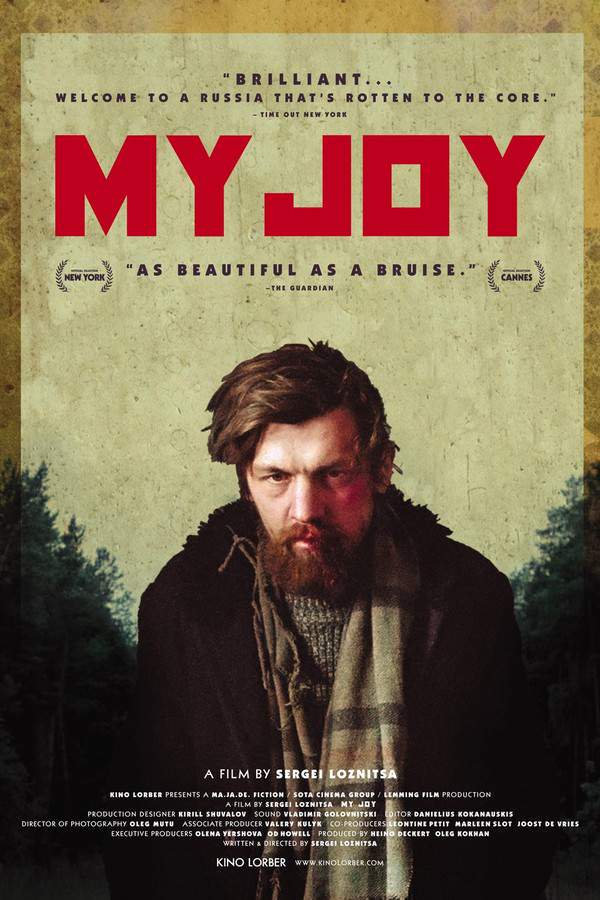
My Joy (2011) movie poster

Plot Summary

My Joy (2011) Plot Summary Explained

Release, runtime and language
2011 · 127 min · German
Loading streaming availability…
Directed by
Sergei Loznitsa

A truck driver's regular delivery route takes an unexpected turn when he encounters a police check, a war veteran, and a young woman, leading him to a remote village facing hardship and struggling to survive. The village's inhabitants are burdened by a troubled past, and the driver finds himself caught up in their complex lives. He witnesses the harsh realities of their existence and becomes intertwined with the fate of those living in this isolated, elemental world.

On this page (5)
  1. 1 Where to watch
  2. 2 What happens: full plot
  3. 3 Plot questions answered
  4. 4 Movie threads
  5. 5 Every angle
Loading streaming availability…

Full plot summary · contains spoilers

What Happens in My Joy: Full Plot Summary

The whole story of My Joy (2011) explained, from the opening scene to the final frame: every key event, every twist and what it all adds up to. Read it as a quick recap before the sequel, to check a scene you missed, or to finally understand what really happened.

It is the height of summer when young driver Georgy embarks on a journey to another town, transporting a load of flour in his light truck. His trip takes an unwelcome turn at a roadside police post, where he encounters a pair of rude and corrupt officers. As these officers flirt with a woman they had just stopped, Georgy cleverly swipes his documents and slips away unnoticed. On the road, he picks up a hitchhiker—an elderly man who shares a harrowing tale from the aftermath of World War II. He recounts a grim incident where a corrupt military officer shamelessly robbed him and threatened him with imprisonment. In a bid for revenge, he ultimately shot the officer. When Georgy parks his truck to take a brief break, he returns to find the old man mysteriously gone.

Shortly after, Georgy crosses paths with an underage prostitute. Feeling sympathy for her, he offers some money and food, but instead of gratitude, she belittles him for his kindness and storms off.

As night falls, Georgy finds himself lost and decides to camp on a field until the morning. His solitude is shattered when three local men approach, attempting to rob him of his load. They engage him in seemingly benign conversation, weaving a tale about a friend rendered mute after witnessing his father’s murder in childhood. Out of nowhere, one of the men strikes Georgy on the head with a log, knocking him unconscious.

The narrative shifts back to World War II. Two Soviet soldiers from a defeated regiment cautiously navigate occupied territory. They stumble upon a house where a widowed teacher lives with his young son. The teacher generously offers them food and shelter. However, the soldiers view his pacifism and indifference towards the German invaders as an act of treason, leading them to murder him and rob the home, leaving the child alone to fend for himself.

Fast forward to winter, where Georgy now resides in the very house abandoned by the teacher. The blow to his head has rendered him feeble-minded and mute, wandering around disheveled and with a vacant stare. The woman residing in the house exploits him, using him as a sex slave while trading his flour at the local market. One day, a policeman warns her that authorities are searching for Georgy and his truck, urging her to dispose of them quickly. After being beaten by locals, Georgy finds himself detained by the police, but he is freed later that night when another inmate engages the lone guard in a fight, opening the cells.

The woman sells Georgy’s truck and leaves him abandoned in a snow-covered village. Now homeless, he roams the area, shunned by the locals until he collapses from fatigue. Miraculously, he is found and taken in by the old man he had previously given a ride to.

As events unfold, a military van arrives in the village, tasked with transporting the body of a deceased soldier back to his homeland. The challenge is compounded for the two servicemen, especially since one officer is plagued by delirium tremens. Unable to track down the soldier's family, they resort to bribing random individuals for signatures on the paperwork. The old man seems initially hesitant but ultimately agrees to help. However, shortly after, Georgy steps outside only to discover the old man lying dead—hinting that the officer in his drunken stupor may be responsible for his demise.

In a trance-like daze, Georgy retrieves the old man's pistol and exits onto the road, where he encounters an excessively talkative truck driver who rambles on about the futility of interfering in others' affairs. Meanwhile, the earlier police officers confront a police major and his wife. During a routine check for a burnt-out headlight, the major attempts to bribe and intimidate them to no avail. Following a tense exchange, a violent brawl breaks out, with the major getting handcuffed and brutally beaten by the corrupt officers. To manufacture two fake witnesses for the arrest, they flag down another vehicle—Georgy's truck. They pressure the driver into complying, and when they turn their attention to Georgy, he remains oddly silent. The situation escalates into a brawl, during which one officer produces an assault rifle. In an instant, Georgy reacts and shoots him dead, continuing to eliminate everyone else in the fray. With a tenuous grip on the pistol, he stumbles into the darkness, haunted by the chaos around him.
Last updated: November 16, 2024 at 15:59

Was this helpful?

Plot questions answered

My Joy Plot Explained: Your Questions Answered

The questions people ask most about My Joy (2011): what happens in the confusing scenes, why the characters do what they do, the twists, hidden details and what the ending means. Each answer contains spoilers.

Q1

Why did the old man disappear from Georgy's truck?

The old man disappeared after Georgy stopped to rest. While the exact reason isn't explicitly shown, the old man had just recounted a story about murdering a corrupt officer for revenge. He likely left suddenly to avoid being connected to his story or because he was wary of staying too long with a stranger. His mysterious vanishing sets up the later revelation that he becomes Georgy's rescuer.

  • old man
  • hitchhiker
  • disappearance
  • georgy
Q2

Why did the underage prostitute reject Georgy's kindness?

The prostitute responds with hostility despite Georgy offering her money and food out of sympathy. This reaction reflects the film's themes of moral decay and the impossibility of genuine kindness in a brutal world. She sees his pity as humiliating and refuses to accept charity from a stranger, demonstrating the psychological damage inflicted by her circumstances.

  • prostitute
  • kindness
  • rejection
  • underage
Q3

Why did the Soviet soldiers kill the teacher in WWII?

The two Soviet soldiers encountered a widowed teacher who showed them hospitality but refused to take up arms against the German occupiers. The soldiers interpreted his pacifism and willingness to coexist with the enemy as treason, a betrayal of the Soviet cause. They murdered him and robbed the house, leaving his young son orphaned. This establishes the film's theme of cyclical violence and moral corruption.

  • soviet soldiers
  • teacher
  • murder
  • WWII
  • pacifism
Q4

How did Georgy become mute and feeble-minded?

Georgy was attacked by three local men who attempted to rob his truck. One of them struck him on the head with a log, rendering him unconscious. The severe head injury left him with permanent brain damage, causing him to become feeble-minded and unable to speak. This injury transforms him from an ordinary driver into a vulnerable victim exploited by others.

  • georgy
  • head injury
  • mute
  • attack
  • robbery
Q5

Why did the woman in the house exploit Georgy?

The woman who lived in the abandoned teacher's house took advantage of Georgy's mental state after his injury. Since he was mute and cognitively impaired, she could control him easily. She kept him as what the summary describes as a 'sex slave' while selling his flour at the market for profit. When police warned her that authorities were searching for Georgy, she prepared to dispose of him, showing complete exploitation of his vulnerable condition.

  • woman
  • exploitation
  • sex slave
  • flour
  • market
Q6

What happened to the old man at the end?

The old man who had previously disappeared from Georgy's truck was later found dead near the village. He had agreed to help the military officers by signing paperwork for transporting a dead soldier. The film implies that the officer suffering from delirium tremens (alcohol withdrawal) may have killed him, though the exact circumstances remain ambiguous. Georgy then retrieves the old man's pistol, leading to the final violent confrontation.

  • old man
  • death
  • military officers
  • delirium tremens
Q7

Why did Georgy shoot the police officers at the end?

Georgy witnessed the corrupt officers assault and handcuff a police major during a confrontation. When one of the officers brandished an assault rifle, Georgy, who had remained silent throughout due to his muteness, suddenly reacted by shooting the officer dead, then killed everyone else in the fray. This violent outburst represents the culmination of the film's cyclical violence theme, showing how an ordinary man becomes consumed by the same brutality he has witnessed throughout his journey.

  • georgy
  • police officers
  • shooting
  • violence
  • murder
Q8

What is the connection between the WWII story and Georgy's story?

The film connects the two time periods thematically through cyclical violence and moral decay. Georgy ends up living in the exact house where the teacher was murdered during WWII, and like the teacher, he becomes a victim of violence. The present-day characters, corrupt police, exploitative locals, and vulnerable victims, mirror the brutality of the wartime soldiers. This cyclical pattern suggests that violence and corruption persist across generations in this region.

  • WWII
  • cyclical violence
  • parallel
  • theme
  • corruption
Q9

Why did the corrupt police officers target Georgy?

The corrupt officers at the roadside post initially confronted Georgy when he stopped. He cleverly retrieved his documents and drove away without being caught. Later, to manufacture fake witnesses for arresting the police major they brutalized, they flagged down Georgy's truck and pressured him to cooperate. This shows the officers using their power to manipulate situations and frame others, demonstrating the film's depiction of systemic corruption.

  • corrupt police
  • georgy
  • truck
  • bribery
  • witnesses
Q10

Why did Georgy become homeless in the village?

After Georgy was detained by police and then freed during a jailbreak, the woman who had been exploiting him sold his truck and abandoned him in the snow-covered village. With no truck, no money, and his mental condition deteriorated, he became homeless. The locals shunned him, leaving him to wander until he collapsed from exhaustion, demonstrating how vulnerability leads to complete social abandonment.

  • georgy
  • homeless
  • abandonment
  • snow village
  • woman
Q11

Why did the old man rescue Georgy after he collapsed?

The old man who Georgy had picked up as a hitchhiker earlier found him collapsed in the village and took him in. This act of kindness completes a circular narrative, Georgy had shown the old man compassion by offering him a ride and listening to his story, and the old man reciprocated by saving Georgy when he was at his lowest point. This brief moment of human connection is rare in the film's bleak atmosphere.

  • old man
  • rescue
  • kindness
  • compassion
  • cycle
Q12

What happened to the police major who confronted the corrupt officers?

The police major attempted to pull over the corrupt officers for a burnt-out headlight. When he tried to bribe and intimidate them, they refused his attempts. A violent brawl erupted, during which the corrupt officers handcuffed the major and brutally beat him. They then needed to manufacture fake witnesses for his arrest, which led them to flag down Georgy's truck, setting up the final violent confrontation.

  • police major
  • corrupt officers
  • brawl
  • arrest
  • assault

Movie threads

More Movies Like My Joy, by Mood & Story

Curated lists built around what makes My Joy tick: the same mood, the same kind of story or the same emotional payoff. Each list explains why these movies belong together.

Movies about moral decay and corruption like My Joy

Stories where protagonists are pulled into a vortex of escalating corruption and brutality. If you were captivated by the bleak spiral of corruption in My Joy, explore these other films. This selection features movies like My Joy that depict protagonists descending into worlds of moral decay, where survival often means sacrificing one's humanity, resulting in similarly heavy and uncompromising narratives.

  • grim
  • brutal
  • fatalistic
  • oppressive
  • desolate
  • anxious
  • Tone: bleak, brutal, fatalistic
  • Pacing: slow, deliberate
Why these movies?

The story pattern: Narratives in this thread typically follow an outsider or relatively ordinary individual who enters a closed, corrupt system. Their initial attempts to navigate or resist are met with overwhelming force, leading them to adopt the very brutality they once opposed. The journey is a one-way trip into darkness, with no redemption or escape, emphasizing the cyclical and contagious nature of violence.

Why they belong together: These movies are grouped by their shared focus on the psychological and ethical unraveling of a central character within a hostile environment. They possess a consistently bleak tone, high emotional weight, and explore themes of systemic corruption, survival, and the loss of innocence, creating a cohesive and intensely grim viewing experience.

Bleak survival dramas in harsh settings like My Joy

Films set in harsh, isolated landscapes where human suffering feels elemental and inescapable. For viewers who appreciated the desolate, elemental world and the grim struggle for survival in My Joy, this list features similar movies. Discover other heavy dramas like My Joy set in remote, harsh locations where characters face immense hardship, trauma, and a pervasive sense of despair, capturing a similarly somber and oppressive vibe.

  • desolate
  • somber
  • oppressive
  • grim
  • elemental
  • isolation
  • Tone: desolate, somber, oppressive
  • Pacing: slow, atmospheric
Why these movies?

The story pattern: Stories in this thread are often less about traditional plot and more about immersing the viewer in an unforgiving world. Narrative progression is slow and episodic, built around vignettes of hardship that highlight the cyclical nature of suffering. Characters are often trapped by their geography and circumstances, their journeys marked by trauma and a futile battle against an indifferent or hostile world.

Why they belong together: These films share a unifying aesthetic and mood of profound desolation. They are connected by their slow pacing, high intensity, complex portrayal of human struggle, and overwhelmingly bleak tone. The combination of a harsh setting, themes of survival and trauma, and a fatalistic outlook creates a distinctively heavy and immersive cinematic experience.

Every angle

My Joy (2011) Explained: Plot, Timeline & Characters

Everything about My Joy in one place: what happens in the plot summary, the timeline in chronological order, the characters and meaning and a spoiler-free summary. What's After the Movie adds the cast, box office and post-credit scenes.

Coming soon on iOS and Android

The Plot Explained Movie Summary App

Plot summaries, endings explained and timelines on your phone. Catch up on any movie in minutes, save your favorites and never miss a twist again.

Be the first to know when we launch. Your email stays private, always.

Learn more about the app