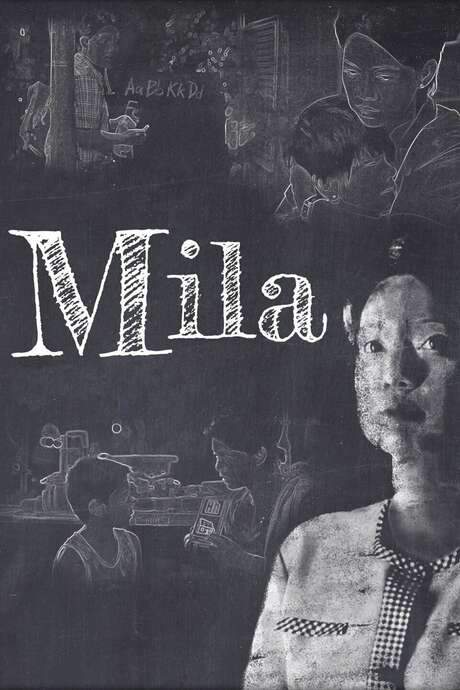
Mila Cabangon, Maricel Soriano, is a devoted public school teacher who deeply cares for her students even as she endures an abusive, gambling-prone husband, Nato, Nonie Buencamino. When his violence and constant money-drain drive her to the edge, she makes the painful choice to leave him, reclaiming a sense of safety for herself and the children she mentors. Mila also acts as a second parent to Jenny, a diligent student under pressure from her own mother, and to Boyet, Kirby de Jesus, a boy whose life is shaped by a father who makes him hawk sampaguita on the streets.
During a Metro Manila teachers’ convention, Mila’s colleagues push for a strike after the Department of Education threatens to force them back to work. The school principal, Miss Pangan, Caridad Sanchez, threatens termination if they walk out, yet the teachers press on with their protest, insisting that their voices deserve to be heard. Mila soon meets Primo, a young waiter, Piolo Pascual, and the two begin living together, sharing a fragile hope for a better future even as their relationship starts to crack.
The strike era intensifies when a hunger strike is adopted after the education department orders a return to duties or risk dismissal. Primo’s problems grow worse as he turns to shabu to cope with his own difficulties. Mila uncovers a troubling pattern: some of their household appliances are being sold off by Primo to finance his drug habit. Confronted with this betrayal, Mila urges him toward change, destroys the useless stereo equipment, and ends the relationship, determined to protect her students and herself from spiraling further.
Primo seeks reconciliation, and Mila agrees on the condition that he undergo rehabilitation. After confiding in her colleague Linda, Mila is urged to keep moving, leaving the city to roam the streets of Manila. Her wandering leads her to Ermita, a red-light district where she encounters Winona, Angie Castrence, a GRO, as well as Rona, Cherry Pie Picache, and her daughter Leni, Katrina Lindain. She also meets Peklat, Jiro Manio, and other street children, and in her heart she chooses to become a teacher to those who live on the margins, bringing a steadier presence to the GROs of Ermita.
With Fidel V. Ramos taking office, some of the strike’s supporters fall ill, and Mila’s circle grows closer. Linda, and Teresa, Kathleen Hermosa, coax Mila back toward the community of teachers. Upon Mila’s return to Ermita, Winona, Rona, and Peklat witness a troubling sight: Kalbo, a known pimp in Ermita, exploiting minors for profit. Mila steps in, warning the American pedophile that Kalbo could face imprisonment or deportation; Kalbo is eventually arrested, and Winona breathes a wary relief for herself and the others.
Mila’s health declines from the harsh life on the streets, and her coughs worsen as she fights to survive in a city that never sleeps. Her lifeless body is found along the shores of Manila Bay, a stark reminder of the toll her work and life have taken. In response to the tragedy, Mayor Alfredo Lim orders the closure of nightclubs and bars in Ermita, cutting off the GROs’ livelihoods and reshaping the district’s economy. Rona and Leni decide to pursue a fresh start in Carmona, Cavite, while Mila’s memory lives on through the remaining teachers and her students, who remember her as a fearless mentor who stood up for the vulnerable.
Before long, Rona reconciles with Mila’s memory, visiting her ailing mother and cherishing the chance to heal old wounds. One stormy night, Mila joins a newly formed homeless family, seeking warmth and solidarity under a single umbrella. The next morning, Belat and Peklat try to rouse Mila to wakefulness, but she does not stir. Mila receives a hero’s farewell from her fellow teachers, her students, and the Ermita community, and the teachers who went on strike are eventually reinstated to their posts, honoring Mila’s enduring commitment to education, dignity, and the most marginalized lives she touched.