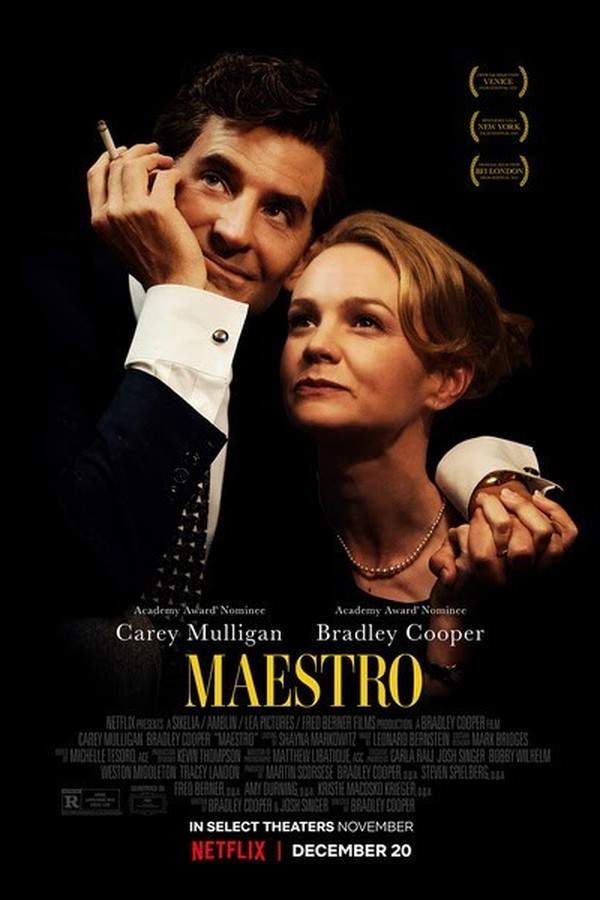
The film chronicles the passionate and complex relationship between legendary composer Leonard Bernstein and his wife, Felicia Montealegre. Their story begins with a whirlwind romance in 1946 and follows them through decades of love, artistic collaboration, and personal challenges. The narrative explores the depths of their connection against the backdrop of Bernstein's extraordinary career and the evolution of American music.
Warning: spoilers below!
Haven’t seen Maestro yet? This summary contains major spoilers. Bookmark the page, watch the movie, and come back for the full breakdown. If you're ready, scroll on and relive the story!
Read the complete plot breakdown of Maestro (2023), including all key story events, major twists, and the ending explained in detail. Discover what really happened—and what it all means.
The curtain rises on an elderly Leonard Bernstein, portrayed by Bradley Cooper, who is immersed in a reflective state as he plays a touching piece from his opera, A Quiet Place. As the camera crew captures this intimate moment, the melody fades, leaving Leonard lost in memories of his late wife, Felicia, brought to life by Carey Mulligan. He confides to the crew that there are times when silence brings her spirit very much to life, almost as if she is right there beside him.
Switching to the year 1943, we encounter a youthful and driven Leonard, affectionately nicknamed “Lenny.” A significant phone call transforms his destiny: renowned conductor Bruno Walter falls ill, creating a golden opportunity for Lenny to step in as assistant conductor for the New York Philharmonic. With his partner, clarinetist David Oppenheim (Matt Bomer), still fast asleep, Lenny leaps into action, arriving at the theater just in time to receive a rousing ovation.
Leonard’s star begins to ascend swiftly as he teams up with David and Jerry Robbins (Michael Urie) on numerous projects. It is amidst a lavish party that he has a chance encounter with Felicia Montealegre, an emerging actress whose chemistry with Lenny ignites a spark. They rehearse a scene at her local theater, culminating in a sweet kiss that hints at a deep connection.
As their romance flourishes, plans for the future take shape. However, the looming specter of anti-Semitism leads Lenny’s friends to suggest adopting a different last name. Felicia, however, intervenes, prompting them to leave the party for a spontaneous theater outing instead.
Lenny soon finds himself grappling with complex emotions, leading to the painful decision to part ways with David, who takes the news with an understanding yet apparent heartache. He eventually marries Ellen Adler (Kate Eastman), starting a family with her before he finds himself deeply enamored with Felicia. They marry and welcome three children: Jamie (Maya Hawke), Alexander (Sam Nivola), and Nina (Alexa Swinton).
As Leonard gains acclaim for works such as On The Waterfront, West Side Story, and operas like Candide, Felicia stands resiliently by his side, all the while coping with the painful truth of his infidelities. During a high-profile gathering, she witnesses him in an intimate conversation with young composer Tommy Cothran (Gideon Glick), leading Leonard to navigate a precarious path to mend his relationship with Felicia.
One eventful morning finds Leonard stumbling into their home, the weight of a tumultuous night hanging over him. Felicia’s mixed expression of worry and unease reflects the tensions building within their family, particularly as their daughter Jamie has begun to hear hurtful rumors about their marriage. Felicia pleads with Leonard not to disclose the truth to Jamie, prompting him to deflect the conversation by showcasing his latest work—a stirring composition titled “Mass.” The children are captivated, yet Felicia’s distress brews beneath the surface, leading her to momentarily plunge into the pool, overwhelmed by her emotions.
As Thanksgiving nears, the escalating friction between Leonard and Felicia climaxes during a sharp disagreement, where Felicia confronts him about the hatred he harbors deep inside, cautioning that it will lead him to a lonely existence. Her piercing words leave Leonard in turmoil.
Their relationship continues to fray amidst their individual ambitions. A performance in England in 1973 provides a professional high for Leonard, yet the distance between him and Felicia feels insurmountable. However, during his impassioned performance of Mahler’s Resurrection Symphony at Ely Cathedral, Felicia is visibly moved, pride washing over her as the audience applauds. In this fleeting moment, the love shared between them sparks anew.
Reality soon hits hard, as Felicia’s health takes a devastating turn with a diagnosis of breast cancer, leaving both of them reeling in its wake. She endures chemotherapy at home, with Leonard and their children rallying around her, but as the cancer advances to her lungs, Felicia becomes progressively frail.
During her final moments, Leonard cradles Felicia tenderly as the sunset blankets them in a warm glow, a heartbreaking farewell steeped in love and sorrow. He later comforts their devastated daughter, Jamie, who seeks solace in the memory of her parents together.
After Felicia’s passing, Leonard and the children leave their grand home, stepping into an uncertain future while still grappling with grief. Leonard continues to share his passion for music with new generations of conductors and encounters a promising student, William (Jordan Dobson), hinting at the potential for a fresh start.
As Leonard reflects on his past during an interview, he recalls Felicia’s wise words that resonate deeply: > “If summer doesn’t sing in you, then nothing sings in you. And if nothing sings in you, you can’t make music.” These poignant insights have become foundational for him, perpetually grateful for the music that indeed resides within him.
As the cinematic journey concludes, the audience is drawn back to Felicia, her spirit beautifully captured in Leonard’s vivid memories. The camera glides over familiar landscapes, offering a touching portrayal of Felicia as she appears in Leonard’s mind, strolling gently into their cherished sanctuary—a quiet moment that unveils the profound depths of a man whose existence has been a vibrant tapestry of musical inspiration.
Accompanying the credits is a tribute to the legendary conductor whose life inspired this cinematic portrayal, featuring Leonard Bernstein himself in archival footage, conducting with unmistakable passion. This serves as a heartfelt reminder of the immortal influence of art and its ability to leave an everlasting imprint on our hearts and minds.
Last Updated: November 17, 2024 at 13:53
Still wondering what the ending of Maestro (2023) really means? Here’s a spoiler-heavy breakdown of the final scene, major twists, and the deeper themes that shape the film’s conclusion.
In the end, Leonard Bernstein reflects on his life and acknowledges how much his wife Felicia Montealegre influenced his journey both personally and professionally. Their relationship was complicated; his bisexuality and infidelities created significant strain, especially on Felicia, who had to balance her acting career with her role as a wife and mother. Despite their struggles, they experienced moments of reconciliation, especially after Leonard’s inspiring performance at Ely Cathedral, which rekindled their bond. Tragically, Felicia’s battle with lung cancer ultimately took her life, leaving Leonard deeply affected and grief-stricken. The film closes with Bernstein’s admission that Felicia’s love and inspiration were vital in shaping his greatness, culminating in a poignant tribute to her memory. As the story concludes, the focus returns to a young Felicia, turning away from the camera, symbolizing her lasting influence on Bernstein’s life and legacy. The ending emphasizes that beneath Leonard’s illustrious career was a deeply personal story of love, loss, and the enduring impact of a woman who inspired his greatest achievements.
Last Updated: June 25, 2025 at 08:44
Discover curated groups of movies connected by mood, themes, and story style. Browse collections built around emotion, atmosphere, and narrative focus to easily find films that match what you feel like watching right now.
Portraits of brilliant artists whose personal lives are as complex as their work.Explore movies like Maestro that chronicle the lives of legendary artists. If you enjoyed the mix of artistic triumph and personal struggle in Maestro, these films offer similar deep dives into the complicated lives of composers, writers, and painters, blending career highs with emotional lows.
These narratives typically span decades, tracing the ascent to fame and the creation of a legacy while juxtaposing public success with private strife. Central conflicts often involve balancing artistic passion with familial duty, leading to a reflective, bittersweet look at a life filled with both brilliance and burden.
Movies in this thread are grouped by their shared focus on the deep connection between artistic genius and personal cost. They share a bittersweet tone, a reflective mood, and a narrative structure that honors an artist's work while examining the complex, often strained relationships that defined their life.
Intimate stories of marriages that endure love, betrayal, and tragedy over many years.Find films similar to Maestro that focus on a complex, decades-long marriage. If you were moved by the portrayal of Leonard and Felicia's enduring but strained relationship, these movies explore the deep, messy, and resilient connections that define a lifelong partnership through joy and sorrow.
The narrative pattern follows a couple from the early, passionate days of their relationship through middle age and into later life. The plot is driven by internal relationship dynamics—such as infidelity, unmet expectations, and shared grief—rather than external events, building a heavy emotional weight as the story accumulates the joys and wounds of a shared history.
These films are connected by their central focus on the intricate, long-term drama of a marriage. They share a heavy emotional weight, a bittersweet tone, and a variable pacing that mirrors the ebbs and flows of a lifelong commitment, making the emotional journey feel deeply authentic and resonant.
Don't stop at just watching — explore Maestro in full detail. From the complete plot summary and scene-by-scene timeline to character breakdowns, thematic analysis, and a deep dive into the ending — every page helps you truly understand what Maestro is all about. Plus, discover what's next after the movie.
Track the full timeline of Maestro with every major event arranged chronologically. Perfect for decoding non-linear storytelling, flashbacks, or parallel narratives with a clear scene-by-scene breakdown.
Discover the characters, locations, and core themes that shape Maestro. Get insights into symbolic elements, setting significance, and deeper narrative meaning — ideal for thematic analysis and movie breakdowns.
What really happened at the end of Maestro? This detailed ending explained page breaks down final scenes, hidden clues, and alternate interpretations with expert analysis and viewer theories.
Get a quick, spoiler-free overview of Maestro that covers the main plot points and key details without revealing any major twists or spoilers. Perfect for those who want to know what to expect before diving in.
Visit What's After the Movie to explore more about Maestro: box office results, cast and crew info, production details, post-credit scenes, and external links — all in one place for movie fans and researchers.
Discover movies like Maestro that share similar genres, themes, and storytelling elements. Whether you’re drawn to the atmosphere, character arcs, or plot structure, these curated recommendations will help you explore more films you’ll love.
Maestro (2023) Scene-by-Scene Movie Timeline
Maestro (2023) Movie Characters, Themes & Settings
Maestro (2023) Ending Explained & Theories
Maestro (2023) Spoiler-Free Summary & Key Flow
Movies Like Maestro – Similar Titles You’ll Enjoy
New York, New York (1977) Film Overview & Timeline
Seymour: An Introduction (2015) Plot Summary & Ending Explained
A Song for Martin (2001) Full Summary & Key Details
Married Life (2008) Movie Recap & Themes
Food of Love (2002) Story Summary & Characters
Two Lovers (2009) Movie Recap & Themes
Mahler on the Couch (2012) Movie Recap & Themes
Young Man with a Horn (1950) Full Movie Breakdown
The Maestro (2019) Complete Plot Breakdown
Making Love (2000) Full Summary & Key Details
Mozart (2006) Spoiler-Packed Plot Recap
The Conductor (1980) Film Overview & Timeline
Bernstein’s Wall (2021) Complete Plot Breakdown
The Music Lovers (1971) Ending Explained & Film Insights
Serenade (1956) Full Summary & Key Details