













Plot Explained Spoilers guaranteed!
Plot Explained

Browse by genre

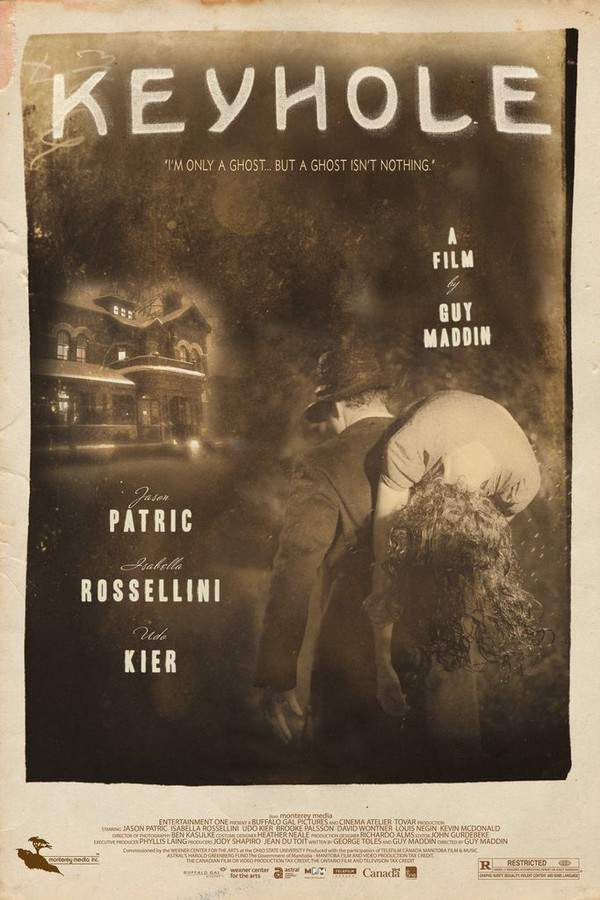
Keyhole (2012) movie poster

Timeline

Keyhole (2012) Timeline Explained – Every Event in Order

Release, runtime and language
2012 · 94 min · English
JustWatch #29,382 1
Directed by
Guy Maddin
Starring
Udo Kier, Isabella Rossellini, Jason Patric, Brooke Palsson

Ulysses Pick, a ruthless gangster and devoted father, returns to his family's mansion after years of absence, accompanied by a teenage corpse and a bound captive. His loyal gang awaits, still reeling from a recent violent confrontation with the police. As Ulysses confronts the mansion's unsettling secrets and navigates a maze of painful memories, he embarks on a deeper journey, seeking to uncover the truth about his family's dark past and the events that led to his exile.

On this page (6)
  1. 1 Where to watch
  2. 2 Events in order (14)
  3. 3 Timeline questions answered
  4. 4 Movie threads
  5. 5 Movies like Keyhole
  6. 6 Every angle

Where to watch

Where to Watch Keyhole (2012)

Where can you watch Keyhole? Stream, rent or buy it in the US, including on Amazon Prime Video, Fandor and Philo: current JustWatch availability with up-to-date prices.

Streaming availability powered by JustWatch

14 events in order · contains spoilers

Keyhole Timeline: Events in Chronological Order

Every key event of Keyhole (2012) in order, scene by scene, with when and where it takes place. Use it to untangle flashbacks, time jumps and parallel storylines, to refresh your memory before the sequel or to find the exact scene you are thinking of.

  1. Gang storms Ulysses' former home with hostage and Crispy

    A gang led by Ulysses Pick storms into his former home, which the police have surrounded. They drag along a hostage and a stuffed wolverine named Crispy. The air crackles with gunfire and tension as the standoff begins inside the haunted house.

    Where
    Ulysses Pick's former home
  2. Big Ed challenges the dead gangsters

    Big Ed confronts the surreal scene by asking the dead gangsters to identify themselves. He demands a show of allegiance, facing the eerie fact that some players are already beyond the living. The rest of the gang waits, uneasy, for Ulysses's next move.

  3. Calypso explains the haunting and origin of sorrow

    Calypso, the narrator-ghost, explains that the haunting stems from sorrow that remains bound to the walls after happiness leaves. He ties Ulysses's family history and Hyacinth’s memory to the house, foreshadowing the emotional battleground ahead. The house’s supernatural weight sets the tone for the night.

  4. Ulysses arrives with Denny and the girl’s powers

    Ulysses arrives carrying Denny, a drowned-looking young woman who seems alive yet injured. Denny reveals she can hear Ulysses's thoughts as he wanders the house, and she begins recounting his memories. A strange psychic bond forms between them.

    Where
    House interior
  5. Hyacinth’s room and the plan’s murkiness

    Hyacinth is said to be in the top bedroom, chained by Calypso’s ghostly influence. Ulysses and Denny join the gang, but the others are unsure about their plan and why the police haven't already stormed the house. The storm outside seems to stall any immediate action.

    Where
    Top-floor bedroom
  6. Guns are hidden and Ogilbe and Heatly die in the haunting

    Ulysses collects the gang's guns and dumps them into the furnace. Ogilbe investigates a noise and is electrocuted when he touches a washerwoman ghost while trying to have sex with her. A stray bullet kills Heatly as the haunted weapons go haywire.

    Where
    House interior / furnace
  7. Motive revealed: Heatly and the hostage Manners

    As Heatly dies, Ulysses confesses he initially adopted him to torment him for his son's death, but grew to love him more than any son. He remains unaware that Manners—the hostage watching—is his surviving son.

    Where
    House interior
  8. Bodies disposed in the bog

    Ulysses disposes of Heatly’s and Ogilbe’s corpses in the central bog, a secluded garden within Hyacinth’s labyrinth. The act blends ritual cleanup with the house’s supernatural logic, hinting at deeper consequences for the living and the dead.

    Where
    The bog in the center of the house
  9. Preparation to find Hyacinth

    Ulysses gathers his knife, the stuffed wolverine Crispy, Denny, and Manners, and orders the rest of the gang to stay put with Big Ed in charge. They set off to locate Hyacinth, moving deeper into memory-filled corridors. The search underscores the personal stakes behind the siege.

    Where
    Inside the house
  10. Memory flash: Hyacinth’s life with the dogs

    Denny helps Ulysses revisit memories of Hyacinth, including a moment when she ran naked with the family dogs. He reflects on how that episode revealed she was a stranger to him even as it intensified his love. The memory anchors the tension as they press on.

    Where
    Top floors, Hyacinth’s memory
  11. First locked door and the keyhole talk

    Ulysses speaks to Hyacinth through the keyhole of the first locked door, offering his scout knife and asking her to pretend he isn’t there so he can open it. Denny’s perception helps him see the room as it once was, guiding him toward hidden truths. The door stands as both barrier and portal.

    Where
    Hyacinth's top bedroom, door
  12. Manners revealed as hostage and the memory of Denny

    Calypso reveals that Manners is the hostage, Ulysses's surviving son. He then reveals his past love for Denny and their shared fate, prompting Manners to attempt to revive Denny through memory and secret passages, including a hidden cyclops wall passage.

    Where
    Hyacinth’s top bedroom / house interior
  13. The doctor examines Denny

    A doctor arrives to examine Denny and declares she is drowned, despite her seeming aliveness. He shares his own grief over his son’s death, deepening the film’s themes of memory and loss intertwined with the supernatural.

    Where
    Denny's examination room
  14. The electric chair: a final, impossible twist

    The gang finishes an electric chair and straps Ulysses into it, powered by pedaling. The shock proves inconsequential because Ulysses is already dead, illustrating the house’s grip on life and memory. Ghosts fade as the memory-filled house returns to silence, with Manners left alone amid his recollections.

    Where
    The house's makeshift electric chair

Last updated: October 09, 2025 at 16:23

Was this helpful?

Timeline questions answered

Keyhole Timeline Explained: Your Questions Answered

When does it happen, and why in that order? The questions people ask about the chronology of Keyhole (2012): time jumps, flashbacks, cause and effect between scenes and the correct order of events, each answered with spoilers.

Q1

Why does Ulysses return to his former home with a hostage?

Ulysses returns to reclaim his family home and confront his past. He's seeking to unlock the secrets of his family's dark history and find his wife Hyacinth, who is chained in the top bedroom. The hostage Denny and the stuffed wolverine Crispy are part of his journey into memory and reconciliation.

Foreshadowing: Calypso hints early on that the house bears sorrow that lingers long after inhabitants have moved on, establishing the emotional stakes of Ulysses's return.

  • ulysses pick
  • return home
  • hostage
  • family house
  • confrontation
Q2

Why is Denny alive despite looking drowned?

Denny is a mysterious young woman who can hear Ulysses's thoughts. She exists in a paradox, physically appearing drowned and blind, yet still alive. The house's memory-printing power seems to keep her in a liminal state between life and death, able to recount Ulysses's memories while remaining injured.

Foreshadowing: The doctor confirms she is drowned but somehow alive, and Calypso mentions the house's ability to preserve memory in strange ways.

  • denny
  • drowned
  • alive
  • blind
  • psychic abilities
Q3

Who is Manners and why is he being held hostage?

Manners is Ulysses's surviving son, though Ulysses fails to recognize him throughout most of the film. He was taken as a hostage by the gang but remains unrecognized by his own father until late in the story. Manners loves Denny and attempts to revive her through memory.

Foreshadowing: Calypso explicitly states that Manners may be the sole living son, but his identity remains unrecognized by Ulysses for most of the narrative.

  • manners
  • son
  • hostage
  • ulysses pick
  • family
Q4

Why does Ulysses kill Heatly after growing to love him?

Ulysses initially took Heatly in intending to torture him as revenge for the death of one of his sons. However, he unexpectedly grew to love Heatly more deeply than his own sons. Despite this love, Ulysses disposes of Heatly in the bog, following the house's supernatural logic where violence within these walls carries a cost.

Foreshadowing: Ulysses's conflicted memory reveals his transformation from torturer to father figure, setting up the tragic paradox of killing someone he loves.

  • heatly
  • killed
  • adopted son
  • love
  • murder
Q5

Why is Big Ed electrocuted in the electric chair?

Big Ed is electrocuted for his insubordination and growing impatience with Ulysses's secretive leadership. After the gang builds a makeshift electric chair powered by pedaling, Ulysses orders Big Ed to be strapped in and electrocuted as punishment before the chair and Heatly are thrown into the bog.

Foreshadowing: Big Ed's escalating impatience and attempts to take control throughout the narrative build toward this violent conclusion.

  • big ed
  • electric chair
  • execution
  • insubordination
Q6

What does the electric chair reveal about Ulysses?

The electric chair proves ineffective against Ulysses because he is already dead. The house's supernatural grip has kept him animated in a state between life and death. This revelation explains his seemingly impossible actions throughout the film and the ghostly nature of the narrative.

Foreshadowing: The film gradually hints at Ulysses's dead status through ghostly elements and Calypso's supernatural narration.

  • electric chair
  • ulysses dead
  • supernatural
  • ghost
  • reveal
Q7

Why is Hyacinth chained in the top bedroom?

Hyacinth is bound by Calypso's ghostly chains in the top-floor bedroom. Calypso explains that the room is not just physically protected but tethered to the past, with chains that can reach far enough to torment others. Ulysses communicates with her through the keyhole, seeking to unlock the doors between them.

Foreshadowing: Calypso's supernatural powers are demonstrated through his chains reaching to torment Big Ed earlier in the house.

  • hyacinth
  • chained
  • bedroom
  • calypso
  • chains
Q8

What is the bog and what happens there?

The bog is a secluded garden located in the center of Hyacinth's labyrinthine house. It's used as a burial ground where Ulysses disposes of the bodies of Heatly and Ogilbe. The bog represents the house's supernatural logic where violence carries a consequence, and it becomes a final resting place for the dead.

Foreshadowing: The bog is introduced as a central, mysterious space within the house's complex geometry.

  • bog
  • burial
  • heatly
  • ogilbe
  • bodies
Q9

What happens at the end of the film?

At the end, the ghosts fade away and the bullets vanish as the house settles into eerie stillness. Manners stands alone at the threshold of a doorway he cannot or will not fully cross, holding a gun. He's left in a quiet, almost sacred limbo between what once was and what might still be within the haunted home, holding his memories.

Foreshadowing: Throughout the film, Manners remains distant and contemplative, absorbed in his own memories, building toward this final isolation.

  • ending
  • manners
  • alone
  • threshold
  • memories
Q10

What is the cyclops wall passage?

The cyclops is a bizarre wall feature described as a penis sticking out of the wall, located in a hidden passage that Denny discovers. This surreal detail underscores the house's strange, dreamlike geometry and serves as another example of the film's surrealist, symbolic imagery.

Foreshadowing: The house's unusual geometry is established early through its labyrinthine corridors and supernatural properties.

  • cyclops
  • wall passage
  • penis
  • hidden passage
  • surreal
Q11

Why does Calypso want Hyacinth to release him?

Calypso, the ghostly narrator, is bound by chains controlled by Hyacinth. He pleads for release because he believes Ulysses poses a greater threat in his path to forgiveness than in his earlier thirst for revenge. Calypso wants to stop Ulysses from reaching Hyacinth and uncovering the truth.

Foreshadowing: Calypso's plea for release intensifies as Ulysses gets closer to the top bedroom, showing his desperation to prevent the confrontation.

  • calypso
  • release
  • chains
  • hyacinth
  • ulysses threat
Q12

Why does Ulysses keep the stuffed wolverine Crispy?

Crispy is a stuffed wolverine that Ulysses carries throughout the journey. It serves as a symbolic object connecting him to his past and hisgang's identity. The wolverine represents the violent, predatory nature of the gang while also being a strange comfort object that Ulysses clings to as he navigates the memory-filled house.

Foreshadowing: Crispy is introduced during the initial storming of the house, establishing it as Ulysses's companion throughout the narrative.

  • crispy
  • wolverine
  • stuffed animal
  • ulysses
  • symbol

Movie threads

More Movies Like Keyhole, by Mood & Story

Curated lists built around what makes Keyhole tick: the same mood, the same kind of story or the same emotional payoff. Each list explains why these movies belong together.

Surreal Haunted House Movies like Keyhole

Psychological journeys where a building reflects and distorts its inhabitants' inner trauma. Explore movies like Keyhole where a home is a vessel for memory and trauma. These films use supernatural or surreal elements to explore family secrets, grief, and the inescapable past. If you enjoyed Keyhole's atmospheric, psychological journey, you'll find similar themes of distorted reality in these haunting stories.

  • haunting
  • dreamlike
  • claustrophobic
  • melancholic
  • unsettling
  • atmospheric
  • Tone: dark, melancholic, haunting
  • Pacing: slow, contemplative
Why these movies?

The story pattern: The narrative in these films is often non-linear, unfolding through fragmented memories and symbolic encounters within a confined space. Characters are forced to confront their personal demons, which are externalized through the supernatural nature of the setting. The journey is inward, focusing on emotional and psychological resolution rather than a traditional external plot.

Why they belong together: These movies are grouped by their shared use of a setting as a psychological mirror. They blend genres like drama, thriller, and horror, prioritizing a melancholic, dreamlike mood. The pacing is often deliberate, building a pervasive sense of unease and claustrophobia as characters unravel deep-seated trauma within the walls that confine them.

Slow Burn Memory Journeys like in Keyhole

Deliberate, atmospheric films where characters piece together painful pasts. Find movies similar to Keyhole that explore a character's painful past through a slow, layered narrative. If you were captivated by Keyhole's melancholic unraveling of family secrets, these films offer comparable journeys through memory and regret, often with a dark tone and a complex, non-linear structure.

  • somber
  • oppressive
  • melancholic
  • dissonant
  • psychological
  • atmospheric
  • Tone: somber, dissonant, bittersweet
  • Pacing: slow, atmospheric build
Why these movies?

The story pattern: The plot follows a character, often an anti-hero, as they are drawn back to a place or situation that forces a confrontation with their history. The story unfolds not through action, but through revelation, with the past bleeding into the present. The climax is typically a psychological and emotional reckoning rather than a physical confrontation.

Why they belong together: They share a specific mood and narrative approach: a somber, oppressive atmosphere combined with a non-linear, complex plot structure. The pacing is intentionally slow to emphasize the weight of the past and the difficulty of the protagonist's introspective journey. The endings are often bittersweet, offering melancholy closure rather than simple resolution.

If you liked this

Movies Like Keyhole

Similar movies to Keyhole: the same genre, themes or kind of story. Each one comes with its own plot summary, timeline and ending explained.

Browse all movie summaries

Every angle

Keyhole (2012) Explained: Plot, Timeline & Characters

Everything about Keyhole in one place: what happens in the plot summary, the timeline in chronological order, the characters and meaning and a spoiler-free summary. What's After the Movie adds the cast, box office and post-credit scenes.

Coming soon on iOS and Android

The Plot Explained Movie Summary App

Plot summaries, endings explained and timelines on your phone. Catch up on any movie in minutes, save your favorites and never miss a twist again.

Be the first to know when we launch. Your email stays private, always.

Learn more about the app