







Plot Explained Spoilers guaranteed!
Plot Explained

Browse by genre

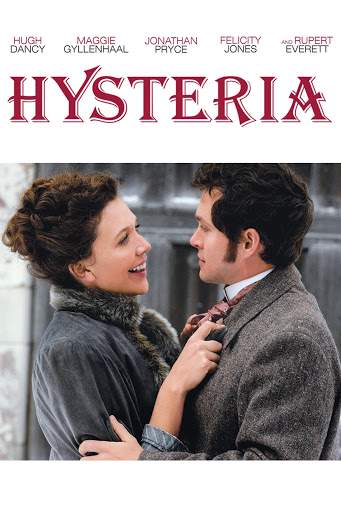
Hysteria (2012) movie poster

Characters & Themes

Hysteria (2012) Characters, Setting & Themes Explained

Release, runtime and language
2012 · 100 min · Korean
JustWatch #22,974 10
Directed by
Tanya Wexler
Starring
Felicity Jones, Jonathan Pryce, Hugh Dancy, Rupert Everett

During the 1800s in England, a doctor pioneers a novel treatment for female hysteria, leading to unexpected romantic entanglements. He collaborates with a clever inventor and develops a surprising connection with a patient, all while navigating the social conventions of the era. The story blends humor and charm as it explores the intersection of medical innovation, burgeoning relationships, and the pursuit of pleasure.

On this page (8)
  1. 1 Where to watch
  2. 2 Characters explained (3)
  3. 3 Where & when it takes place
  4. 4 Themes & meaning (2)
  5. 5 Character & meaning questions
  6. 6 Movie threads
  7. 7 Movies like Hysteria
  8. 8 Every angle

Where to watch

Where to Watch Hysteria (2012)

Where can you watch Hysteria? Stream, rent or buy it in the US, including on Amazon Video, Apple TV Store and Google Play Movies: current JustWatch availability with up-to-date prices.

Streaming availability powered by JustWatch

3 main characters · contains spoilers

Hysteria Characters Explained: Who Is Who

The main characters of Hysteria (2012), heroes and villains: what drives them, how they change over the course of the story and what each of them reveals about the film's bigger ideas.

  • Dr. Mortimer Granville

    played by Felicity Jones

    Dr. Granville is a young and progressive physician caught between conventional medical practices and modern advancements. His inventive spirit drives him to develop the vibrator as a medical tool, significantly impacting his career and personal life. Throughout the film, he evolves from a compliant assistant to a man advocating for women's rights and modern healthcare.

    • 👨‍⚕️ Doctor
    • 💔 Innovator
  • Charlotte Dalrymple

    played by Hugh Dancy

    Charlotte is portrayed as a premodern feminist deeply invested in her community's welfare. Her passion for social reform and women's rights often puts her at odds with societal expectations. As the narrative unfolds, she becomes a pivotal figure in challenging the status quo, showcasing strength and compassion as she supports her friends and her cause.

    • 👩‍⚖️ Feminist
    • 💪 Resilient
  • Emily Dalrymple

    played by Rupert Everett

    Emily is the more traditional sister, initially engaged to Granville. Through her character, the film explores themes of familial duty and personal fulfillment, revealing her internal struggles with expectations versus her desires. Her journey ultimately leads her to redefine her priorities and relationships.

    • 💍 Engaged
    • 😔 Traditional

Last updated: September 27, 2026 at 19:26

Was this helpful?

Setting

Where and When Does Hysteria Take Place?

The setting of Hysteria (2012): the year and time period, the places and locations, and how they shape the characters, the mood and the tension of the story.

Time period

Late 19th century

The movie is set at the end of the 1880s, a period marked by innovative advancements in medicine and a burgeoning awareness of women's issues. This time was pivotal in shaping modern sexual health and understanding of hysteria, which was a common diagnosis among women. The era also highlights the conflicts between traditional medical practices and emerging scientific methods.

Location

East London

East London serves as a backdrop for significant events in the film, showcasing its socio-economic challenges of the era. The settlement house run by Charlotte signifies the ongoing struggle for women's rights and social reforms during the late 19th century. It represents both the hardships faced by the community and the progressive ideals of characters like Charlotte.

  • 🏙️ City
  • 🏥 Medical

Last updated: September 27, 2026 at 19:26

Was this helpful?

2 major themes

Hysteria Meaning: Themes & Message Explained

What is Hysteria (2012) really about? The emotional, social and philosophical themes the film keeps returning to, its symbolism and the message beneath the surface.

  • Women's Rights

    The film explores the struggles of women in a patriarchal society, primarily through Charlotte's character, who fights for social justice and welfare. The storyline emphasizes the need for reform in how women's health was perceived and treated, relating it to broader feminist movements of the time. Hysteria's portrayal reveals the misconceptions about female behavior and health that were rampant during this period.

  • Innovation

    Innovation plays a crucial role, epitomized by the invention of the vibrator itself as a medical device. This theme relates to the broader cultural shifts towards embracing modernity and the new ideas in medical treatment. Granville’s adaptation of the electrical feather duster into a massager symbolizes the intersection of technology and healthcare, challenging traditional methods.

Last updated: September 27, 2026 at 19:26

Was this helpful?

Character & theme questions

Hysteria Characters & Meaning: Your Questions Answered

The questions people ask about Hysteria (2012): who the characters really are, their relationships, what the symbols mean, where it takes place and what the movie is really about. Each answer contains spoilers.

Q1

Where is the story set?

The story is set in East London during the late 1800s. This area is depicted as a working-class district marked by socio-economic challenges, and it grounds the film's exploration of reform, class, and women's welfare in a specific urban environment.

  • east london
  • setting
  • location
  • victorian london
Q2

What time period does the story take place in?

The story takes place at the end of the 1880s, a transitional moment when medicine was beginning to modernize and women's issues were gaining public attention. This setting allows the film to position its characters at the crossroads of outdated traditions and emerging scientific thinking.

  • 1880s
  • victorian era
  • late 19th century
  • period setting
Q3

What does the settlement house represent in the story?

The settlement house run by Charlotte Dalrymple represents both the hardships of East London's poor communities and the progressive push for women's rights and social reform. It functions as a visual symbol of how Victorian reformers tried to provide welfare services outside formal institutions, and it directly ties Charlotte's activism to the feminist themes of the film.

  • settlement house
  • charlotte dalrymple
  • women's rights
  • social reform
Q4

What is the main message about women's rights?

The film argues that women in the Victorian era were systematically misunderstood, particularly through the catch-all diagnosis of 'hysteria.' By framing the treatment of this condition as a breakthrough, Hysteria suggests that women's health, autonomy, and pleasure were legitimate concerns that deserved serious medical and social attention rather than dismissal.

  • women's rights
  • feminism
  • hysteria
  • victorian gender roles
Q5

What does the movie say about medical innovation?

The film celebrates the willingness to question conventional medical practices in favor of new, more humane treatments. Dr. Mortimer Granville's reinvention of an electrical feather duster into a massager is presented as a turning point where industrial technology is repurposed for patient care, signaling a broader shift from tradition toward evidence-based and patient-centered medicine.

  • innovation
  • medical invention
  • vibrator
  • granville
  • modern medicine
Q6

Who is Dr. Mortimer Granville?

Dr. Mortimer Granville is the protagonist, a young and progressive physician who begins as a conventional assistant but gradually redefines his practice. His drive to find a faster, more effective treatment leads him to invent a mechanical device for hysteria, and his growing closeness to Charlotte's reformist circle pushes him toward advocacy for women's healthcare.

  • mortimer granville
  • doctor
  • protagonist
  • physician
  • inventor
Q7

Who is Charlotte Dalrymple?

Charlotte Dalrymple is a feminist social reformer who runs a settlement house in East London and champions causes like women's suffrage and welfare. She represents the film's progressive voice, often clashing with societal expectations, and her activism provides the moral and political backbone against which Granville's medical work gains meaning.

  • charlotte dalrymple
  • feminist
  • reformer
  • settlement house
  • suffrage
Q8

Who is Emily Dalrymple and what is her role?

Emily Dalrymple is Charlotte's sister and Granville's initial romantic interest, embodying the conventional Victorian expectations of marriage, family duty, and social respectability. Her character gives the film a counterweight to Charlotte's activism by showing the quieter pressures faced by women who chose to conform, and her eventual arc toward self-definition highlights the cost of those expectations.

  • emily dalrymple
  • victorian marriage
  • sister
  • duty
  • expectations
Q9

How do Charlotte and Emily Dalrymple differ as characters?

Charlotte is driven by activism, independence, and a desire to reform society, while Emily is shaped by tradition, family obligation, and the pursuit of a socially acceptable marriage. Together they illustrate two paths available to Victorian women, and their contrasting choices provide the film with its central tension between personal fulfillment and conformity.

  • charlotte
  • emily
  • sisters
  • contrast
  • victorian women
Q10

What does the vibrator symbolize in the film?

In the film, the vibrator symbolizes the moment when modern technology, patient comfort, and women's wellbeing are taken seriously by medicine. It represents the collapse of the barrier between the mechanical and the intimate, treating female pleasure as something medically legitimate rather than shameful, and aligning Granville's career with the era's progressive reforms.

  • vibrator
  • symbolism
  • modernization
  • women's health
  • invention
Q11

What broader social issues does the movie explore?

Beyond the central romance, the movie explores women's rights, the medicalization of female sexuality, class inequality in East London, and the tension between traditional Victorian values and modern science. These themes are woven into everyday scenes rather than delivered as lectures, giving the film's charm and humor their underlying weight.

  • social issues
  • women's rights
  • class
  • victorian society
  • reform
Q12

Why is East London significant to the story?

East London situates the film's characters in one of the most economically unequal parts of Victorian England, where reformers like Charlotte were actively working with working-class communities. This setting reinforces the gap between upper-class medical practice and the women most likely to be dismissed, making the geographical contrast an essential part of the film's social commentary.

  • east london
  • poverty
  • victorian class
  • reform
  • social reform

Movie threads

More Movies Like Hysteria, by Mood & Story

Curated lists built around what makes Hysteria tick: the same mood, the same kind of story or the same emotional payoff. Each list explains why these movies belong together.

Whimsical period romances with a wink like Hysteria

Charming love stories set in elegant eras where wit and warmth outshine the corsets. If you enjoyed the charming, witty tone of Hysteria, these period romance films offer similar warmth and historical flair. Movies like Hysteria blend Victorian-era elegance with playful humor, gentle social commentary, and tender love stories, all wrapped in beautiful costumes, clever dialogue, and a lighthearted heart.

  • whimsical
  • period charm
  • witty banter
  • romantic
  • lighthearted
  • elegant era
  • Tone: whimsical, charming, romantic
  • Pacing: steady, character driven
Why these movies?

The story pattern: A spirited protagonist navigates restrictive social norms while pursuing passion or purpose, often as a professional or reformer in a gilded cage. A central romance develops through clever banter and shared ideals rather than dramatic obstacles, while secondary characters provide comic relief. Subplots quietly address gender, class, or reform, and conflicts arise from convention or misunderstanding but resolve warmly into engagement and mutual respect.

Why they belong together: Grouped for their shared tone of gentle humor set against historical backdrops, their focus on romance that feels hopeful rather than tragic, and their willingness to weave social commentary into lighthearted storytelling without becoming preachy or bleak. They balance elegant production design with playful spirit.

Movies like Hysteria where invention sparks unexpected love

Brilliant ideas, eccentric creators, and the romances that catch them by surprise. Movies like Hysteria that pair quirky innovation with charming romance. If you loved how Hysteria wove the invention of the vibrator into a witty love story, these films share that magical blend of creative genius, eccentric characters, and tender romantic discovery, where pursuing a wild idea leads to finding the right person.

  • inventive
  • quirky genius
  • romantic spark
  • witty
  • uplifting
  • charming
  • Tone: charming, witty, hopeful
  • Pacing: steady, unfolding
Why these movies?

The story pattern: A passionate but socially awkward inventor or visionary pursues a radical idea, often facing skepticism from polite society. Along the way, they meet someone whose warmth, values, or shared curiosity complement their obsession. Romance develops through collaboration and mutual purpose rather than conventional courtship, with the invention's triumph or failure intertwining with the emotional arc toward a happy resolution.

Why they belong together: These stories share a narrative engine where curiosity, invention, or unconventional thinking drives both the plot and the romance. They feature protagonists whose brilliance is matched by emotional growth, and they balance intellectual excitement with tender human connection, often set against a historical or period backdrop that heightens the sense of social risk.

If you liked this

Movies Like Hysteria

Similar movies to Hysteria: the same genre, themes or kind of story. Each one comes with its own plot summary, timeline and ending explained.

Browse all movie summaries

Every angle

Hysteria (2012) Explained: Plot, Timeline & Characters

Everything about Hysteria in one place: what happens in the plot summary, the timeline in chronological order, the characters and meaning and a spoiler-free summary. What's After the Movie adds the cast, box office and post-credit scenes.

Coming soon on iOS and Android

The Plot Explained Movie Summary App

Plot summaries, endings explained and timelines on your phone. Catch up on any movie in minutes, save your favorites and never miss a twist again.

Be the first to know when we launch. Your email stays private, always.

Learn more about the app